
Quick Answer
Vehicle-to-grid (V2G) charging is no longer a pilot-stage curiosity; in 2026 it is a procurement requirement for commercial DC charging infrastructure across Europe, North America, and Asia. V2G enables an EV battery to discharge stored energy back into the grid through a bidirectional charger, turning every connected vehicle into a distributed energy asset. The shift is driven by three forces: regulation (the EU Alternative Fuels Infrastructure Regulation and ISO 15118-20 interoperability standards), grid economics (capacity constraints and volatile energy prices), and hardware maturity (SiC-based bidirectional power modules now exceed 97% conversion efficiency in both directions). For charge point operators (CPOs), fleet managers, and property owners, choosing V2G-capable DC chargers in 2026 is the difference between infrastructure that merely dispenses energy and infrastructure that earns revenue from grid services, peak shaving, and energy arbitrage.
Key Takeaways
- V2G moved from pilots to procurement specs in 2026, driven by ISO 15118-20, EU grid legislation, and multi-market tariff programs that pay EVs for grid services.
- DC is the preferred V2G pathway for commercial sites: DC bidirectional chargers deliver 30–360 kW of two-way power versus 3.7–22 kW through AC, with faster response times and higher round-trip efficiency.
- Silicon carbide (SiC) is the enabling technology: SiC-based bidirectional modules achieve 97%+ efficiency in charge and discharge directions, cutting energy losses and thermal load compared with IGBT designs.
- V2G creates new revenue lines — frequency regulation, peak demand shaving, and energy arbitrage — that improve the total cost of ownership (TCO) of DC fast charging assets by 10–20% in high-value markets.
- Battery degradation concerns have been substantially answered: shallow-depth (10–20% DOD) V2G cycling, combined with LFP/LMFP chemistries, keeps capacity fade within normal driving-use ranges, according to multiple 2024–2026 field studies.
Why V2G Moved from Pilot to Mainstream in 2026
The headline conclusion for 2026 is simple: bidirectional charging stopped being a technology question and became a business question. In 2023, V2G was confined to roughly a dozen utility pilots worldwide, mostly in Japan, the UK, the Netherlands, and California. By 2026, more than 40 markets host active commercial V2G programs, and major charging networks in Germany, France, the Nordics, and North America are specifying bidirectional capability as a default feature of new DC fast chargers rather than an optional extra.
Three structural changes explain this acceleration. First, the economics of the power grid have shifted. Renewable penetration above 30–40% in leading markets creates midday supply surpluses and evening scarcity, which widens the price spread that energy arbitrage exploits. Second, grid operators facing transformer capacity constraints in dense urban areas increasingly treat EV batteries as deferrable load and dispatchable storage — the same resource, managed in two directions. Third, the hardware cost of bidirectional power electronics collapsed between 2022 and 2026, with SiC module costs falling roughly 40–50% over that window, making bidirectional DC chargers only 5–15% more expensive than unidirectional equivalents at the same power class.
For a charge point operator evaluating 2026 capital expenditure, the practical consequence is that buying unidirectional hardware now means paying more later: retrofitting bidirectional capability is rarely possible without replacing power modules, so the forward-looking TCO calculation favors V2G-ready equipment from day one.
DC vs. AC: Why DC Infrastructure Carries the V2G Workload
V2G is technically possible through both AC and DC pathways, but the two architectures serve completely different economic tiers. In an AC V2G setup, the vehicle’s onboard charger (OBC) performs the AC/DC conversion, which limits two-way power to the OBC rating — typically 3.7–22 kW. In a DC V2G setup, a bidirectional power module inside the charging station converts grid AC to battery DC for charging and reverses the flow for discharging, unlocking 30 kW to 360 kW of two-way power.
For commercial fleets, bus depots, logistics hubs, and highway corridors, only the DC pathway delivers meaningful grid-service revenue. Frequency regulation markets reward fast, dispatchable response, and many European and US markets require a minimum bid size of 100 kW–1 MW for profitable participation — a threshold that AC V2G can only reach by aggregating dozens of vehicles, while a single 120 kW DC bidirectional charger participates directly.
Round-trip efficiency is the second decisive factor. AC V2G loses efficiency at the vehicle OBC in both directions, and measured round-trip losses for AC V2G systems commonly reach 12–18%. Modern DC bidirectional chargers built on SiC inverters hold round-trip losses to 4–6% at typical operating points, which is critical because every percentage point of loss is energy the site owner pays for twice — once to charge the vehicle and once when the grid pays for delivery that never arrives.
AC V2G vs. DC V2G: 2026 Technical Comparison
| Parameter | AC V2G (Type 2 / OBC-based) | DC V2G (Bidirectional DC charger) |
|---|---|---|
| Two-way power range | 3.7–22 kW (limited by onboard charger) | 30–360 kW (module-limited, scalable) |
| Round-trip efficiency | 82–88% typical | 94–96% typical (SiC: 95%+) |
| Response time to grid signal | 2–10 seconds (aggregator-mediated) | 200 ms–1 s (direct, local control) |
| Equipment cost delta vs. unidirectional | Low (OBC + communication stack) | +5–15% vs. unidirectional DC charger |
| Minimum bid size for grid services | Requires fleet aggregation (10+ vehicles) | Single 120 kW unit qualifies |
| Best-suited use cases | Home V2H/V2G, small office fleets | Fleet depots, highway HPC, CPO networks |
| 2026 deployment status | Consumer pilots, some tariffs | Mainstream commercial procurement |
The Regulatory Push: Mandates, Standards, and Grid Codes
Regulation is the strongest single driver of V2G adoption in 2026, and three instruments matter most for procurement decisions.
ISO 15118-20 — published in 2022 and now broadly implemented in 2026 charging hardware — defines bidirectional power transfer and Plug & Charge over the CCS protocol. Compliance with ISO 15118-20 is the de facto technical ticket for selling V2G services in Europe and North America, and it enables the seamless, certificate-based authentication that grid operators require for dispatchable assets.
The EU regulatory stack — the Alternative Fuels Infrastructure Regulation (AFIR, in force since April 2024) mandated 150 kW+ charging pools every 60 km along the core TEN-T network, and the recast Energy Performance of Buildings Directive requires smart and bidirectional-capable charging in new and renovated non-residential buildings above 10 parking spaces. Several member states, including Germany and the Netherlands, have introduced or expanded grid codes that compensate EVs for bidirectional grid support under the “prosumer” framework.
North America — California’s V2X pilots, New York’s demonstration programs, and FERC Order 2222 (allowing distributed resources to participate in wholesale markets) create a clear pathway for EV batteries to bid into capacity and ancillary service markets. In parallel, utilities in Hawaii, Massachusetts, and Ontario have launched V2G tariff pilots that pay participating EV owners a monthly fee plus per-kWh export credits.
The procurement implication is unambiguous: a DC fast charger purchased in 2026 should be certified against ISO 15118-20, support OCPP 2.0.1 for smart-charging and demand-response signaling, and offer V2G-capable power modules with a documented upgrade path — because grid codes and utility programs are expanding faster than hardware replacement cycles.
The Technology That Makes It Work: SiC and Conversion Efficiency
The reason V2G became economically viable in 2026 — rather than in 2016, when the concept was first demonstrated at scale in Japan — is silicon carbide power electronics. SiC MOSFETs switch at higher frequencies with lower conduction and switching losses than silicon IGBTs, and they tolerate higher junction temperatures. In a bidirectional DC charger, these properties translate directly into four commercial advantages.
First, conversion efficiency. MIDA Power’s bidirectional chargers, built on SiC modules, sustain over 97% efficiency in both charging and discharging directions, compared with 94–95% for comparable IGBT designs. On a 240 kW bidirectional unit cycling 200,000 kWh per year, a 2–3% efficiency advantage saves 4,000–6,000 kWh of losses annually — electricity the operator never has to buy, worth roughly €800–1,200 per year at 2026 European commercial rates, and €8,000–12,000 over a ten-year asset life per charger.
Second, thermal management. Lower losses mean less waste heat, which reduces cooling system load, extends component life, and enables higher power density in the same enclosure. This is particularly valuable for bidirectional operation, where discharge cycles generate the same thermal stress profile as charging cycles.
Third, bidirectional symmetry. SiC modules are inherently symmetrical power devices; the same module that rectifies AC to DC for charging inverts DC to AC for discharging with near-identical efficiency. MIDA’s 30–62.5 kW bidirectional modules and 20–45 kW V2G charging modules are designed for this dual-mode duty cycle, with grid-tie synchronization and islanding protection integrated at the module level.
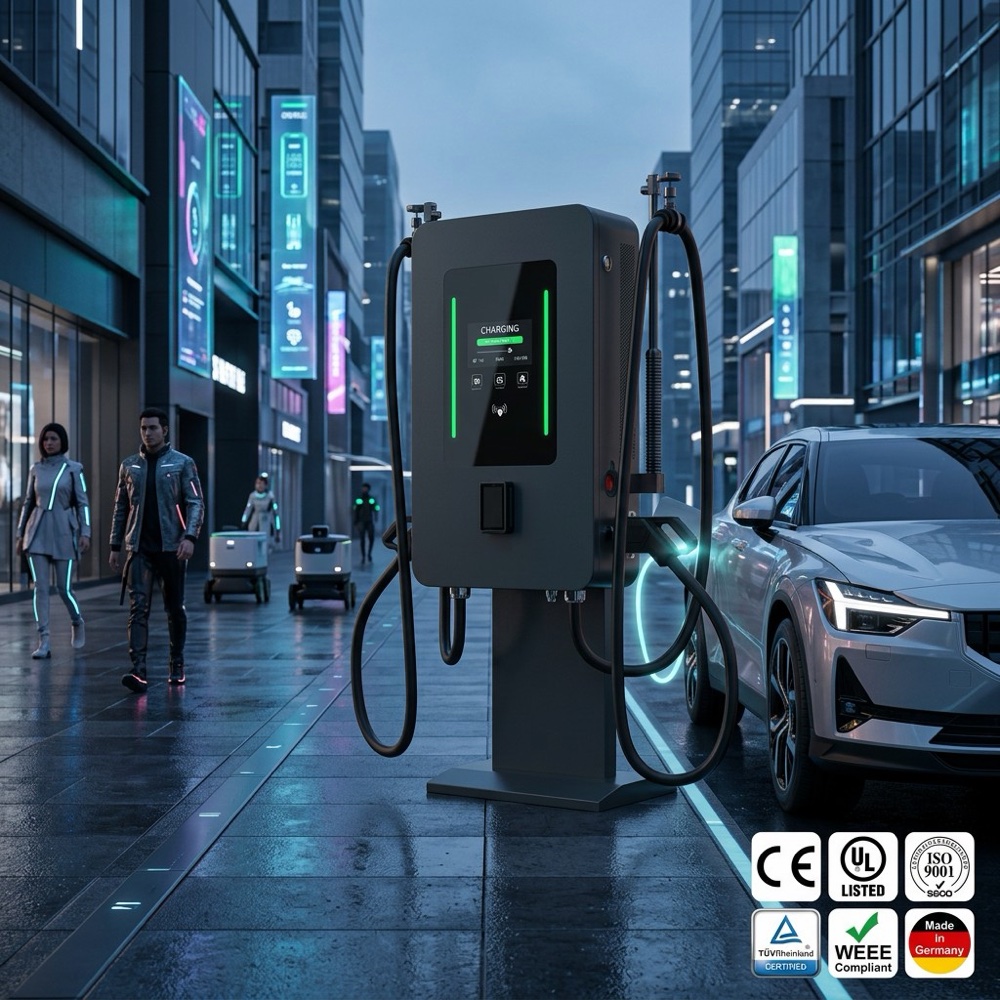
Fourth, grid-code compliance. Fast switching with low harmonic content makes SiC-based chargers easier to certify against EN 50160 and IEEE 1547 grid-connection requirements, and enables the sub-second response times that frequency-regulation markets pay for. A V2G unit that cannot respond within the market’s dispatch window is a unit that cannot earn ancillary-service revenue; SiC closes that gap.
The Business Case: Revenue Streams Beyond the Kilowatt-Hour
For a CPO or fleet operator, a bidirectional DC charger is not merely a faster dispenser of energy — it is a dispatchable energy asset with four addressable revenue streams. The complete 2026 business case stacks them:
- Frequency regulation (primary/secondary reserve): EVs connected to a bidirectional charger can respond to grid frequency deviations within milliseconds. Market prices in the UK, Germany, and PJM (US) have ranged from roughly €30–€80 per kW-year in recent years; a 120 kW bidirectional charger participating 6 hours per day can contribute €2,500–€6,000 annually before aggregator fees.
- Peak demand shaving: A commercial site with a 500 kW grid connection can use fleet batteries to shave 100–200 kW of demand during peak windows, avoiding demand charges of $10–$20 per kW per month in many US markets — a saving of $12,000–$48,000 per year for a 100 kW shaving capacity.
- Energy arbitrage: Charging fleet vehicles during low-price hours (often negative or near-zero prices in high-renewable markets at midday) and discharging during evening peaks captures spreads of €0.05–€0.25/kWh. For a fleet cycling 500 kWh/day through V2G, arbitrage can add €9,000–€45,000 per year.
- Resilience and backup power (V2B/V2H): In buildings and depots, bidirectional chargers double as backup power sources during outages, replacing or deferring stationary storage investment — a CAPEX saving that often justifies the V2G hardware premium on its own.
The aggregate effect on TCO is meaningful. A 2026 analysis of depot charging in Germany and the Netherlands found that V2G-capable DC chargers improved asset-level net present value by 10–20% versus unidirectional equivalents when regulation and arbitrage revenues were included, even after accounting for the 5–15% hardware premium and the cost of grid-interconnection upgrades.
What Still Holds V2G Back — and How 2026 Hardware Answers It
Three objections dominated V2G skepticism through 2024: battery degradation, grid-integration complexity, and vehicle compatibility. All three have measurably softened by 2026.
Battery degradation. Early V2G research (e.g., studies of the Nissan Leaf era) reported accelerated calendar aging, but modern field data tells a different story. Shallow-depth cycling — 10–20% depth of discharge, typical of grid-service duty — produces minimal added capacity fade on modern NMC chemistries and near-negligible fade on LFP and LMFP packs now dominant in commercial vehicles. Multiple 2024–2026 studies (including university and utility programs in California and the Netherlands) report that V2G cycling adds less than 1% extra capacity fade per year when managed within OEM-approved state-of-charge windows. The remaining risk is contractual: fleet operators should verify OEM warranty language, as several 2026 models now explicitly cover bidirectional use.
Grid-integration complexity. Bidirectional chargers interact with grid protections, metering, and tariff structures that unidirectional units never touch. The 2026 answer is standards-based integration: OCPP 2.0.1 for charge-management signaling, ISO 15118-20 for vehicle authentication and power-flow negotiation, and local controller capabilities (including islanding detection) that satisfy grid codes without custom engineering at every site. Certification against IEC 61851-23-1 and relevant national grid codes is now a standard feature of commercial-grade bidirectional DC chargers.
Vehicle compatibility. Not every EV on the road today supports bidirectional discharge, which historically capped the addressable fleet. By 2026, the majority of new passenger EVs sold in Europe — and nearly all new commercial EVs, buses, and trucks — ship with CCS bidirectional capability or LFP packs designed for it, and CHAdeMO vehicles remain V2G-capable through adapter-based or native support. The procurement answer is to buy chargers that negotiate power bidirectionally with any ISO 15118-20-compliant vehicle while still operating as ordinary fast chargers for legacy vehicles — a compatibility guarantee that mature vendors document explicitly.
A Procurement Checklist for V2G-Ready DC Chargers
When evaluating 2026 DC fast charging equipment with V2G in mind, the following criteria separate revenue-generating assets from stranded infrastructure:
- Bidirectional power modules with published efficiency curves — verify 96%+ efficiency in both directions across the operating range, not just peak-point marketing figures.
- ISO 15118-20 and OCPP 2.0.1 certification, with demonstrated Plug & Charge and smart-charging interoperability.
- Grid-service readiness — sub-second response capability, islanding detection, and certification against local grid connection codes (EN 50160, IEEE 1547, or regional equivalents).
- Modular, hot-swappable architecture so power modules (the highest-failure component) can be replaced in under an hour without taking the whole station offline — critical because availability directly caps revenue.
- Warranty aligned with duty cycle — bidirectional operation stresses power electronics; a 3-year (or longer) warranty on modules and converter stages reflects confidence in the design.
- Documented upgrade path for sites that are not deploying V2G on day one, preserving the option to enable discharge when tariffs and grid programs mature.
- OEM vehicle compatibility list showing which vehicle platforms are validated for bidirectional operation on the charger.
How MIDA Power Is Shaping the 2026 V2G Landscape
MIDA Power builds its V2G strategy on the same SiC foundation that drives its unidirectional fast chargers: bidirectional modules from 30 kW to 62.5 kW, dedicated 20–45 kW V2G charging modules with dual AC/DC input, and DC fast chargers up to 120 kW with V2X grid-support functionality. The company’s engineering position is that bidirectional capability should be an intrinsic property of the power stage, not an add-on — which is why its bidirectional EV charging systems and bidirectional charging technology share a common SiC module platform with the company’s DC fast charger portfolio.
Two engineering details matter for buyers. First, the 30kW–40kW V2G charging modules support AC and DC dual input, enabling a depot to charge vehicles from the grid, from an on-site battery, or from other vehicles — a flexibility that simplifies energy-arbitrage and resilience architectures without additional conversion stages. Second, MIDA’s SiC-based bidirectional chargers exceed 97% efficiency in both directions, which is the single most important specification for V2G economics because every efficiency point compounds across thousands of charge–discharge cycles over a ten-year asset life. For CPOs and fleets planning 2026 infrastructure, that combination — bidirectional symmetry, module-level flexibility, and high round-trip efficiency — is precisely the specification set that turns grid services from a roadmap item into a revenue line.
FAQ
1. What is V2G (vehicle-to-grid) charging, and how is it different from V1G or V2H?
V2G lets an EV battery discharge electricity back into the grid through a bidirectional charger. V1G (smart charging) only shifts charging timing to cheap or green hours without discharging. V2H/V2B discharge to a home or building for self-consumption or backup, without exporting to the grid. V2G is the only mode that earns grid-service revenue from exported energy.
2. Why is DC fast charging preferred for V2G instead of AC home charging?
DC bidirectional chargers deliver 30–360 kW of two-way power versus 3.7–22 kW through AC onboard chargers, reach 94–96% round-trip efficiency versus 82–88% for AC V2G, and respond to grid signals in milliseconds. Higher power and faster response are what make V2G revenues (regulation, arbitrage, demand shaving) large enough to matter commercially.
3. Does bidirectional charging degrade EV batteries?
Modern field studies show shallow-depth (10–20% DOD) V2G cycling adds less than 1% extra capacity fade per year on contemporary chemistries, and near-negligible fade on LFP/LMFP packs. Managing charge within OEM-approved state-of-charge windows and confirming OEM warranty coverage of bidirectional use are the practical safeguards.
4. What standards govern V2G charging in 2026?
ISO 15118-20 defines bidirectional power transfer and Plug & Charge over CCS; OCPP 2.0.1 handles charger-to-network smart-charging and demand-response signaling; IEC 61851-23-1 covers DC charging safety; and national grid codes (EN 50160, IEEE 1547) govern grid connection and islanding protection.
5. How much revenue can a V2G-enabled charger actually generate?
A 120 kW bidirectional charger can earn roughly €2,500–€6,000 per year from frequency regulation, plus demand-charge savings of $12,000–$48,000 per year for a site shaving 100 kW of peak demand, plus arbitrage of €0.05–€0.25/kWh on cycled energy. Realized revenue depends on market, aggregation, and utilization.
6. Do I need new hardware, or can existing DC chargers be upgraded to V2G?
Most unidirectional DC chargers cannot be retrofitted because the power modules are unidirectional by design. Upgrading typically means replacing the power stage or the entire charger. Buying V2G-capable hardware now is the lower-cost path versus retrofitting later.
7. Is 2026 the right time to invest in V2G-capable DC charging infrastructure?
Yes for most commercial buyers. ISO 15118-20 hardware is mature, SiC module costs have fallen 40–50% since 2022, the bidirectional hardware premium is down to 5–15%, and regulation, tariffs, and grid codes across Europe and North America now pay for bidirectional services. V2G-ready procurement in 2026 avoids the cost and downtime of replacing unidirectional assets later.
Post time: Aug-18-2026