
How Advertising EV Chargers and Dual-Gun Wallboxes are Redefining Retail ROI in 2026
Quick Answer
Advertising-enabled EV chargers — and specifically dual-gun wall-mounted DC wallboxes — are redefining retail ROI in 2026 by converting the 20-to-45-minute charging session into a billable media inventory stream. Instead of relying on a thin energy margin of USD 0.02–0.05 per kWh, retailers monetize dwell time through integrated digital screens, branded content, and retail media network (RMN) placements, typically adding USD 1.50–25 per charging session in advertising revenue. Dual-gun wallboxes double throughput per parking bay, which doubles the media impressions a single site can sell. For retailers with constrained floor space and limited grid capacity, the combination of compact wall-mounting, OCPP 1.6J remote management, and dual connectors makes advertising EV charging a measurable, scalable profit line rather than a sustainability cost center.
Key Takeaways
- Dwell-time monetization, not energy margin, is the primary ROI driver of advertising EV charging in 2026; per-session advertising revenue can exceed charging margin by 3–10x.
- Dual-gun wallboxes deliver twice the sessions per parking bay, directly doubling the media inventory a retail site can sell without expanding footprint.
- Wall-mounted DC form factor reduces civil works and installation capex by roughly 30–50% versus pedestal stations, shortening payback for single-site retail pilots.
- OCPP 1.6J and open APIs allow retailers to integrate charging telemetry with ad-serving platforms for programmatic inventory management.
- Dynamic load balancing and smart scheduling keep advertising-enabled sites within grid limits while maximizing session count during peak retail hours.
The Retail Charging Equation Has Flipped in 2026
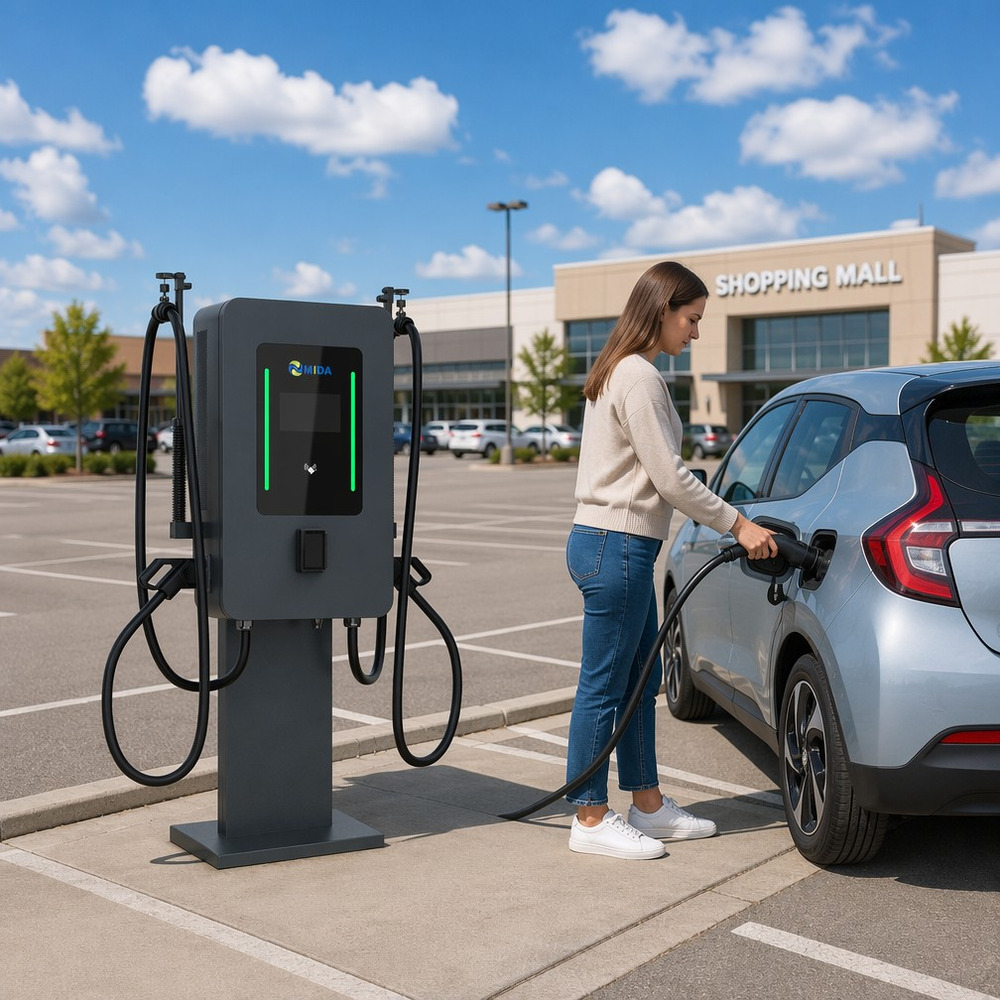
For most of the last decade, retailers installed EV charging as a loss-leading amenity: a way to attract electric-vehicle owners, extend their stay, and quietly burn capital in the process. That assumption no longer holds. By 2026, EVs account for more than one in four new passenger vehicles sold in major European and Chinese markets, and retail landlords report that charging availability influences where a growing share of affluent, early-adopter shoppers choose to park. Yet the unit economics of selling energy remain thin. A 80kW DC session that delivers roughly 30 kWh at a gross margin of USD 0.04 per kWh yields only about USD 1.20 in energy profit — far too little to justify the charger, the cabling, and the network fees alone.
The correction comes from the other side of the balance sheet. Retail media is one of the fastest-growing advertising segments in the world, and physical retail assets are finally being treated as media properties. An advertising-enabled EV charger sits at the intersection of three measurable assets: a captive audience with a guaranteed dwell time, a digital screen at eye level, and a transaction event (the charging session) that produces timestamped footfall data. When these three are combined, the charger stops being an amenity and becomes an inventory unit.
Dwell Time Is the New Retail Inventory
Traditional retail media monetizes minutes: a shopper in a supermarket aisle, a queue at a checkout, a wait at a gas pump. EV charging compresses this logic into a more valuable format because the dwell window is both long and predictable. A typical 80kW DC session runs 20–45 minutes depending on battery state of charge, ambient temperature, and vehicle architecture. That is not a glance; it is a sustained, high-attention media exposure with a viewer who is physically present and, in most cases, receptive to location-relevant offers.
Why 20–45-minute sessions are the media sweet spot
Media buyers pay a premium for measurable attention. Short dwell windows (under ten minutes) fragment exposure and make sequential storytelling impossible; very long dwell windows (overnight AC charging) have low engagement because the driver leaves the vehicle. The 20–45-minute DC window sits in the engagement sweet spot: long enough to serve a full video sequence of two to four ads, short enough that the driver remains near the vehicle or the storefront, and tied to an active purchase intent. Chargers in supermarket, gym, and hospitality parking environments see the strongest response rates because the surrounding retail context makes the advertised products immediately relevant.
Session data as a retail asset
Advertising value is also derived from data. Each OCPP-controlled session generates a clean record of start time, duration, energy delivered, and connector usage. Aggregated and anonymized, this session data becomes footfall intelligence: retailers can map which hours of the week generate the most charging traffic, correlate charging behavior with store visits, and price their media inventory dynamically. This is the same logic that powers programmatic digital-out-of-home (pDOOH) buying, and it requires no new hardware beyond a standards-compliant charger and an open API integration layer.
Why Dual-Gun Wallboxes Amplify Media ROI
Not all charging hardware is equal as a media platform. The architectural choice that most directly affects advertising ROI is the connector count and the mounting format, and dual-gun wall-mounted DC wallboxes win on both dimensions.
Doubling throughput per parking bay
A dual-gun wallbox serves two vehicles from a single unit, which is a decisive advantage in a retail parking environment where bays are expensive and grid capacity is fixed. With power-sharing logic, the unit can deliver full 80kW to a single vehicle or split capacity across two sessions, keeping both cables busy during peak periods. From a media perspective, two simultaneous sessions mean two simultaneous audiences: a single advertising screen now serves two drivers, and the impressions per bay per day effectively double. Across a 20-unit deployment, that is the difference between 40 and 80 concurrent media exposures at peak hour.
Eye-level screens and space efficiency
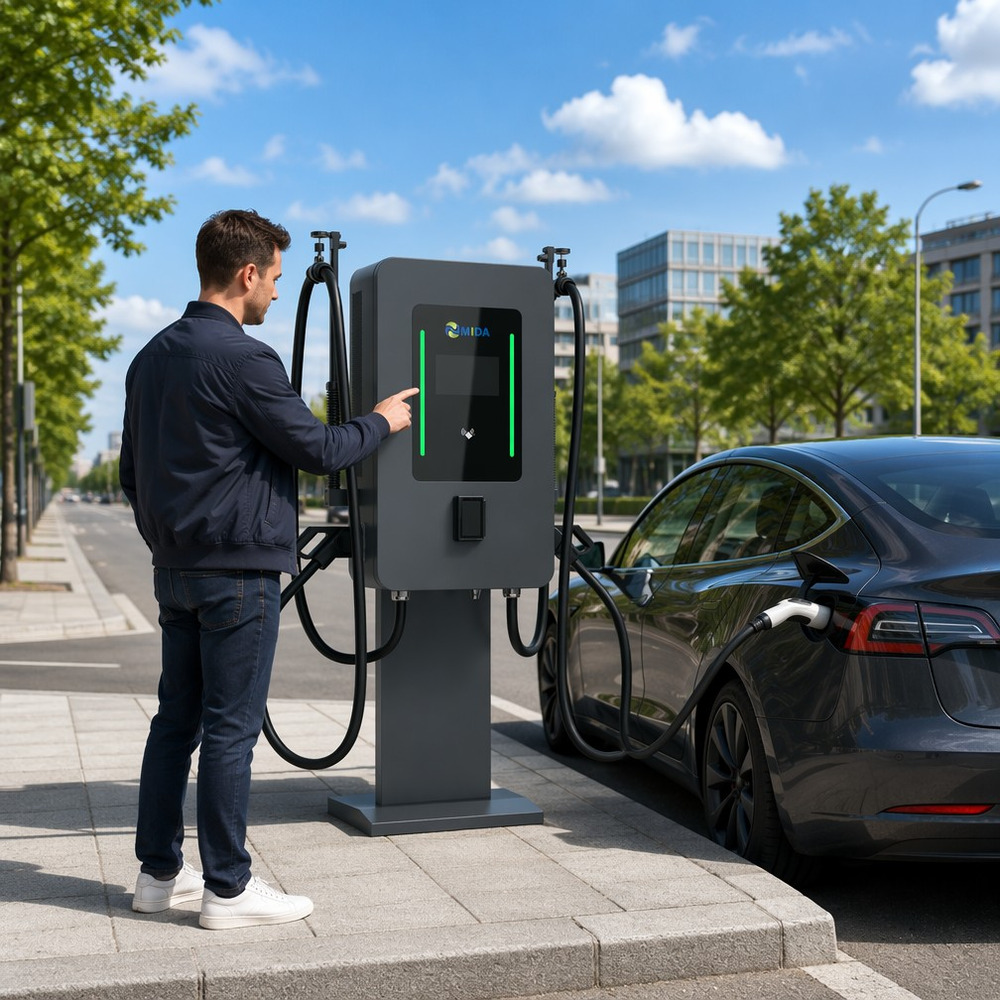
Wall-mounted units place the display and the charging hardware at a natural viewing height in car parks and along building facades, without the ground clutter of pedestal stations. This improves sight lines for advertising content and simplifies site design, cable management, and anti-vandalism measures. For retrofit projects, wall mounting also reduces the structural work required versus freestanding cabinets, which matters when the retail site is leased and the landlord requires reversible installations.
Installation economics versus pedestal stations
The capex differential is substantial. Pedestal DC stations typically require concrete foundations, trenching, longer armoured cable runs, and separate bollard protection. Wall-mounted dual-gun wallboxes mount directly on existing walls or structural columns, with shorter cable paths and minimal civil works. Procurement teams evaluating 2026 projects consistently find that the all-in installed cost of an 80kW wallbox site is 30–50% lower than an equivalent pedestal layout, which shortens the payback period of an advertising-funded business case by a full operating year in many cases.
Comparing Retail Monetization Models
Retailers entering the market in 2026 face three distinct business models. The choice determines hardware specification, contractual structure, and media pricing strategy.
| Model | Energy Margin (USD/kWh) | Ad Revenue (USD/session) | Installed Capex Intensity | Operational Complexity | Best Fit |
|---|---|---|---|---|---|
| Charging-only (amenity) | 0.02–0.05 | 0 | Medium | Low | Convenience sites with low footfall |
| Advertising-enabled wallbox | 0.02–0.05 | 1.50–8.00 | Medium | Medium | Supermarkets, gyms, hospitality |
| Hybrid RMN placement | 0.02–0.05 | 8.00–25.00 | Medium–High | High | Malls, flagship retail, multi-brand ad networks |
The hybrid RMN model is the fastest-growing segment in 2026. Under this structure, the retail media network supplies the ad sales capability and the advertising inventory is sold as part of a larger portfolio of screens, kiosks, and parking assets. The retailer contributes the physical charging asset and the audience; the network contributes demand-side sales and measurement. For hardware, the requirement is uniform: standards-compliant, remotely manageable, and API-accessible — exactly the profile of a smart commercial dual-gun wall-mounted DC fast charging station built for fleet and public use.
The Technical Stack Behind Advertising-Ready Charging
OCPP 1.6J and remote management
Advertising revenue depends on uptime. A charger that is offline during peak retail hours sells no energy and no media. OCPP 1.6J is the de facto management standard for 2026 commercial deployments because it standardizes remote start/stop, real-time status reporting, firmware updates, and transaction data exchange with any backend. Buyers should treat OCPP compliance as non-negotiable, and should verify that the charger’s firmware supports scheduled ad-screen content updates and integration hooks for external control systems.
Dynamic load balancing and site capacity
Retail sites rarely have spare grid capacity for a bank of 80kW chargers. Dynamic load balancing solves this by monitoring the site’s total demand — refrigeration, HVAC, lighting, and charging combined — and throttling charging power to stay inside the utility’s agreed capacity envelope. The result is that a site with a 100A service can host multiple dual-gun wallboxes without a transformer upgrade, dramatically improving the economics of advertising deployments. This is covered in depth in our guide to dynamic load balancing in dual-gun EVSE deployments.
Metering, billing, and ad-telemetry integration
A complete advertising stack needs three data flows: energy metering for settlement, session telemetry for ad serving, and content scheduling for the display. On a well-integrated system, each completed session triggers a media event that the ad server can use to rotate creative, count impressions, and report verified plays to the advertiser. Retailers should require documented APIs and, ideally, a sandbox environment from the charger manufacturer before committing to a media partnership.
A Worked ROI Model for a 2026 Retail Site
A realistic pilot illustrates the shift. Consider a supermarket with four dual-gun 80kW wallboxes, eight parking bays, operating twelve hours per day at an average of 14 sessions per bay per day.
- Energy revenue: 112 sessions/day × 28 kWh × USD 0.04 margin ≈ USD 125/day.
- Advertising revenue (hybrid RMN): 112 sessions × 60% fill rate × USD 6.50 CPM-equivalent ≈ USD 437/day.
- Total incremental revenue ≈ USD 562/day, of which media contributes 78%.
- All-in installed capex for four wallboxes ≈ USD 48,000–68,000; simple payback lands between 3 and 5 months on revenue, versus 18–30 months for a charging-only model.
These figures assume moderate utilization; sites with higher dwell and stronger local advertiser demand routinely exceed them. The key structural insight is that media revenue scales with sessions, while charging revenue scales with energy — and dual-gun architecture increases sessions per bay more efficiently than any single-gun alternative.
Risks and Compliance Considerations
Advertising-enabled charging introduces obligations that pure charging does not. Screen content should respect local advertising standards, and any use of session data for targeting must comply with privacy regulations such as GDPR in Europe, which requires anonymization and clear disclosure. Retailers should also plan for creative fatigue: ad rotation frequency, content quality, and relevance directly affect both viewer tolerance and the charger’s perceived convenience. Finally, contracts with media networks should specify measurement standards — verified impressions, viewable seconds, and reporting cadence — so that the retailer’s media inventory is priced transparently.
Selecting an Advertising-Ready Dual-Gun Wallbox
Procurement teams should evaluate hardware against five criteria: OCPP 1.6J compliance and API openness; dual-gun power-sharing flexibility (e.g., 40kW/60kW/80kW configurability); IP rating and outdoor durability; display and connectivity options for ad content; and the manufacturer’s track record for firmware support. A high-efficiency 80kW wall-mounted DC EV charger with dual CCS2/GBT interfaces satisfies most retail requirements out of the box, while newly designed commercial-grade dual-gun wallbox DC charging stations with CE certification are appropriate where certification evidence and rapid deployment matter most. For parking-lot retail environments, factory-direct 80kW dual-gun CCS2 fast charging stations deliver the throughput and OCPP smart-EVSE features that media networks expect, and APP-controlled dual-gun wallbox DC fast chargers add the remote monitoring layer that operations teams rely on during peak hours.
FAQ
How much revenue can advertising add to an EV charger in 2026?
Depending on fill rate, location, and ad network, advertising typically adds USD 1.50–25.00 per charging session on top of energy margin. At a busy supermarket site, media revenue often exceeds charging revenue by a factor of 3–10.
Why are dual-gun wallboxes better than single-gun chargers for advertising?
Dual-gun units serve two vehicles from one footprint and one screen, doubling sessions and media impressions per parking bay without additional civil works or grid allocation.
Do I need OCPP compliance to run advertising on EV chargers?
Yes. OCPP 1.6J is the practical requirement for remote management, transaction telemetry, and backend integration with ad-serving platforms. Non-OCPP chargers are difficult to operate at fleet scale.
What is the typical payback period for an advertising-enabled wallbox?
With an active retail media network, payback typically ranges from 3 to 8 months at moderate utilization, versus 18–30 months for charging-only deployments.
Can existing chargers be upgraded to display advertising?
Only if the hardware has a display, sufficient compute, and an open API. In practice, most legacy units cannot support media scheduling, and a hardware refresh is the cleaner path.
What compliance issues apply to advertising EV chargers?
Content must comply with local advertising rules, and session data used for targeting must be anonymized and processed in line with GDPR or equivalent privacy frameworks.
Does dynamic load balancing reduce advertising revenue?
No. Load balancing only throttles power during grid peaks; it preserves session count, which is what media revenue depends on. In fact, it enables more wallboxes per site, increasing total inventory.
Post time: Sep-01-2026