
AI-Driven Charging Orchestration: Predicting Consumer Behavior to Optimize Grid Resilience
Quick Answer
AI-driven charging orchestration predicts when, where, and how much energy electric vehicles will demand — down to the individual session — and then schedules charging to flatten load, protect transformers, and capture cheaper or flexibility-linked energy. Unlike rule-based load management, which reacts to measured load with fixed thresholds, AI orchestration uses historical telemetry, weather, events, grid-price signals, and driver-behavior features to forecast demand 15 minutes to 48 hours ahead, then optimizes power allocation across chargers, vehicles, and storage in near real time. Mature deployments report 15–40% peak-load reduction, 10–20% increases in charger utilization, and 10–25% lower energy cost per session while avoiding transformer overloads that would otherwise cap network growth. This article breaks down the AI stack, the behavior-prediction problem, the comparison with rule-based systems, the resilience KPIs that matter, and the step-by-step deployment path for charge point operators and fleets.
Key Takeaways
- Charging demand is predictable enough to orchestrate: session-level features — arrival time distributions, dwell-time behavior, battery state, weather, and local events — let AI models forecast load with useful accuracy 15 minutes to 48 hours ahead.
- AI orchestration outperforms rule-based load management on the metrics that matter: 15–40% peak reduction, 10–20% utilization gains, and 10–25% energy-cost savings in time-of-use markets.
- Grid resilience is the strategic payoff: orchestrating around transformer and feeder limits lets networks add chargers without grid reinforcement, deferring capex and shortening deployment timelines.
- Behavior prediction and control must be decoupled: forecasting models learn from data, while optimization engines apply constraints (capacity, fairness, driver deadlines) — combining both is what makes orchestration both smart and safe.
- A phased rollout — telemetry baseline, forecasting, advisory mode, then closed-loop control — lets operators build trust in the models before handing them control of revenue-critical sessions.
Why Charging Orchestration Is First a Grid Problem
Electric vehicle charging concentrates load in space and time: the same parking lot, the same evening window, the same transformers. A single 150 kW fast charger draws roughly the power of 100–150 homes; a hub of six chargers can draw 600–900 kW simultaneously, and without coordination that demand lands on transformers, feeders, and substations sized for much lighter loads. Grid operators are therefore moving from a passive “connect and hope” posture to explicit capacity management: interconnection queues are lengthening, and networks increasingly require demand-response capability as a condition of connection. Orchestration is the tool that converts charging from an unmanaged load into a flexible, schedulable resource — but scheduling requires prediction, and prediction at useful accuracy is exactly what AI brings that fixed rules cannot.
The economic stakes are large. A transformer upgrade can cost USD 50,000–150,000 and take 6–18 months of lead time; every charger added without reinforcement eventually trips protection or triggers demand charges. Operators that orchestrate around existing capacity can deploy 1.5–3× more charging on the same connection, deferring capex and shortening time-to-revenue. In markets with time-of-use tariffs, capacity charges, or flexibility programs, the orchestrated site also becomes a revenue participant: it can shift load to cheap hours, cap peak demand, and export flexibility to the grid operator when called.
The AI Stack for Charging Orchestration
Production orchestration systems layer three components: telemetry ingestion, behavior forecasting, and optimization control.
Telemetry and Feature Engineering
Everything starts with data. Chargers stream session records — plug-in time, charge start, power profile, energy delivered, connector, driver ID — plus status telemetry over OCPP. Around that, the platform ingests grid connection limits, tariff schedules, weather forecasts, local event calendars, and, where available, vehicle-level data such as battery state of charge at arrival. Feature engineering turns raw records into predictors: rolling arrival distributions by hour and day type, dwell-time behavior per driver segment, weather effects on range and charging depth, and holiday and event lift factors. The quality of these features — not the sophistication of the model — is usually what separates useful forecasts from decorative ones.
Demand Forecasting Models
Forecasting operates at two horizons. Short-horizon models (15 minutes to a few hours ahead) predict imminent session arrivals and loads to manage real-time power allocation; medium-horizon models (24–48 hours) predict daily energy profiles to optimize energy procurement, storage charging, and staffing. Typical approaches combine gradient-boosted trees or neural networks on historical data with regime detection for special days, and ensemble them with physical constraints — a transformer’s rating or a charger’s derating curve. Forecast accuracy at the site level routinely reaches 80–95% for next-hour load bands, which is sufficient to run control decisions with confidence.
Optimization and Control
The forecast feeds an optimizer that decides, every few minutes, how much power each charger or vehicle receives. The optimizer’s objective can be weighted: minimize peak demand, minimize energy cost, maximize completed sessions, or a blend; its constraints are hard limits — transformer rating, breaker size, minimum session completion, driver-announced departure times. The output is a power-allocation schedule pushed to chargers via OCPP smart-charging commands. This forecast-then-optimize architecture is deliberately modular: models can be retrained without touching control logic, and control logic can be hardened against model error by enforcing hard limits at the charger layer.
Predicting Consumer Behavior: The Core Insight
Consumer behavior at charging sites is far more structured than it appears. EV drivers are not random walkers; they follow work schedules, commute patterns, meal and shopping routines, and fleet duty cycles. Arrival time at a workplace hub clusters around shift starts; dwell time at a retail charger correlates with visit duration; a cold snap increases both energy per session and demand for fast charging; a local festival or sports event produces a predictable load spike an hour before it starts. AI models capture these correlations across thousands of sessions and turn them into site-specific demand forecasts — effectively predicting consumer behavior from its observable traces without any tracking of individual identity.
The behavioral signal is strongest where it matters most. Fleet operations are the easiest to orchestrate because duty cycles are scheduled: depot charging can be shifted wholesale to off-peak hours with driver-aware minimum state of charge. Public fast charging is harder but still predictable at the aggregate level, and semi-public destinations (hotels, restaurants, retail) sit in between, with dwell-time distributions that allow power-sharing windows of 20–120 minutes. The prediction problem is therefore not “what will this driver do” but “what will this site’s demand distribution look like in the next hour” — and that is a problem AI solves reliably with enough telemetry.
Rule-Based vs. AI-Driven Orchestration: A Comparison Table
| Dimension | Rule-Based Load Management | AI-Driven Orchestration |
|---|---|---|
| Decision logic | Fixed thresholds and static schedules | Models learned from site data, updated continuously |
| Demand visibility | Reactive: reacts to measured load | Predictive: forecasts load 15 min–48 h ahead |
| Peak-load reduction | 5–15% typical on simple thresholds | 15–40% through proactive scheduling |
| Utilization impact | Can strand capacity at quiet hours | +10–20% utilization by matching supply to predicted demand |
| Energy-cost response | Static time-of-use tables | Dynamic response to price signals and flexibility events |
| Fairness and driver needs | First-come-first-served or static priority | Deadline-aware allocation with fairness constraints |
| Anomaly handling | Manual; surprises trip limits | Regime detection; forecasts adapt to events and weather |
| Deployment effort | Low; simple to configure | Higher; needs telemetry maturity and model validation |
| Grid-resilience value | Protects against obvious overloads | Enables 1.5–3× more capacity per connection and flexibility export |
The table reframes the choice: rule-based systems are the correct starting point and a safety net, but they cap what a site can extract from its grid connection. AI orchestration is the layer that turns the same connection into a resilient, revenue-optimizing asset.
Grid Resilience Outcomes and the KPIs That Prove Them
Grid resilience is measured in avoided events and avoided capex, not in model accuracy. The operational KPIs that matter to a CPO or fleet are: transformer and feeder utilization (staying under rated limits during peaks), peak-demand reduction at the site meter, session completion rate (the share of sessions finishing with the driver’s required energy), average delivered power per session, and energy cost per kWh. Mature orchestration deployments report 15–40% peak-load reduction, 10–20% utilization gains, and 10–25% energy-cost savings in time-of-use markets, with session completion rates held at 95%+ through deadline-aware scheduling. The strategic KPI is capacity headroom: the additional chargers a site can host on its existing connection, which for orchestrated sites commonly reaches 1.5–3× the un-orchestrated baseline.
Resilience also compounds at the network level. When thousands of orchestrated sites respond predictably to price and flexibility signals, the distribution grid sees smoother regional load curves, fewer overload alarms, and more dispatchable demand — the exact properties that let utilities accommodate EV growth without blanket reinforcement programs. Individual-site orchestration is therefore the foundation of system-wide grid resilience, and the data standards that make it possible — OCPP smart charging, ISO 15118 session intelligence, and emerging flexibility APIs — are already shipping in commercial hardware.
A Deployment Roadmap for CPOs and Fleet Operators
- Phase 1 — Telemetry baseline: instrument chargers and the site meter, normalize OCPP session records, and build a clean historical dataset. No orchestration succeeds without trustworthy telemetry.
- Phase 2 — Forecasting: deploy demand-forecasting models in shadow mode; validate next-hour and next-day accuracy against actual load before any control action.
- Phase 3 — Advisory mode: surface recommended schedules and power allocations to operators; measure what advisory guidance would have achieved versus the baseline.
- Phase 4 — Closed-loop control: enable automated power allocation with hard safety limits, starting on a pilot site or depot; expand once completion rates and peak limits hold.
- Phase 5 — Value stacking: add tariff optimization, storage coordination, and flexibility-market participation; report resilience KPIs to utilities and financiers to unlock connection and financing advantages.
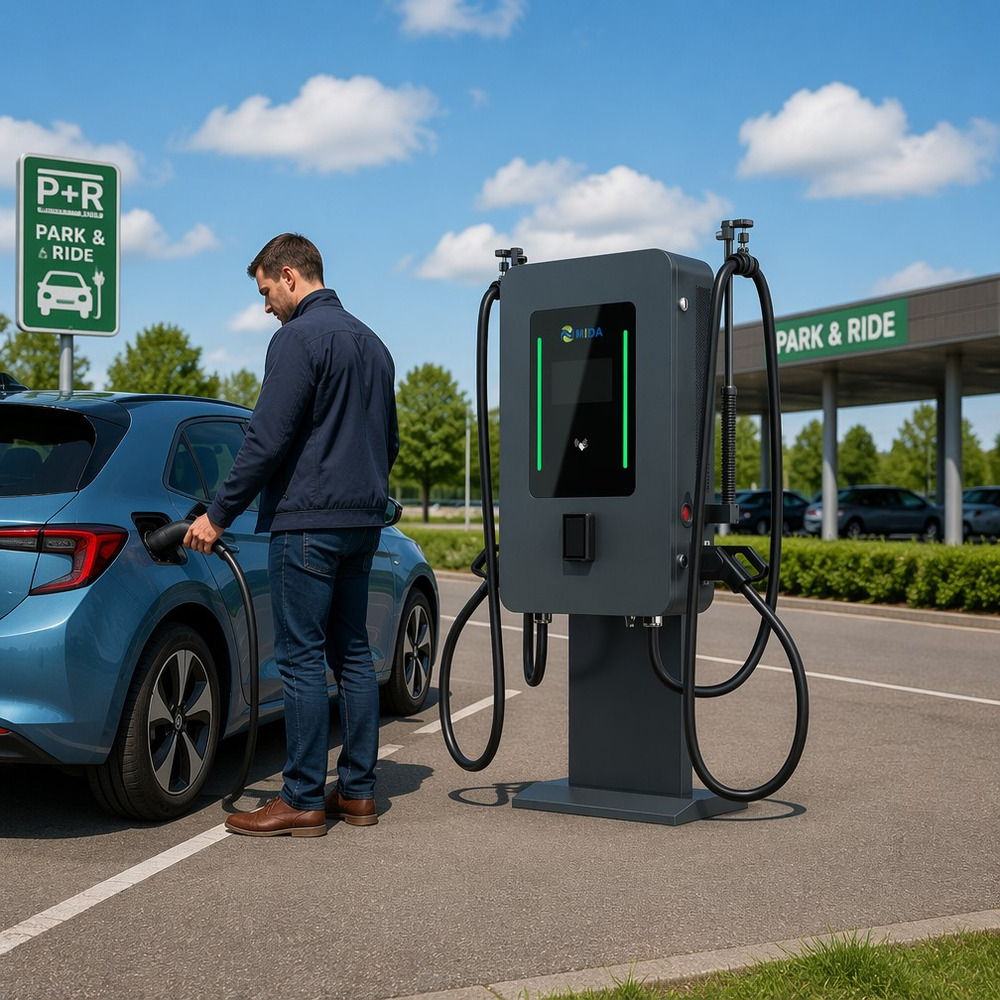
The hardware under orchestration must respond faithfully to smart-charging commands — and the installed base matters as much as the model. Intelligent dual-gun wallbox DC fast charging stations with load balancing for multi-vehicle use are designed to execute exactly the power-sharing commands an orchestrator issues. Dual-gun EV wallbox fast charging stations with intelligent load balancing bring site-level coordination to commercial deployments, while APP-controlled dual-gun DC fast charging stations with CE/TUV certification give drivers the session visibility that feeds behavioral forecasting. OCPP smart EVSE dual-gun fast charging stations with CCS Combo 2 provide the protocol-native telemetry orchestration platforms depend on, and professional dual-gun DC fast charging stations built for fleet management anchor the depot use case where orchestration economics are strongest.
Frequently Asked Questions
Q1. What is AI-driven charging orchestration?
It is the practice of using machine-learning demand forecasts to schedule and allocate charging power across vehicles, chargers, and storage — predicting when sessions will start, how long they will last, and how much energy they will draw, then optimizing power to flatten peaks, cut costs, and stay within grid limits.
Q2. How does it differ from smart charging or load management?
Load management reacts to measured load with fixed rules; smart charging often applies simple schedules. AI orchestration forecasts demand 15 minutes to 48 hours ahead using telemetry, weather, events, and price signals, then optimizes continuously — delivering materially better peak reduction, utilization, and cost outcomes.
Q3. What data does an AI orchestration platform need to start?
A baseline requires OCPP session records (plug-in time, energy, duration, connector), site meter data, grid connection limits, and tariff schedules. Weather and event feeds improve forecasts. Quality telemetry matters more than quantity — a year of clean session data is typically sufficient to begin.
Q4. Can orchestration delay or cancel a driver’s charge?
It can shift or rate-limit power, but well-designed systems are deadline-aware and fairness-constrained: drivers who announce a departure time or request immediate charging are prioritized, and completion rates are held above 95%. Orchestration is designed to preserve the driver experience while using slack in the schedule.
Q5. How much peak load can AI orchestration actually shave?
Reported results range from 15–40% peak-load reduction at orchestrated sites, depending on demand patterns, storage availability, and how much schedule flexibility drivers allow. Utilization typically rises 10–20% and energy cost falls 10–25% in time-of-use markets.
Q6. Does orchestration require vehicles or chargers to be AI-capable?
No. The AI runs in the cloud or at the edge in the orchestration platform; chargers only need to accept OCPP smart-charging commands, which most modern DC fast chargers support. Vehicles benefit from ISO 15118 session intelligence but are not a requirement for site-level orchestration.
Q7. Is it safe to hand control of charging to an AI model?
Yes, when the architecture enforces hard limits independently of the model: transformer ratings, breaker sizes, and safety limits live in the control layer and cannot be exceeded even if the forecast is wrong. Deploying in advisory mode first, then enabling closed-loop control on a pilot site, builds the operating confidence operators need.
Post time: Sep-01-2026