
From Diesel to Decarbonized: Special Infrastructure Requirements for Heavy-Duty Electric Truck Charging
Quick Answer
Electrifying heavy-duty trucking is an infrastructure project before it is a vehicle project. A Class 8 electric truck consumes 15–25 times the energy of a passenger EV per charge, draws at 800–1000V, and needs depot charging that can deliver 300–1000kW per bay — which means site electrical capacity measured in megawatts, not kilowatts. The special requirements beyond passenger-car charging are concrete: medium-voltage transformers and switchgear, 800–1000V charger platforms with CCS or MCS connectors, industrial cable-management systems for cables that weigh more than the average driver, thermal design for sustained high-current sessions, and deep integration with fleet telematics so charging follows dispatch rather than the reverse. This article maps the infrastructure stack — power, hardware, layout, and control — that converts a diesel depot into an electric one, and explains what to phase first when capital is limited.
Key Takeaways
- Heavy-duty electric trucks charge at 800–1000V and 300–1000kW per bay, making site power delivery — transformer, switchgear, and grid connection — the first and most expensive infrastructure decision.
- Depot charging economics favor overnight energy: low utilization of grid capacity at night means depots can often avoid expensive demand charges with intelligent scheduling.
- Charger hardware for HD fleets needs wide voltage ranges (150–1000V), dual connectors, and OCPP-based fleet integration; passenger-car units cannot simply be scaled up by adding stalls.
- Cable management is an operational requirement, not an ergonomic nicety: 150–250kg CCS cables and heavier MCS cables need mechanical assistance to be safe for drivers.
- Megawatt Charging System (MCS) readiness — conduit, space, and power headroom — should be designed into every new depot even if MCS hardware ships later.
Why Heavy-Duty Charging Is a Different Engineering Problem
The scale difference is the whole story. A passenger EV with a 75kWh battery charges at 150–350kW for 20–40 minutes. A Class 8 electric tractor carries 400–900kWh of battery and must recover 80% of it inside a driver’s legal rest break or overnight at the depot. At 350kW, a 600kWh battery needs nearly two hours to refill; at 750kW–1MW, the same energy arrives in 40–60 minutes. This is why the industry is converging on two charging modes with entirely different infrastructure: depot charging at moderate power over long overnight windows, and highway/opportunity charging at megawatt scale for short driver breaks. Both are heavy-duty problems, but they stress different parts of the electrical and physical site.
There is a second difference that infrastructure planners routinely underestimate: the vehicles are 800–1000V systems. Passenger cars are migrating from 400V to 800V, but most HD trucks already operate at 800V+ to keep cable weight and losses manageable at high power. Chargers must therefore deliver full power across a wide voltage range — 150–1000V is the practical band — and handle the sustained, high-current sessions that make thermal management non-negotiable. A charger that performs well on 15-minute passenger sessions may derate badly on a 90-minute truck session if its cooling system is undersized for continuous full output.
Depot Charging: The Megawatt-Scale Load Center
The depot is where diesel-to-electric conversion is won or lost, because it carries the daily energy volume. A 100-truck depot charging 500kWh per truck per night draws roughly 50MWh of energy in an 8-hour window — an average load around 6MW, with peaks higher when charging windows overlap. For comparison, a typical passenger fast-charging hub runs at 0.5–2MW. The depot therefore needs a dedicated medium-voltage connection, a transformer sized to the load, switchgear, and a distribution topology that can feed dozens of bays.
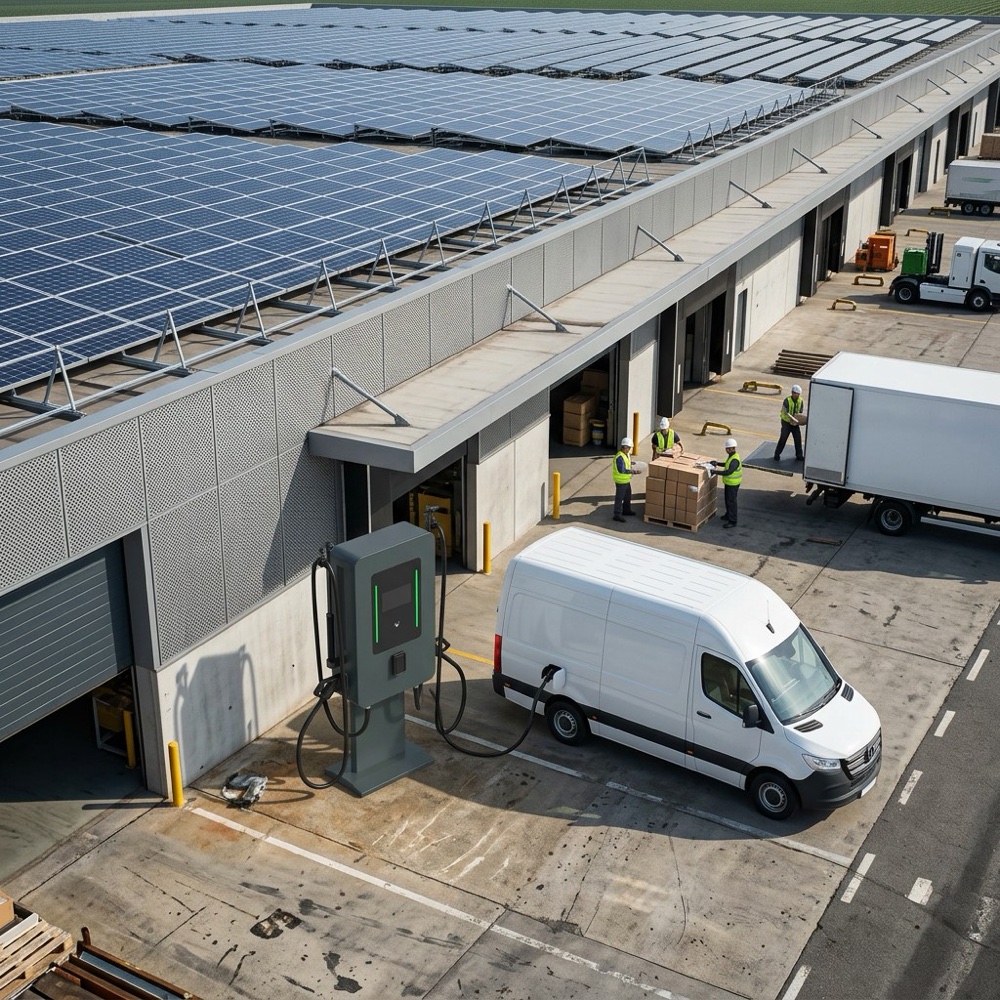
The grid connection is the critical path. Utilities quote lead times of 1–3 years for megawatt-class connections, which is why the electrical design must start before the trucks are ordered. Two mitigations reduce the connection burden. First, intelligent scheduling spreads charging across the full night window, flattening the load curve so the required capacity tracks average demand, not peak coincidence. Second, on-site battery storage or solar-storage integration caps the import ceiling and can defer transformer upgrades entirely — the same BESS logic that serves power-constrained regions applies at depots where the constraint is the connection queue rather than network weakness. Specifying chargers that accept remote power limits is what makes both mitigations possible, since the site controller needs to shape a load composed of many simultaneous sessions.
The Charger Layer: What HD Trucks Actually Need at the Bay
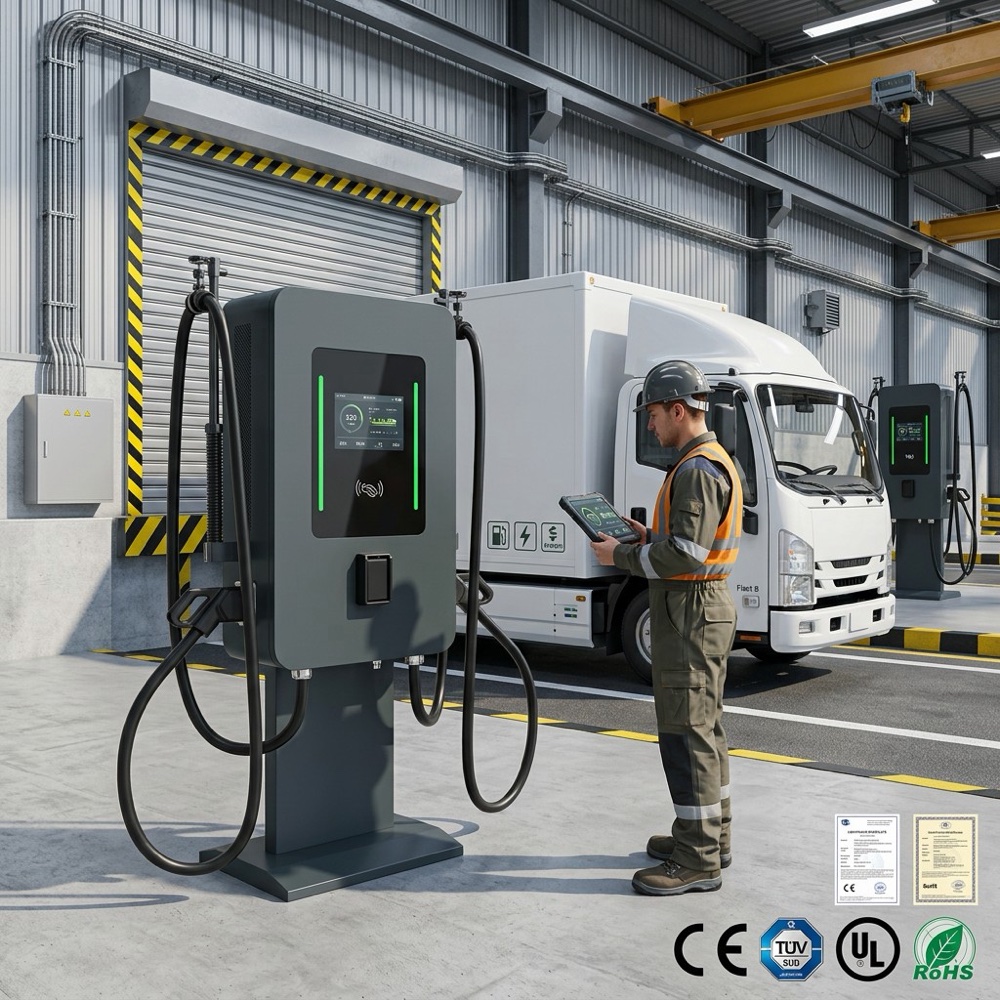
Passenger-market chargers are not simply undersized versions of the right answer; they are architecturally different. HD fleet charging requires: a wide voltage window (150–1000V) so mixed fleets of 400V and 800V vehicles all charge at full capability; dual connectors so a bay serves two trucks or two inlet positions without a second unit; OCPP with fleet-relevant data (session energy, power curves, readiness states) feeding the transport management system; and ruggedized outdoor construction, because depots are industrial yards, not conditioned parking garages.
In the practical 40–80kW class that covers yard trucks, regional haulers, and depot top-up, dual-gun wall-mounted units are the workhorse. Deployments using factory-grade OCPP smart dual-gun fast charging stations with CCS Combo 2 and premium dual-gun wallbox DC fast charging stations for fleet operations deliver the wide-voltage output and remote management that fleet operators depend on, while units like the commercial-grade 80kW dual-gun wallbox DC fast chargers with a 150–1000V range cover mixed-voltage yards without derating. The specification pattern is consistent: wide voltage, dual guns, OCPP, IP-rated enclosures, and power modulation the site controller can command.
Site Infrastructure: The Seven Non-Negotiables
1. Power Delivery
Medium-voltage service, transformer, and switchgear sized to the scheduled load profile — not to nameplate charger totals. Engage the utility before the trucks; the connection is the schedule driver.
2. Thermal and Electrical Derating
Depot chargers run for hours at full output. Specify continuous-power ratings (not peak) and verify cooling performance at the site’s worst ambient temperature, because summer-afternoon sessions are exactly when derating bites.
3. Cable Management
A 200–500kW CCS cable assembly weighs 20–50kg; MCS cables reach 150–250kg. Every bay needs a mechanical assist — ceiling hanger, articulated arm, or floor-mounted mast — plus defined cable paths that keep high-voltage cables out of forklift and truck turning arcs.
4. Physical Layout and Dock Access
Bay geometry must match the fleet: charging in the yard requires pull-through lanes for trailers; charging at the dock requires the charger to reach the truck’s inlet without blocking loading doors. Leave turn radius and cable reach on the drawing board before pouring concrete.
5. Fleet Integration and Control
The chargers must appear in the fleet management system with the same fidelity as fuel dispensers once did: per-session energy, cost allocation per vehicle, readiness signals, and remote power limits from the site controller. OCPP is the carrier; the contract must require it.
6. Safety and Compliance
High-voltage DC at fleet scale triggers distinct codes: arc-flash studies, grounding design, cable tray ratings, signage, and driver training. Budget for a qualified electrical contractor with HD EV infrastructure experience; this is not a retrofit job for general electricals.
7. MCS Readiness
Even if megawatt charging arrives with the next truck generation, install conduit, transformer headroom, and bay space now. Retrofitting MCS conduit through an operational depot costs multiples of doing it during construction.
Passenger Charging vs. Heavy-Duty Truck Charging
| Dimension | Passenger EV Charging | Heavy-Duty Truck Charging |
|---|---|---|
| Battery size | 40–120kWh | 400–900kWh |
| Charging power per bay | 50–350kW | 300–1000kW (MCS up to 3.75MW) |
| System voltage | 400V, migrating to 800V | 800–1000V standard |
| Site electrical scale | 0.1–2MW | 2–15MW depots |
| Session duration | 15–45 minutes | 30 minutes to 8 hours (overnight) |
| Cable weight | 5–10kg, hand-manageable | 20–250kg, mechanical assist required |
| Grid connection | Existing LV often sufficient | Dedicated MV service; 1–3 year utility lead times |
| Primary connector | CCS2, CHAdeMO, NACS | CCS (up to ~1MW), MCS (megawatt+) |
| Key operational concern | Stall utilization | Dispatch reliability and energy cost |
The table summarizes why the engineering cannot be borrowed from the passenger market. The most common planning error is scaling passenger-style stations upward — more stalls, same architecture — which produces a depot with underpowered transformers, hand-managed cables, and no fleet telemetry. The correct approach is to design from the truck’s energy and voltage up, then adapt the passenger-market lessons that do transfer: load management, telemetry, and serviceability.
Highway and Opportunity Charging: The Corridor Problem
Beyond the depot, long-haul trucks need charging where drivers rest. Highway sites face their own constraints: utility capacity at rural interchanges is often scarce; dwell time is legally capped (drivers rest 30–45 minutes), so power must be high; and cable management must serve drivers of varying ability in all weather. These sites are where MCS will matter most, and where OCPP 1.6J dual-connector wall-mounted DC fast charging stations already play a role today for regional trucks and vans that top up between depot shifts. The planning rule for corridors is the reverse of the depot: because energy volumes are lower but power peaks are higher, storage and demand management are used to stretch scarce connection capacity, and charger power matters more than count.
Phasing the Conversion: A Capital-Constrained Path
Few fleets electrify a depot in one pass. A pragmatic sequence begins with the site electrical backbone — transformer, switchgear, conduit, cable management — sized for the end state, because these are the expensive, long-lead, non-relocatable investments. Phase one deploys charging for the first truck tranche using the most flexible hardware: units like APP-controlled dual-gun DC fast charging stations with CE/TUV certification that serve both passenger vans and light trucks while the heavy-duty fleet ramps. Phase two adds megawatt-class bays and MCS connectors as the Class 8 population grows. Phase three adds solar and storage, cutting the site’s grid import and locking in the lowest possible energy cost. The diesel-displacement economics improve at each step: displacing diesel at USD 0.30–0.50/kWh with grid energy at USD 0.08–0.20/kWh is the single largest line item in the transition, and it compounds with utilization.
One warning applies across all phases: do not let the vehicle procurement set the infrastructure schedule. Trucks arrive on vehicle-manufacturer lead times measured in months; substations arrive on utility lead times measured in years. The depot that orders its transformer when the trucks are ordered will park electric trucks at a diesel depot for its first winter.
A 2026 Depot Readiness Checklist
- Commission a load study built on planned routes and battery sizes, not on charger nameplates — the connection size follows the schedule, not the hardware list.
- Start the utility application in month one; megawatt connections are the longest lead item in the entire program.
- Specify 150–1000V wide-voltage chargers with dual guns and OCPP remote power limits for every bay.
- Engineer cable management for the heaviest cable the site will ever run, including MCS-class cable if corridor service is planned.
- Design bays for pull-through and dock access simultaneously; retrofitting yard geometry is expensive.
- Integrate charging data into the TMS from day one so cost allocation and readiness reporting exist before the first truck rolls.
- Phase solar and storage in behind the backbone to cap demand charges and hedge energy price exposure.
Frequently Asked Questions
Q1. How much power does a heavy-duty truck charging depot need?
A 100-truck depot drawing 500kWh per truck over an 8-hour window averages roughly 6MW, with peaks higher. Connections of 2–15MW are typical depending on fleet size, charging windows, and whether storage flattens the load.
Q2. Why do truck chargers need a 150–1000V range?
Heavy-duty trucks run 800–1000V systems, while vans and passenger vehicles remain at 400–800V. A wide voltage window lets one charger serve the whole mixed fleet at full capability instead of derating low-voltage vehicles.
Q3. Can I charge a Class 8 truck with passenger-car chargers?
Electrically, only at reduced capability: most passenger chargers cap at 920–1000V and lower current, adding hours to a truck session, and their cables are not built for industrial handling. HD fleets need dedicated hardware with continuous-power ratings.
Q4. What is MCS, and when do I need it?
The Megawatt Charging System is the emerging connector standard for 1–3.75MW charging. You need the hardware when megawatt-capable trucks enter the fleet; you need the infrastructure — conduit, transformer headroom, bay space — now, because retrofits are expensive.
Q5. How long does it take to get grid power for a depot?
Megawatt-class utility connections typically take 12–36 months depending on region and network constraints. This is the critical-path item: the utility application should be the first step of the electrification program, not the last.
Q6. What role does battery storage play at a truck depot?
Storage caps the site’s grid import, flattens the overnight load curve, and can defer transformer upgrades. It is also the backbone of solar integration, letting daytime PV charge the depot’s night load.
Q7. How do I keep energy costs down for overnight depot charging?
Schedule charging across the full night window to flatten demand, buy on off-peak ToU rates, use OCPP-based load management across all bays, and add solar-plus-storage in later phases to displace grid energy entirely.
Post time: Sep-01-2026