
Emerging Markets Spotlight: Southeast Asia vs. Middle East EV Infrastructure Growth Logic
Quick Answer
Southeast Asia and the Middle East are both “emerging” EV markets, but they run on opposite growth engines. Southeast Asia is a volume story led by two-wheelers and affordable four-wheelers: Indonesia, Vietnam, Thailand, and Malaysia are electrifying millions of motorcycles and price-sensitive city cars, with charging demand concentrated in dense urban cores, fragmented across thousands of operators, and constrained by grids that are strong in cities but weak in the archipelago. The Middle East is a value story led by premium vehicles and state capital: Saudi Arabia, the UAE, and Qatar are electrifying luxury fleets, government mandates, and long-distance corridors, with abundant, low-cost energy, harsh desert heat, and oil-funded national programs that build infrastructure ahead of demand. The growth logic differs accordingly — SEA rewards high-volume, low-cost, climate-hardened AC-plus-DC urban networks; the Gulf rewards premium fast-charging corridors, destination charging, and megawatt-scale highway assets. This article compares the two markets across infrastructure, policy, energy, and hardware implications, and provides a B2B entry playbook for each.
Key Takeaways
- SEA electrifies from volume (two-wheelers, affordable cars, ride-hailing fleets); the Gulf electrifies from value (premium EVs, government fleets, luxury tourism corridors).
- Grid reality differs fundamentally: SEA’s archipelago grids and urban concentration favor distributed, grid-friendly charging with solar and storage; the Gulf’s robust, subsidized grids favor fast corridor build-out with less demand-charge anxiety.
- Climate dictates hardware: tropical humidity, heat, and flooding in SEA demand IP54–IP65 tropicalized units; Gulf dust storms and 50°C ambient temperatures demand sand-proof, thermally derated designs.
- Payments and ownership models diverge: e-wallet and telco-led payments dominate SEA; the Gulf runs card-first, app-first experiences with higher per-session revenue.
- For B2B suppliers, the same product family must be configured regionally — dual-gun, OCPP-compliant DC hardware with wide voltage ranges is the common core, localized by climate rating, payment integration, and after-sales logistics.
Two Emerging Markets, Two Electrification Engines
Both regions are growing from a low EV base toward meaningful penetration, but the entry points could not be more different. Southeast Asia’s vehicle stock is dominated by two-wheelers — more than 300 million motorcycles across the region — and its cities move on ride-hailing, tuk-tuks, and affordable sedans. Electrification there begins at 0.5–2.5 kWh per vehicle, not 60–100 kWh. The Middle East’s vehicle stock is skewed toward large, premium cars and SUVs with high fuel subsidies that make gasoline cheap but government commitments to diversification strong; electrification begins at 80–150 kWh per vehicle, financed by sovereign wealth and national mandates. The unit economics of a charging point follow the vehicle: SEA stations must earn from many small sessions at low margin, the Gulf from fewer sessions at high margin. That single difference cascades through every downstream decision — site selection, charger power class, pricing, and partner choice.
Southeast Asia: The Two-Wheeler and Megacity Growth Engine
Indonesia, Vietnam, Thailand, and Malaysia anchor the SEA story. Indonesia is aggressively pushing domestic EV and battery manufacturing, with nickel resources as leverage, and is electrifying motorcycle fleets through incentives; Vietnam’s VinFast is building a domestic ecosystem; Thailand has become the region’s manufacturing hub for EVs and chargers; Malaysia is rolling out national charging targets and green electricity mandates. The common thread is urban density: charging demand concentrates in Jakarta, Bangkok, Manila, Ho Chi Minh City, and Kuala Lumpur, where land is expensive, parking is scarce, and grid connections are congested. Two-wheeler electrification shifts demand toward battery-swap and low-power AC solutions in addition to DC hubs, and ride-hailing fleets create predictable, high-utilization anchor demand that financing can underwrite.
Middle East: Premium Electrification and National Mandates
The Gulf Cooperation Council states — led by Saudi Arabia, the UAE, and Qatar — are pursuing electrification as a diversification policy rather than a fuel-cost response. Saudi Arabia’s Vision 2030 targets electric vehicle manufacturing and national charging infrastructure with public investment; the UAE has set aggressive EV sales targets for Dubai and Abu Dhabi and is building charging networks into every new commercial development; Qatar’s post-World Cup infrastructure, including a mass EV bus fleet, is being sustained and expanded. These markets have world-class roads, centralized decision-making, and electricity prices that are among the cheapest in the world — which paradoxically means the business case is not energy arbitrage but service revenue, uptime, and premium experience. Long intercity distances and tourism flows push investment toward highway fast-charging corridors and destination charging at malls, hotels, and airports.
The Growth Logic: Volume vs. Value
The strategic planning consequence is a divergence in what “scaling” means. In SEA, scaling means density: thousands of low-power points in urban areas, battery-swap stations for two-wheelers, and DC fast charging concentrated at depots, malls, and corridor pinch points, with utilization spread across many sessions per day. Utilization is the entire game because margin per kWh is thin; operators win by maximizing sessions per point and minimizing cost per point, which favors smaller, modular, cheaper hardware and aggressive site-sharing deals with fuel retailers, convenience chains, and parking operators.
In the Gulf, scaling means coverage and reliability: fewer, larger stations on highways and premium locations, each with multiple high-power dispensers, high uptime SLAs, and concierge-level service, because a failed charger at a premium site destroys brand value and deters the very customers the policy is courting. Utilization matters less than availability and reputation; operators win by being the dependable premium network, which favors robust, high-power, dual-gun hardware with strong remote management, and contracts that tie revenue to uptime. Both regions reward OCPP-compliant, remotely manageable hardware; they differ on power class, climate engineering, and the commercial model around each point.
Infrastructure Design Implications
Climate is the hardest engineering constraint. SEA’s tropical environment combines 30–35°C ambient temperatures, 80–95% humidity, torrential monsoon rain, and coastal salt air. Hardware must be IP54 at minimum, with IP55–IP65 preferred outdoors, plus condensation management, salt-spray corrosion protection, and thermal design that derates gracefully rather than tripping. Flood-prone sites demand raised mounting and sealed connectors. The Gulf flips the problem: 45–50°C summer ambients, dust and sand abrasion, and solar loading that can push enclosure temperatures far higher. Units need sand-filtered cooling, aggressive thermal derating curves, and protection against dust ingress (IP6x), with power modules rated for sustained high-temperature operation. A charger engineered for Amsterdam will fail in either market; the product family must be climate-configured per region.
Grid and energy profiles shape sizing. SEA grids are strong in megacity centers but strained at the edge; connection queues are real, and voltage quality varies. This favors load-balanced, power-limited deployment, solar plus storage where tariffs allow, and dual-gun units that share a connection efficiently. The Gulf’s grid is robust and cheap, but summer air-conditioning peaks create demand-charge exposure at commercial sites; load management still matters, but the priority is throughput and reliability rather than capacity rationing. Payment rails differ as sharply: SEA consumers live in e-wallet and QR ecosystems (GrabPay, GoPay, ShopeePay, PromptPay), while the Gulf is card- and app-first with higher average transaction values — hardware and platform choices must accommodate both.
Southeast Asia vs. Middle East: A Comparison Table
| Dimension | Southeast Asia | Middle East (GCC) |
|---|---|---|
| Primary vehicle mix | Two-wheelers, affordable cars, ride-hailing fleets | Premium SUVs, sedans, government and luxury fleets |
| Growth engine | Volume & density (many small sessions) | Value & coverage (fewer, high-revenue sessions) |
| Energy price | Moderate, rising; tariff sensitivity high | Very low, subsidized; energy not the business driver |
| Grid conditions | Urban-strong, archipelago-weak, connection queues | Robust and centralized; summer AC peaks |
| Climate challenge | Humidity, monsoon rain, salt air, floods | Extreme heat, dust, sand, solar loading |
| Hardware priority | IP54–IP65 tropicalized, low-cost modular, swap-capable | IP6x sand-proof, thermally derated, high-power dual-gun |
| Payment ecosystem | E-wallets, QR, telco-led, cash on delivery | Cards, apps, high-ticket premium experience |
| Financing source | Private capital, OEM partnerships, ride-hailing anchors | Sovereign funds, national mandates, developer-led |
| Main network archetype | Urban AC + DC hubs, two-wheeler swap stations, depot charging | Highway fast corridors, destination charging, premium hubs |
| Key market risks | Fragmentation, thin margins, grid constraints | Subsidy dependence, low utilization early, brand expectations |
The table condenses the divergence: SEA’s opportunity is distribution and utilization engineering in dense, price-sensitive markets; the Gulf’s opportunity is premium coverage and service excellence in wealthy, policy-driven markets. The hardware core — dual-gun, OCPP-compliant, wide-voltage DC fast charging — is shared, but the configuration, the commercial model, and the after-sales footprint are region-specific.
A Market-Entry Playbook for B2B Suppliers and Operators
For Southeast Asia, enter through anchors: ride-hailing fleets, two-wheeler swap operators, fuel-retail chains, and mall groups give predictable utilization that finances expansion. Localize hard — e-wallet payment integration, Bahasa/Vietnamese/Thai platform interfaces, and regional certification (SIRIM, SNI, TISI, SUTeP) — and price for volume, not margin. For the Middle East, enter through policy and partnerships: national programs, utility subsidiaries, sovereign-linked developers, and luxury hospitality groups; position on reliability, uptime, and white-glove service, and invest in hot-climate engineering credibility before quoting. In both regions, a single regional hub for spares and service, and hardware that can be reconfigured between climate variants, keeps the product family economic across the two growth logics.
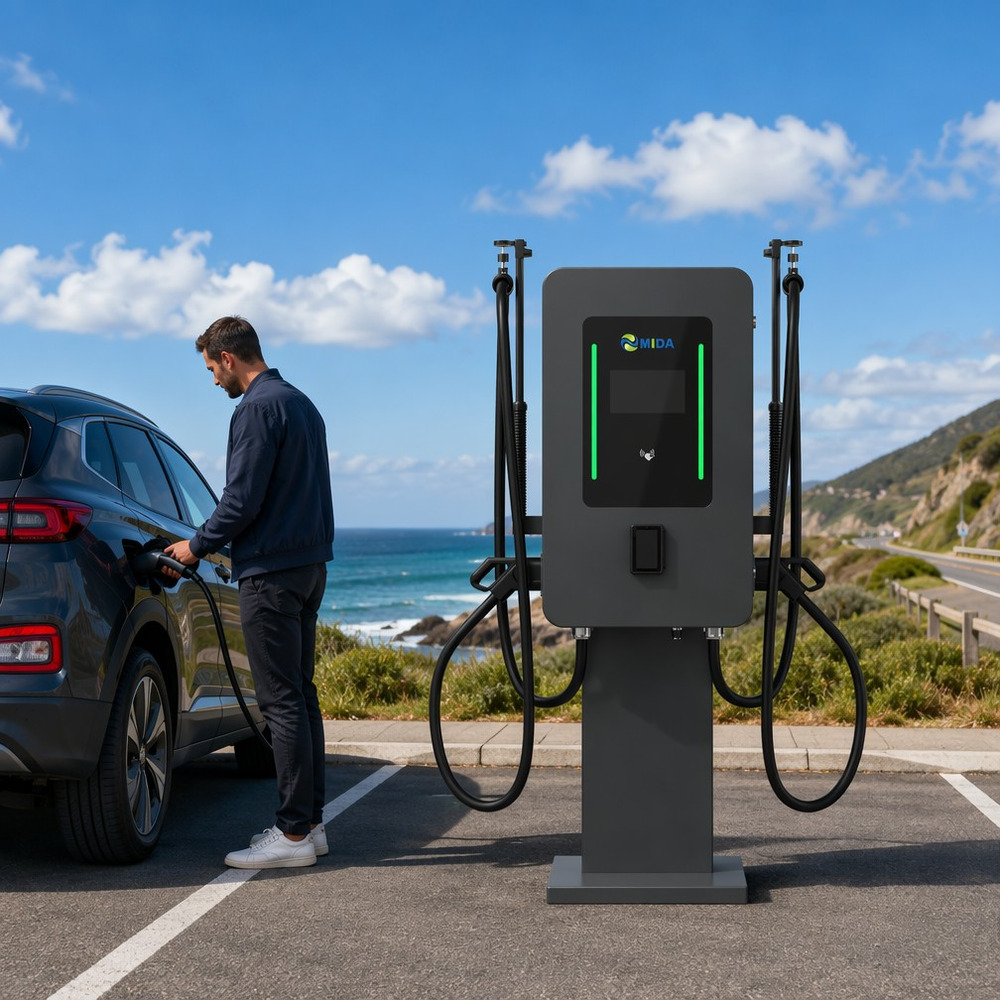
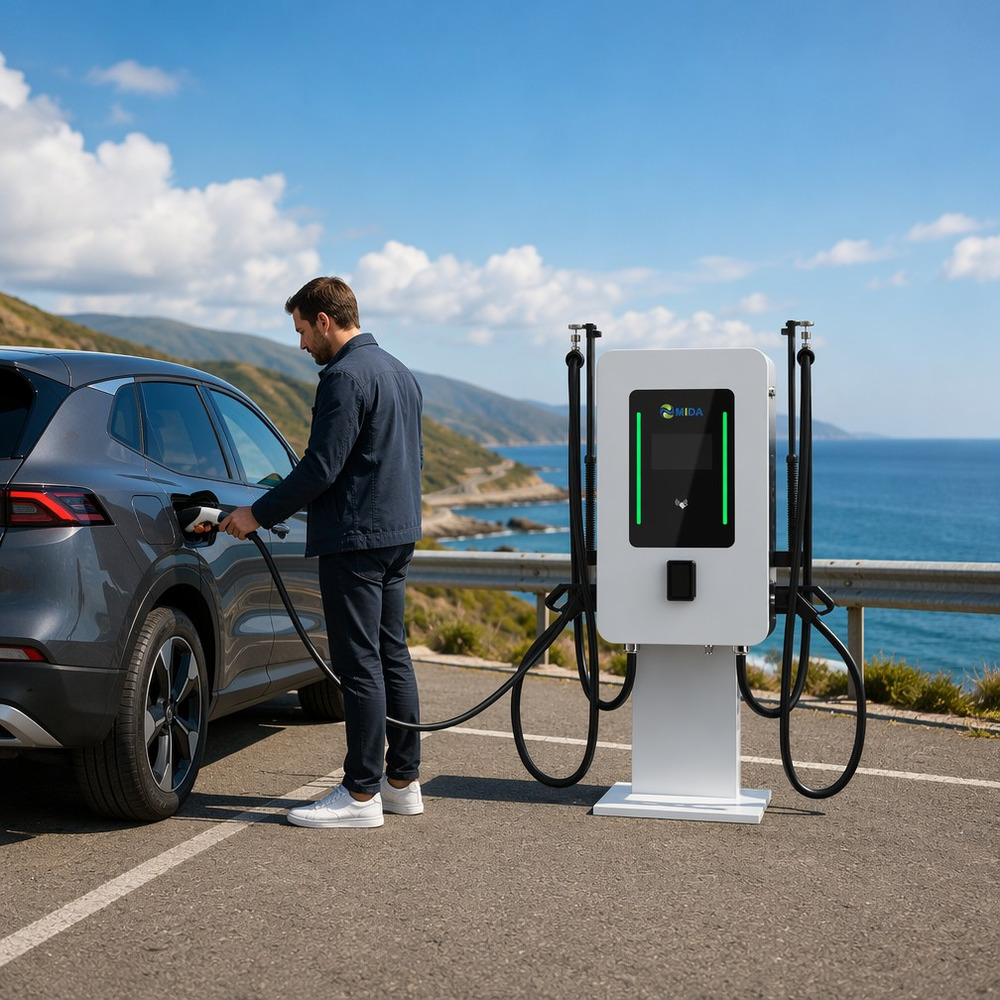
Concretely, operators building SEA networks will find the density economics work best with compact, climate-hardened units that share scarce connections: CCS2/GBT Type 2 dual-gun wall-mounted DC fast charging stations with IP54 and CE ratings suit the humid urban environment, while mini dual-gun DC fast charging stations with OCPP and IP55 outdoor ratings fit tight-footprint city sites and two-wheeler-adjacent hubs. dual-gun EV wallbox fast charging stations with intelligent load balancing and commercial-grade 80kW dual-gun wallbox DC fast chargers with a 150–1000V range let both regions maximize throughput per connection — load balancing for SEA’s constrained feeders and wide voltage coverage for the Gulf’s premium 800V vehicles. OCPP smart EVSE dual-gun fast charging stations with CCS Combo 2 provide the fleet-grade interoperability that anchors both airport and logistics deployments.
A 2026 Checklist for Emerging-Market Entry
- Pick your growth logic first: volume/density play in SEA or value/coverage play in the Gulf; the commercial model follows the vehicle mix, not the other way around.
- Engineer for climate reality: tropicalized IP54–IP65 for SEA, sand-proof thermally derated IP6x for the Gulf — and verify with regional certification bodies, not datasheets.
- Design for the payment rails: e-wallet and QR integration in SEA; card, app, and premium checkout in the Gulf.
- Anchor on utilization: ride-hailing and swap fleets in SEA, government and luxury fleets in the Gulf, underwrite the first wave of stations.
- Standardize on OCPP and remote management so one platform operates assets across both regions, with load balancing and power limiting as default capabilities.
- Build regional service depth: a spares-and-service hub within each region is the difference between a pilot and a network.
Frequently Asked Questions
Q1. Which region is the bigger EV charging market by 2030?
By unit count, Southeast Asia — driven by two-wheeler and ride-hailing electrification across large populations — will deploy far more points. By revenue per point and infrastructure value, the Middle East’s premium, policy-funded build-out can match or exceed it on a per-capita basis. Both are multi-year, structural opportunities.
Q2. Why don’t the same chargers work in both regions?
Climate engineering differs fundamentally: SEA’s humidity, salt air, and flooding demand tropicalized enclosures and corrosion protection; the Gulf’s 50°C ambients and dust demand sand-filtered cooling and thermal derating. The electronics core is the same; the enclosure, cooling, and certification are not.
Q3. Is there a role for AC charging in these markets?
Yes, especially in SEA, where two-wheelers and overnight home/workplace charging make AC the volume workhorse and DC the destination solution. In the Gulf, the premium vehicle mix and policy emphasis on fast corridors tilt the mix toward DC, though destination AC still serves hotels and residential compounds.
Q4. What are the biggest risks of entering these markets?
SEA: fragmentation, thin margins, grid constraints, and slow permitting across many jurisdictions. Gulf: subsidy dependence, low early utilization, and very high service expectations. Both require patient capital and strong local partnerships.
Q5. How important are government incentives in each region?
Critical in both, in different forms: SEA uses purchase subsidies, manufacturing incentives, and two-wheeler conversion programs; the Gulf uses sovereign funds, national targets, and utility-backed build-out. Suppliers should map incentives at national and emirate/province level before pricing.
Q6. What hardware features matter most across both regions?
Dual-gun operation, OCPP compliance, wide voltage range (150–1000V), remote power limiting and load balancing, and climate-appropriate enclosure ratings. These five features let one product family serve both the SEA volume play and the Gulf premium play.
Q7. Should a new entrant start in one region or both?
Start in one, win it, then extend. The two growth logics demand different commercial teams, payment integrations, and service footprints. A shared product platform and management stack lower the cost of the second region, but only after the first region’s reference deployments exist.
Post time: Sep-01-2026