
Enhancing Corporate Branding Through Sustainable Charging Solutions
Quick Answer: Corporate branding in 2026 is no longer confined to logos, websites, or sponsorships — it is expressed through the physical infrastructure a company installs. Sustainable charging solutions, particularly advertising-integrated DC fast chargers, turn an ordinary office parking lot into a visible statement of environmental commitment. By deploying branded EV charging stations with integrated digital signage, corporations can simultaneously reduce fleet emissions, support employee EV adoption, and broadcast their ESG narrative to thousands of daily visitors. The most effective approach pairs high-power charging hardware with cloud-managed media screens, so brand messaging stays current, localized, and measurable — turning a capital expense into a reputational and revenue-generating asset.
Key Takeaways
- Branded EV charging infrastructure converts corporate sustainability commitments from abstract reports into visible, daily proof points for employees, clients, and investors.
- Digital signage on charging stations creates a second communication channel that can be scheduled, localized, and monetized — even for a single office site.
- Power-tier selection (60kW to 240kW) should match dwell-time targets, site electrical capacity, and the mix of employee versus visitor traffic.
- Cloud-based media management lets non-technical marketing teams update screens across the portfolio in minutes, without on-site visits.
- Charging infrastructure contributes directly to ESG reporting metrics, including Scope 2 emissions reduction and employee EV-readiness indicators.
1. The Branding Imperative in the Electric Era
Corporate sustainability reporting has moved from a compliance exercise to a competitive differentiator. In 2026, institutional investors, B2B buyers, and top-tier talent all evaluate companies on environmental performance — and they increasingly verify claims with their own eyes. A headquarters that publicly displays renewable energy commitments while its parking lot offers no charging for a single electric vehicle creates a credibility gap that no press release can close.
Sustainable charging solutions close that gap. When a company installs branded DC fast chargers at its office campus, factory gate, or distribution center, it creates a physical, verifiable demonstration of its energy transition strategy. Every employee who plugs in, every delivery driver who stops for a top-up, and every visitor who parks beside the units absorbs the same message: this organization is investing in electrification, today, on its own premises.
This matters commercially. Surveys across European and North American markets consistently show that consumers prefer brands with visible environmental action, and B2B procurement teams now routinely include sustainability criteria in vendor scorecards. Charging infrastructure is one of the few investments that delivers operational value and brand value simultaneously — the hardware charges vehicles while the integrated display communicates the corporate story.
2. Charging Infrastructure as a Brand Touchpoint
Brand touchpoints are moments of contact between a company and its audience. Most are digital and fleeting — an ad impression, a social post, an email. Charging stations are different. They command physical space, they are visited repeatedly, and they hold the visitor’s attention for the entire duration of a charging session. A 120kW charger typically delivers a meaningful top-up in 20 to 40 minutes, which is an extraordinary window for brand communication compared with the two seconds a passerby spends glancing at a billboard.
2.1 First Impressions at the Corporate Gate
Consider the visitor journey at a corporate campus. The first structured encounter after the security checkpoint is the parking area. If that area contains a row of sleek, illuminated charging stations displaying the company logo, live sustainability messaging, and directional content, the visitor’s perception of the organization is shaped before the first meeting begins. If the lot is empty of charging infrastructure, the same journey delivers an implicit signal that the company’s green positioning is rhetorical.
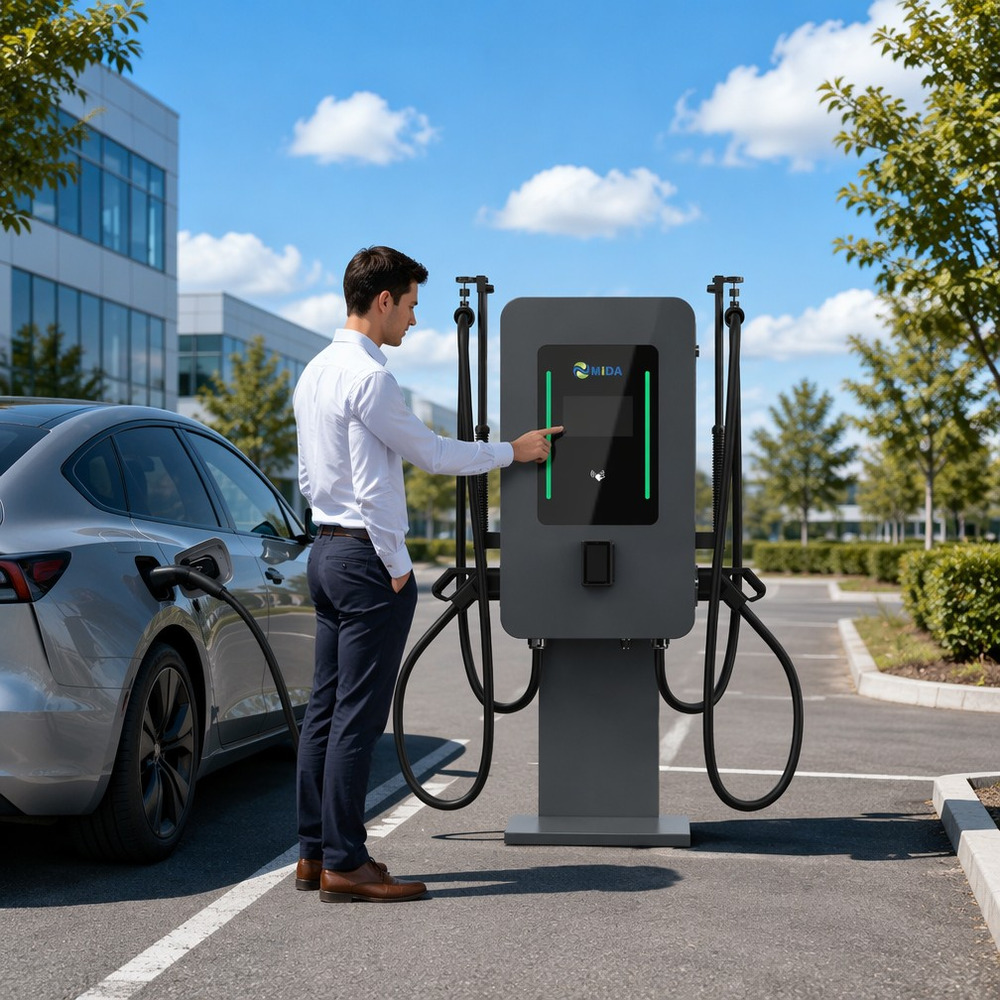
The Smart City 120kW Advertising Charging Station with 43-Inch Display is a strong fit for this exact scenario. Designed for office-building use, it pairs a 120kW DC fast charger with a high-brightness advertising display, allowing corporate communications teams to rotate welcome messages, safety notices, sustainability dashboards, and local community content without any hardware intervention.
2.2 Employee Experience and Retention
The employee perspective is equally strategic. Workplace charging is consistently ranked among the most valued benefits by EV-driving employees, and the availability of charging is a decisive factor for many when choosing between job offers. When that charging experience is branded and well-designed, it reinforces pride in the employer and signals that the company invests in the daily realities of its people.
For hotel and hospitality groups operating corporate-adjacent facilities, the same logic applies to guests. A waterproof 120kW Advertising Charger with Smart LCD Screen at a hotel parking area communicates the brand’s commitment to sustainable travel while generating incremental revenue from charging fees and on-screen promotion of hotel services, restaurants, and local partnerships.
3. Matching Hardware Design to Corporate Identity
Brand consistency extends to the industrial design of the charging hardware itself. A premium corporate brand deploying beige, utilitarian charging cabinets will undermine its own aesthetic standards; the same brand deploying a unit with an integrated display, controlled illumination, and a clean form factor reinforces them. The table below summarizes the key design dimensions to evaluate when selecting branded charging hardware.
| Design Dimension | Brand Impact | Recommended Specification |
|---|---|---|
| Display size and resolution | Message legibility and premium feel | 43″ to 55″ full-HD or 4K panels |
| Display brightness | Visibility in direct sunlight | ≥ 1500–2500 nits |
| Enclosure finish | Alignment with brand aesthetics | Powder-coated steel, customizable color |
| Ingress protection | Longevity and appearance retention | IP54 or higher |
| Media management | Ability to update content centrally | Cloud CMS with scheduling and zoning |
Beyond aesthetics, the physical footprint matters. Floor-standing designs with integrated screens occupy roughly the same space as conventional fast chargers while adding the display as a functional layer. This means brands can achieve a premium visual presence without sacrificing parking efficiency — a consideration that matters in constrained urban sites and campus garages.
4. The Sustainable Charging Ecosystem
A single branded charger is a good start; a coherent ecosystem is a strategic asset. The most sophisticated corporate deployments combine several layers:
- On-site solar and storage integration: Charging stations paired with photovoltaic canopies and battery buffers maximize the share of renewable energy delivered to vehicles, strengthening the sustainability narrative.
- Load management: Smart power distribution prevents expensive grid upgrades by sharing capacity intelligently across multiple dispensers.
- Cloud management and reporting: Platforms that aggregate energy consumption, session data, and media performance give the sustainability team the numbers it needs for ESG reporting and investor communications.
- Branded media content: Screens that rotate between corporate messaging, sustainability metrics, and partner advertising turn infrastructure into a communication network.
For multi-site corporations, the Large Screen 60kW–180kW Advertising Station with Cloud Management is particularly relevant. Its cloud management system allows a headquarters marketing team to push new brand campaigns to every site simultaneously, ensuring that the corporate identity remains consistent across offices, plants, and logistics hubs in different cities — or different countries.
5. Measuring Brand Impact: KPIs Beyond kWh
Charging infrastructure is typically justified with operational metrics: energy delivered, utilization rate, and payback period. For corporate branding initiatives, the measurement framework must be broader. The table below maps brand objectives to measurable indicators.
| Brand Objective | Measurement Approach | Example Indicator |
|---|---|---|
| Sustainability visibility | Media impressions on integrated screens | Screen views per month per site |
| Employee EV adoption | Session data correlated with headcount | Unique vehicles charging per week |
| ESG reporting | Energy and carbon accounting | kWh delivered from renewable sources |
| Partner engagement | Advertising revenue or barter value | Local ad inventory utilization |
| Reputation | Sentiment and press mentions | Media coverage of campus EV program |
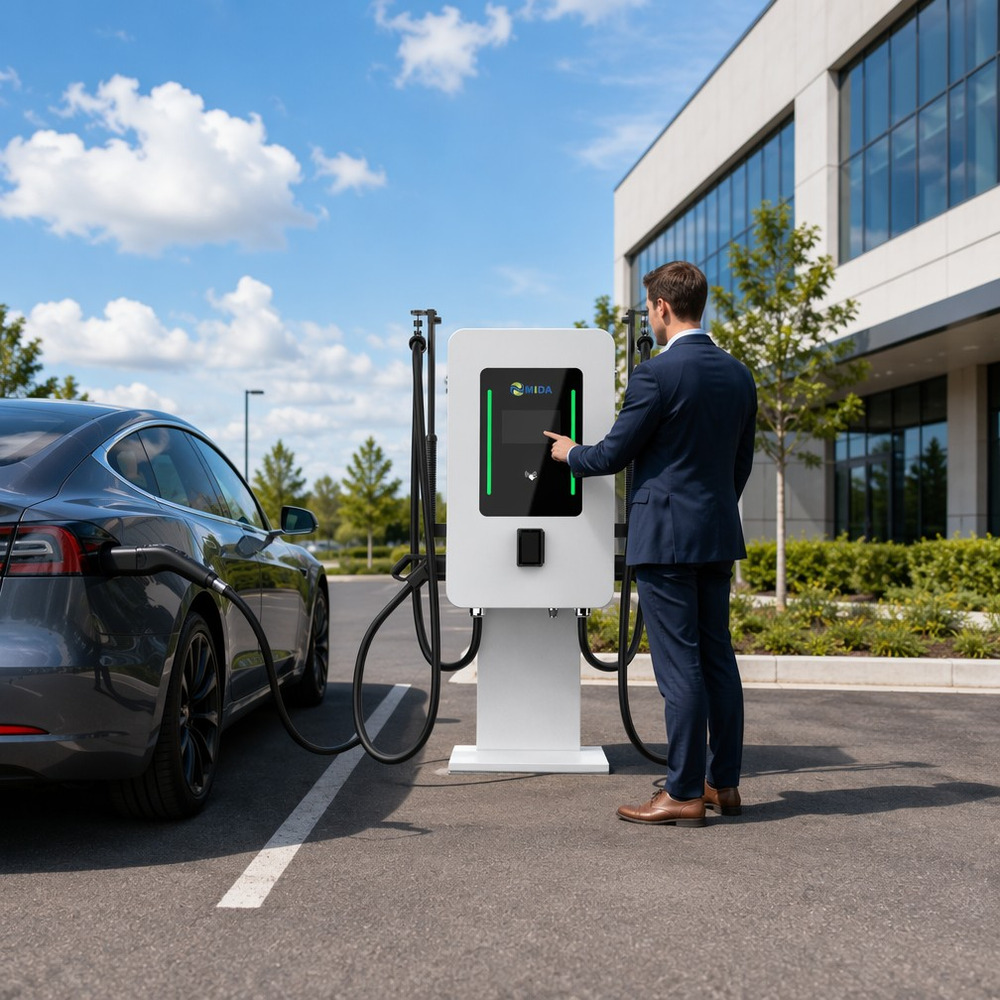
Notably, integrated screens convert the sustainability program into measurable media inventory. A corporate campus with a 43-inch display at each charging bay can quantify brand impressions with the same rigor as a digital out-of-home campaign — giving the marketing department a concrete, attributable asset rather than a vague CSR talking point.
6. From Cost Center to ESG Asset
The financial narrative has shifted as well. Early corporate charging programs were treated as employee perks — a cost center justified by retention. In 2026, well-designed programs generate their own economics. Charging fees can be structured to cover operational costs, while screen-based advertising to local businesses, suppliers, and even adjacent retail partners creates incremental revenue. Combined with renewable energy attributes, the infrastructure contributes positively to the company’s ESG scorecard and, in some jurisdictions, to carbon credit programs.
Regulatory tailwinds reinforce the case. European Union directives under the AFIR framework, national EV-readiness requirements for new commercial buildings, and local green-building certification schemes increasingly treat workplace charging as a prerequisite rather than an option. Companies that deploy branded charging infrastructure now are not merely ahead of regulation — they are shaping the perception of their brand in the markets where they operate.
7. Deployment Scenario: A Corporate Headquarters Retrofit
To make the concept concrete, consider a typical scenario. A multinational company with 800 employees at its headquarters decides to retrofit its parking structure with branded charging. The planning team defines three goals: support the growing EV share of the workforce, demonstrate sustainability leadership to clients, and create a recurring media channel for corporate and partner content.
The deployment chooses a mix of power tiers. A set of 60kW and 120kW units serves employee top-up needs with reasonable rotation, while a small number of higher-power bays handles visitor and executive fast-charging requirements. Each unit carries the company’s brand identity on its enclosure and a 43-inch display for messaging. The Commercial Advertising EV Charger in 60kW–120kW with APP Operation and Floor-Stand Design fits this mixed model well, providing APP-based access control for employees while keeping visitor charging simple and secure.
Within the first quarter, the company reports measurable outcomes: a double-digit percentage increase in employee EV commuting, positive feedback from visiting clients, and a new revenue line from local advertisers renting screen time. The sustainability team extracts session-level data for its annual ESG disclosure, and the marketing team treats the screens as a permanent, zero-media-buy channel for corporate announcements.
8. How to Select the Right Branded Charging Solution
Selection should follow a structured process rather than a single specification sheet. The sequence below reflects best practice observed across successful corporate deployments:
- Audit the fleet and workforce: Determine the current and projected EV share among employees, visitors, and light commercial vehicles.
- Assess electrical capacity: Identify available power, and plan load management where capacity is constrained.
- Define the brand experience: Specify display size, brightness, enclosure finish, and content strategy before hardware procurement.
- Evaluate management software: Confirm cloud media management, OCPP compliance, access control (RFID, APP, or card), and reporting capabilities.
- Model the economics: Combine charging revenue, advertising revenue, ESG benefits, and grid upgrade costs into a five-year total cost of ownership.
Throughout this process, prioritize vendors that treat branding as a first-class requirement rather than an afterthought. Charging stations with integrated, high-brightness displays, robust ingress protection, and cloud-based content management will serve the brand for a decade — while cheaper, display-less alternatives lock the organization into a purely utilitarian footprint that communicates nothing.
9. Frequently Asked Questions
Q1. How do branded EV chargers improve corporate sustainability reporting?
They generate verifiable operational data — energy delivered, renewable share, and session counts — that feeds directly into Scope 2 calculations and ESG disclosures. The visible infrastructure also demonstrates the commitment behind the numbers.
Q2. Can a single corporate site generate advertising revenue from its charging screens?
Yes. Local businesses, suppliers, and recruitment partners are natural advertisers for campus screens. Even a modest single-site network can offset operating costs, while multi-site portfolios create meaningful media inventory.
Q3. What power level should a corporate campus choose?
For employee top-ups, 60kW to 120kW provides strong turnover at reasonable grid cost. If visitor fast-charging or fleet support is required, 180kW to 240kW bays are justified. Mixed deployments are common and recommended.
Q4. How is branded content updated on the displays?
Through the cloud management platform. Marketing teams schedule playlists, rotate campaigns, and localize content per site remotely — typically without any on-site technical support.
Q5. Do branded screens consume significant power when not charging?
Modern panels use low-power standby modes and scheduled on/off profiles. Consumption is a small fraction of charging energy and is far outweighed by the communication and revenue value of the display.
Q6. Are these stations compatible with existing access control systems?
Professional units support RFID, APP-based access, and OCPP integration, so they can be embedded into existing employee badge systems or fleet management platforms with minimal integration effort.
Q7. How long does it take to install a branded charging station?
Typical installations complete in one to two days per site once electrical infrastructure is ready, with commissioning and content upload handled remotely through the cloud platform.
Post time: Aug-25-2026