
Global EV Trends: The Integration of Multimedia in Charging Networks
Quick Answer: The global EV charging market has crossed the threshold from plug-and-charge utility to multimedia platform, and 2026 tenders now treat digital signage, cloud content management, and charging hardware as a single specification rather than separate line items. The integration of multimedia in charging networks is driven by three converging forces: operators need second revenue lines because energy margins alone do not cover network economics; drivers expect charging stops to inform and entertain rather than dead-time; and cities and venues demand infrastructure that communicates—wayfinding, safety, and commercial messaging—alongside delivering power. Regionally, Europe leads in standardization-driven integration, North America scales it through retail and hospitality partnerships, Asia-Pacific drives high-volume hardware adoption, and the Middle East is specifying multimedia charging as a flagship amenity in destination projects. The technology stack that makes this possible is mature and portable: OCPP 1.6J/2.0.1 control planes, 4G/WiFi/Ethernet connectivity, Android-based 4K display players, and multi-credential payment—all packaged in IP54-rated, 60kW–400kW DC hardware.
Key Takeaways:
- Multimedia is now a scoring criterion — global RFPs increasingly require integrated displays and cloud content management, not optional add-ons.
- Energy margin alone is insufficient — operators across regions use media revenue, sponsored sessions, and data-driven services to close the network business case.
- One global stack, many local formats — OCPP control, Android 4K players, and multi-credential payment travel across regions while content adapts to local languages and regulations.
- Venue type shapes the spec — highway, retail, hospitality, and public-hub deployments each favor different power classes and screen formats.
- Interoperability protects the asset — standards compliance keeps stations inside roaming networks, energy systems, and future grid services for a 10-year asset life.
From Plugs to Platforms: The Multimedia Inflection
The history of public EV charging is short and decisive. The first generation was dumb hardware: a connector, a meter, and a payment terminal. The second generation added connectivity: OCPP, roaming, and remote management. The third generation, which is defining 2026, adds a media surface and an application layer: every charger is also a screen, and every screen is a channel for revenue, information, and engagement. The industry has moved from selling kilowatt-hours to operating platform assets, and the hardware specification has moved with it.
The numbers behind the inflection are straightforward. Utilization is the single biggest driver of charging-network profitability, and multimedia directly attacks the two utilization constraints: dwell-time value and idle-time waste. A driver who is informed, entertained, or receiving a promotional offer is more likely to choose the station again; a station that earns media revenue while idle is worth keeping online even in low-traffic hours. Networks that integrate multimedia therefore report better per-station economics than networks that compete on energy price alone, which is why the integration has become a global trend rather than a regional experiment.
Regional Adoption Patterns
Multimedia integration is global, but it is not uniform. Each region arrived at the trend through a different route, and the differences matter for suppliers and operators planning cross-border rollouts.
Europe: Standardization as the Driver
Europe leads because its charging market matured under strong standardization. OCPP compliance is effectively mandatory, roaming is normal, and the network economics are tight enough that operators adopted supplementary revenue early. European RFPs routinely score digital signage and content-management capability, and cities treat integrated displays as part of the civic furniture. The European pattern is: standards first, multimedia as the differentiator on top of a compliant core.
What Standardization Produces
Compliant cores make multimedia the differentiator rather than a compliance risk.
North America: Retail and Hospitality Partnerships
North America scales multimedia charging through the retail and hospitality sectors. Malls, supermarkets, hotels, and mixed-use developments deploy advertising chargers because the real-estate owner captures the media revenue and the traffic effect, and because the network operators prefer host-owned hardware to leased utility boxes. The North American pattern is: host economics first, with multimedia as the revenue engine that makes host ownership rational.
Asia-Pacific: High-Volume Hardware Adoption
Asia-Pacific, led by China, moves the highest hardware volumes and ships the most advanced integrated units per capita. The region’s manufacturing ecosystem compresses cost curves, which has pushed integrated advertising stations down-market and made them the default commercial format. The Asia-Pacific pattern is: volume and cost leadership, with multimedia as a standard feature rather than a premium option.
Middle East: Flagship Destination Amenity
The Middle East treats multimedia charging as a flagship amenity in destination projects: resorts, mega-malls, and smart-city districts specify high-power stations with large displays because the charging stop is part of the guest experience. The regional pattern is: experience-led specification, where screen size and content quality matter as much as power output.
| Region | Primary Driver | Typical Format | Dominant Spec Emphasis |
|---|---|---|---|
| Europe | Standardization & tight margins | Public hubs, civic sites | OCPP compliance, civic content quotas |
| North America | Host & retail economics | Malls, supermarkets, hotels | Media revenue, dual-gun throughput |
| Asia-Pacific | Volume & cost curves | Commercial lots, city streets | Integrated display as standard |
| Middle East | Destination experience | Resorts, mega-malls, smart districts | Large screens, premium finish |
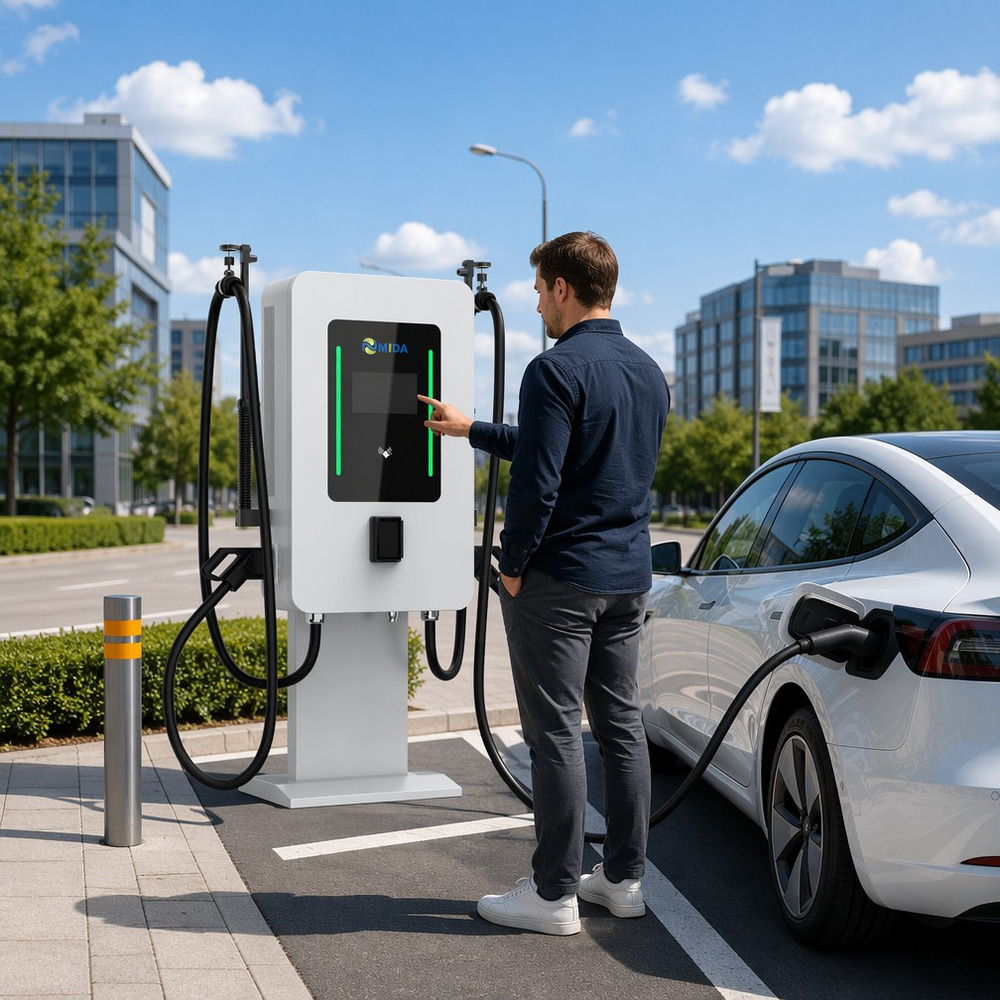
What Multimedia Brings to the Charging Network
The integration of multimedia changes the network P&L in three ways that show up in every regional model: a second revenue line, a better user experience, and a richer data relationship with the grid and the city.
Revenue Diversification
Media revenue converts screen time into cash. A 55-inch display at a high-traffic station generates verified impressions that local brands, venue tenants, and programmatic DOOH networks will pay for; sponsored-session models add a third line where an advertiser funds the driver’s charge in exchange for engagement. The 180kW dual-gun advertising pile with a large screen is the reference configuration for this revenue model at commercial parking lots, where the combination of two-vehicle throughput and a commanding display maximizes both session count and impressions.
User Experience and Station Choice
The driver experience determines station choice and loyalty. A station that shows wait times, local services, and venue information feels safer and more useful than a bare cabinet, and drivers route toward that certainty. Hospitality is a particularly clear example: the waterproof 120kW station with a smart LCD screen for hotel parking areas turns the charging stop into a concierge touchpoint, displaying hotel services, local directions, and offers while the guest charges—experience features that drive return stays and direct bookings.
Grid and City Intelligence
The connected display is also a data node. Session data feeds load forecasting and tariff optimization; the screen can communicate grid signals—price windows, demand events—to drivers in real time; and cities gain a communication channel that works when phones are unreliable. These functions make multimedia stations more valuable to grid operators and municipalities than single-purpose hardware, which is why they increasingly appear in energy and smart-city programs.
The Technology Stack Driving Integration
The global trend is enabled by a technology stack that is standardized enough to travel across regions and flexible enough to adapt locally. Four components define the stack in 2026:
| Layer | Technology | Why It Matters Globally |
|---|---|---|
| Charging control | OCPP 1.6J / 2.0.1, 1000V DC | Roaming, energy management, future grid services |
| Media playback | Android 4K player, 32–55″ high-brightness panel | Local content formats, OTA updates, DOOH integration |
| Connectivity | 4G / WiFi / Ethernet | Works in any market’s network environment |
| Identity & payment | RFID, mobile APP, POS | Covers fleets, roaming apps, and walk-up users |
The 400kW public charging station with digital signage exemplifies the flagship end of this stack: transport-hub power density, a 55-inch advertising surface, and full protocol compliance in a single floor-mounted unit. At the destination end, the dual-connector 360kW floor-mounted station with a digital display shows how the same stack scales to resort and destination venues, where dual connectors and premium presentation matter most.
Use Cases by Venue Type
The global trend manifests differently by venue, and buyers should map their requirement to the venue archetype before specifying hardware:
- Highway corridors — 360kW+ ultra-fast stations with 55-inch displays; content mixes brand advertising with wayfinding to services; throughput and visibility are the priorities.
- Retail and supermarkets — 120–240kW dual-gun units; content is merchandising and time-limited offers; redemption tracking ties the screen to the sales floor.
- Hospitality and resorts — 120–360kW waterproof units with smart displays; content is concierge-style services, directions, and offers; experience is the product.
- Public and civic hubs — 120–400kW units with civic content quotas; content mixes safety alerts, wayfinding, and municipal messaging with commercial inventory.
- Fleet depots — 60–240kW units with RFID access; content is shift communication, load management, and idle-window advertising.
| Venue | Power Class | Screen | Content Priority |
|---|---|---|---|
| Highway | 360–400kW | 55″ | Brand ads + service wayfinding |
| Retail | 120–240kW | 43–55″ | Merchandising + offers + redemption |
| Hospitality | 120–360kW | 43–55″ | Concierge services + directions |
| Civic / public | 120–400kW | 32–55″ | Safety alerts + wayfinding + municipal |
| Fleet depot | 60–240kW | 32–43″ | Shift comms + load status + ads |
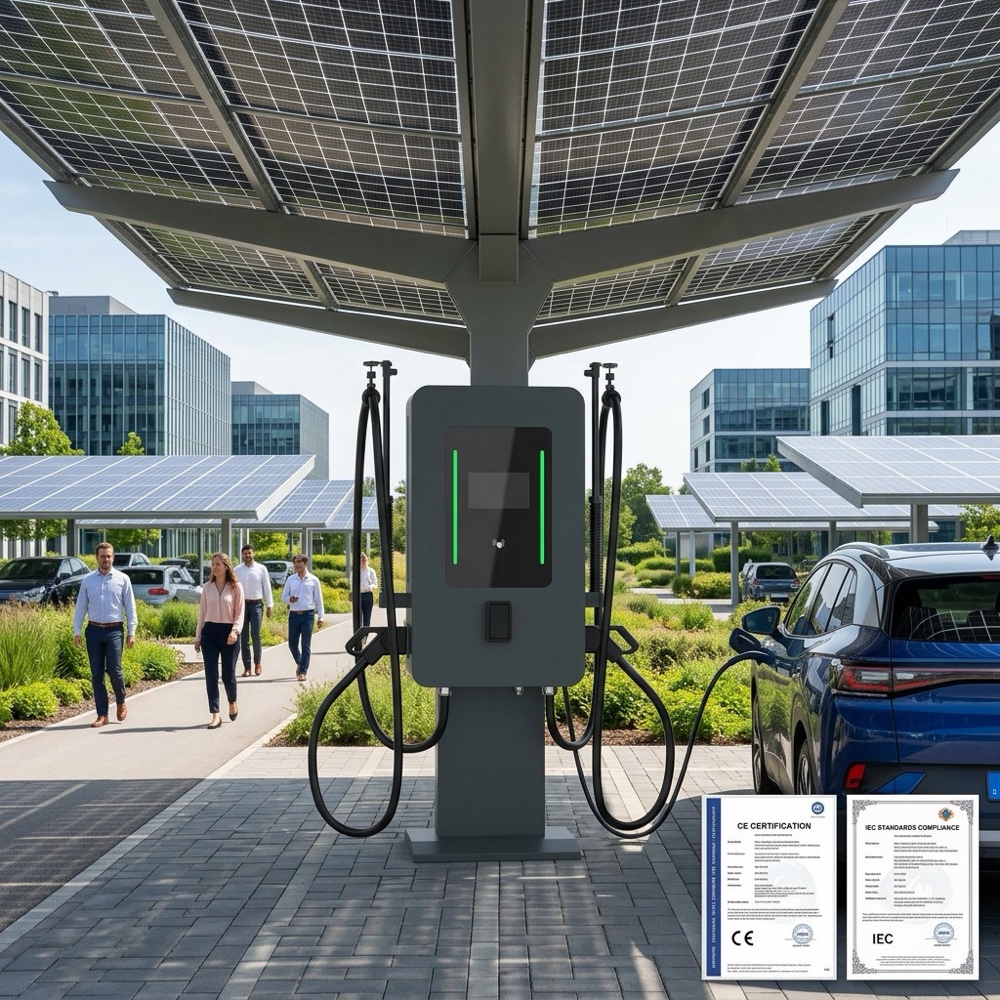
Standards and Interoperability as a Global Requirement
For multinational operators and export-minded suppliers, interoperability is the difference between a global product and a regional one. OCPP 1.6J and 2.0.1 compliance is the baseline that lets a station join any roaming network and any energy-management platform; 4G/WiFi/Ethernet connectivity removes dependence on any single carrier; and multi-credential payment covers the payment habits of every market. The 180–240kW multimedia display stations for supermarket use illustrate the interoperable approach in the retail channel: OCPP-certified cores, cloud-managed Android displays, and CE certification that smooths market entry across regulated jurisdictions.
Standards also protect the 10-year asset life. Charging hardware deployed in 2026 will still be operating when the next protocol revisions, new grid services, and new content formats arrive. Hardware with field-upgradeable firmware, Android-based media players, and documented certification can absorb those changes; proprietary, closed systems cannot. Buyers who weight interoperability in their 2026 specifications are not just buying today’s station; they are buying the right to participate in tomorrow’s network.
What Buyers Should Specify in 2026
Global buyers translating the multimedia trend into a tender should lock the following requirements into the specification:
- OCPP 1.6J and 2.0.1 as mandatory, with certification documents required at bid stage.
- Integrated high-brightness 4K display sized to the venue (32–55 inches), with outdoor rating for open sites.
- Cloud content management with role-based access, scheduling, and OTA updates.
- Dual-gun intelligent power distribution and 1000V DC output to cover mixed vehicle populations.
- Multi-credential payment — RFID, mobile APP, and POS—with roaming compatibility.
- IP54 or better enclosure and 24/7-rated components for the intended climate.
- Regional certifications (CE, and market-specific marks) confirmed before award.
- A content-operations plan — who produces, schedules, and sells the screen inventory—agreed before commissioning.
FAQ
1. Why is multimedia integration becoming a global EV charging trend?
Because energy margins alone rarely cover network economics. Integrated displays add a second revenue line, improve driver experience and station choice, and give cities and grids a communication channel—three benefits that single-purpose hardware cannot deliver.
2. Which regions are adopting multimedia charging fastest?
Europe leads through standardization and civic RFPs; North America scales through retail and hospitality host economics; Asia-Pacific leads in hardware volume; the Middle East specifies it as a flagship destination amenity. All four regions converge on the same OCPP-based technology stack.
3. Does multimedia integration require proprietary software?
No. The AD20-series approach is standards-based: OCPP 1.6J/2.0.1 for charging, Android-based 4K players for content, and 4G/WiFi/Ethernet connectivity, which keeps the station compatible with roaming networks, energy systems, and third-party content platforms.
4. How do operators make money from charging screens?
Through advertising sold directly to local brands or via DOOH programmatic networks, and through sponsored sessions where an advertiser funds the charge in exchange for engagement. Both lines scale with network size and location quality.
5. What power class is best for a global rollout?
There is no single answer; power should match the venue. Highway and hub sites favor 360–400kW; retail and supermarket sites favor 120–240kW; hospitality and mixed-use sites span 120–360kW; depots favor 60–240kW. Dual-gun distribution is recommended across all classes.
6. Are multimedia charging stations weather-proof for outdoor use?
Yes. The units are IP54-rated with 24/7-rated components, and screens are high-brightness outdoor panels that remain legible in direct sunlight, so no shelters or additional enclosures are required.
7. What should a 2026 tender require for future-proofing?
Mandate OCPP 1.6J/2.0.1 compliance, field-upgradeable firmware, Android-based media players, and documented CE and market-specific certifications. These protect interoperability, roaming access, and the asset’s ability to absorb future protocol and content-format changes.
Conclusion: The Network as a Media Platform
The integration of multimedia in charging networks marks the third generation of EV infrastructure, and the trend is now global. Operators no longer ask whether stations should carry displays; they ask which power class, screen format, and content model each venue requires. The technology that makes the trend portable is mature: OCPP control planes, Android 4K players, 4G/WiFi/Ethernet connectivity, and multi-credential payment, packaged in IP54-rated DC hardware from 60kW to 400kW. From 180kW dual-gun commercial piles anchoring retail lots, to 360kW destination stations anchoring resorts, to 400kW public hubs anchoring cities, the same architecture now serves every venue on the map. In 2026, the winning charging network is the one that treats every station as both a power connection and a communication channel—and the global evidence says that network is already being built.
Post time: Aug-25-2026