
How Cloud-Based Media Management Boosts Charging Station Revenue
Quick Answer: Advertising-equipped EV charging stations generate revenue in two layers: electricity sold and media displayed. The second layer is only as valuable as the software that controls it. Cloud-based media management platforms let operators update content across an entire charging network in seconds, schedule campaigns by time and location, and measure playback with the same rigor as digital out-of-home advertising. For a station operator, this transforms screens from static decoration into a programmatically manageable revenue asset — unlocking higher advertising rates, lower operating costs, and new revenue models such as dynamic pricing and sponsored charging. In 2026, the competitive difference between charging networks is defined less by hardware power and more by the intelligence of the cloud layer that manages it.
Key Takeaways
- Cloud media management separates the hardware investment from the content business: operators buy a screen once and sell its time many times.
- Centralized scheduling and zoning let a single team manage hundreds of screens across regions without on-site visits, cutting content-operations costs dramatically.
- Playback analytics provide advertisers with verifiable impressions, supporting premium ad rates and repeat bookings.
- Integration with OCPP creates a single operational platform where energy data and media data live together — enabling dynamic pricing and sponsored charging campaigns.
- Cloud-managed networks can repurpose screens for public information, safety alerts, and partner content, increasing both utility and revenue.
1. The Software Layer Is the Revenue Layer
When operators evaluate advertising charging stations, the instinct is to compare hardware: power output, connector count, display size. These matter, but they define only the ceiling of the asset’s potential. The floor — and the realized value — is set by software. A 55-inch display that requires a technician with a USB stick to update content is worth a fraction of an identical display managed through a cloud platform, simply because the cloud version can be sold, scheduled, and verified at scale.
The revenue logic is straightforward. Charging income is capped by energy prices, session volumes, and utilization. Media income, by contrast, scales with the quality of the audience, the number of screens, and the flexibility of the inventory. A cloud-managed network of screens can sell national campaigns, regional spot packages, and local targeted slots simultaneously — an impossible task with manual content management.
2. What Cloud-Based Media Management Actually Does
A professional cloud media management system for advertising chargers delivers five core capabilities:
- Remote content distribution: Push videos, images, and HTML5 playlists to any screen or group of screens in real time, without physical access.
- Time-based and zone-based scheduling: Define when content runs (rush-hour slots, night cycles) and where (all screens in a city, a single mall, or a specific bay).
- Playlist sequencing: Chain multiple content items — brand spot, then local offer, then safety message — into structured loops that match dwell time.
- Playback monitoring and analytics: Confirm every screen is online and playing the right content, and log impression-level proof for advertisers.
- Integration with charging operations: Link media control with OCPP telemetry, so campaigns can be triggered by events such as charging session start or site occupancy thresholds.
These capabilities directly shape revenue. Campaign flexibility justifies higher CPM rates. Verified playback attracts national advertisers who refuse to buy unverifiable inventory. And remote management removes the single largest operating cost of distributed signage: the human visit.
3. OCPP Plus Media: One Platform, Two Pipelines
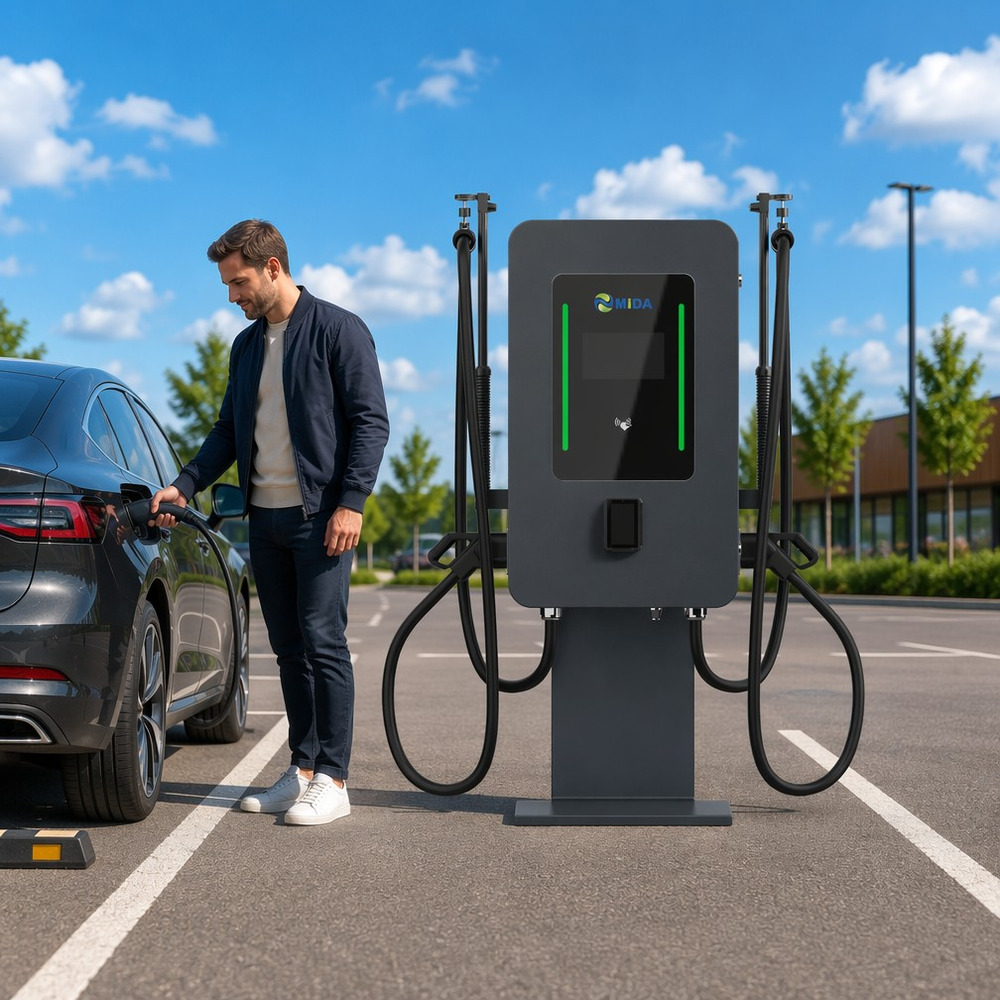
The most efficient charging networks run both energy and media through an integrated management stack. The charging pipeline uses OCPP (Open Charge Point Protocol) — typically version 1.6J or 2.0.1 — to handle session start, metering, billing, and diagnostics. The media pipeline runs through the cloud CMS. When the two are unified, operators gain capabilities that neither system delivers alone:
- Dynamic content triggers: Show a welcome animation when a session begins, or display wait-time messaging when all bays are occupied.
- Sponsored charging: An advertiser funds a charging session in exchange for a full-screen experience — a model that increases utilization while generating media revenue.
- Load-aware messaging: Communicate energy pricing periods or site status directly on the dispenser screen, reducing support calls.
- Unified reporting: Correlate session data with content playback to prove to advertisers exactly what ran when, and to optimize content by site performance.
The Large Screen 60kW–180kW Advertising Station with Cloud Management System is architected around exactly this convergence: the cloud platform manages both charging operations and media playback, giving operators a single source of truth for energy and advertising.
4. Revenue Models Enabled by the Cloud Layer
Once media management is cloud-native, the list of monetizable products grows well beyond “sell a static ad slot.” The table below summarizes the primary revenue models available to operators.
| Revenue Model | How It Works | Cloud Requirement |
|---|---|---|
| Local ad slots | Nearby businesses rent screen time | Zone-based scheduling and billing |
| National campaigns | Brands buy corridor- or country-wide packages | Network-wide playlist distribution |
| Sponsored charging | Advertiser pays for user sessions | OCPP-media event integration |
| Public information | Municipalities contract for alerts and wayfinding | Priority content tiers and templates |
| Dynamic pricing display | Real-time energy pricing shown on screen | Telemetry-driven content updates |
| Data-driven optimization | Adjusted inventory pricing by time and site | Playback analytics dashboards |
The Smart Advertising EV Charger 120kW–180kW with OCPP 1.6J and Dual Plug illustrates the hardware side of this strategy in retail settings: dual connectors keep bays busy, OCPP 1.6J guarantees network interoperability, and the integrated smart display carries whatever content mix the operator’s cloud platform dictates.
5. Manual versus Cloud: The Operating Cost Story
The revenue upside of cloud management is matched by an operating-cost story that is often the deciding factor in network expansion. Consider a regional operator with 50 advertising stations across 15 sites. With manual content management, updating a campaign means dispatching a technician to every screen — 50 visits, several days, and significant labor cost per campaign cycle. With cloud management, the same update is a playlist change executed in minutes from a laptop.
| Operation | Manual Management | Cloud Management |
|---|---|---|
| Campaign update (50 screens) | 50 site visits, 2–4 weeks | One upload, minutes |
| Content localization per site | Technically impractical | Zone rules, instant |
| Playback verification | Spot checks, photos | Continuous, logged |
| Advertiser reporting | Manual spreadsheets | Automated dashboards |
| Emergency messaging | Not possible at scale | Broadcast in seconds |
The cost difference compounds with every campaign and every site added. Operators who standardize on cloud-managed hardware from the first deployment — rather than retrofitting later — capture the full benefit from day one.
6. Deployment Scenario: A Multi-Site Retail Network
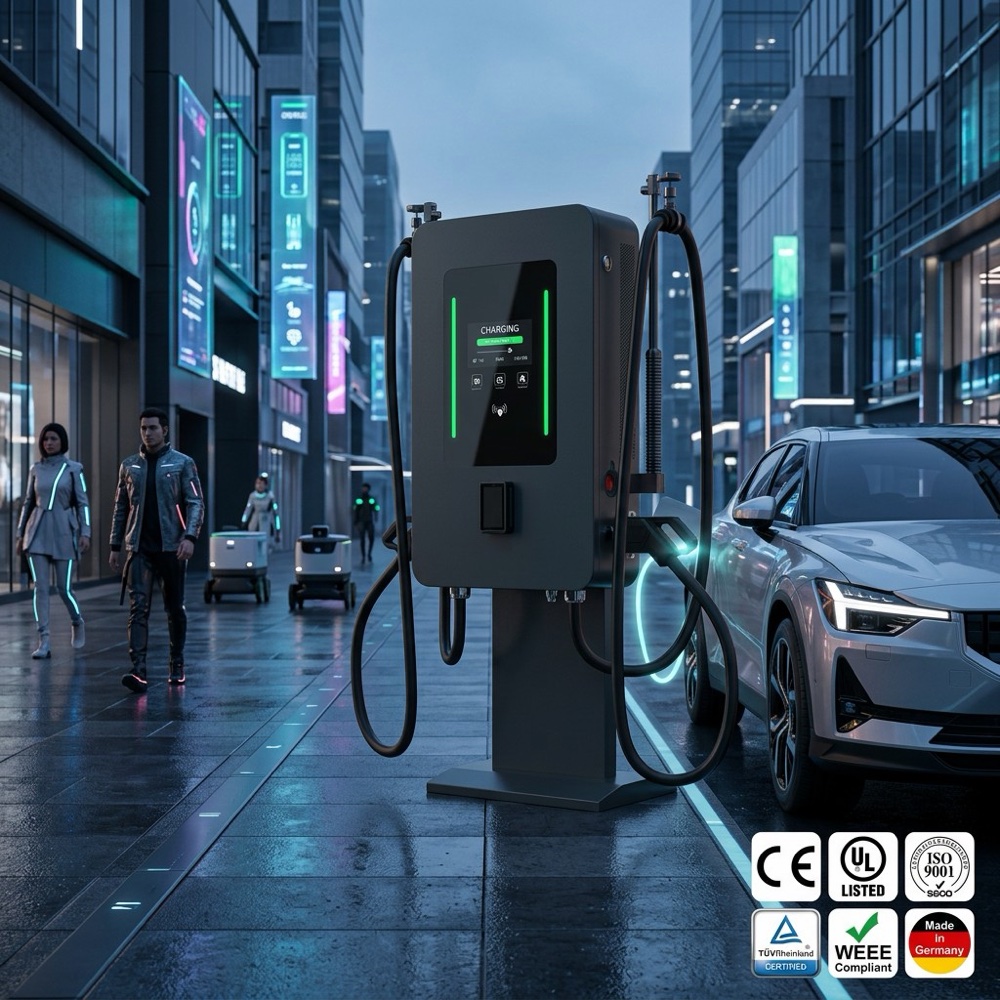
Imagine a shopping mall operator managing charging stations across ten locations. Each location hosts two to four advertising chargers. Before cloud management, the operator sold ad space only to a local business at each mall, updated content quarterly, and had no playback proof. Media revenue was negligible.
The operator migrates to a cloud-managed platform. A national beverage brand now buys a corridor-wide package covering all ten sites. A regional bank buys morning and evening commute slots at the three busiest locations. Each mall’s own tenants get discounted local slots, strengthening tenant relationships. The operator’s marketing team creates a single seasonal content pack that is distributed to all screens in one upload, with site-specific localization applied automatically.
The operator also activates sponsored charging: a coffee chain funds 500 charging sessions per month across the network, each session preceded by a 30-second branded sequence. Utilization rises, customers perceive added value, and the coffee chain gains a measurable channel to precisely the audience it wants — EV-driving mall visitors. Within two quarters, media revenue at the network reaches a material double-digit percentage of total charging income.
For operators replicating this model, the High Power 240kW Station with Advertising Screen and OCPP is a strong anchor for high-traffic locations, while smaller 60–120kW units with cloud management fill the mid-tier sites — a tiered hardware strategy that optimizes capital while keeping a single software stack.
7. Choosing a Cloud-Managed Advertising Charger
Not all “cloud” implementations are equal. When evaluating platforms, operators should verify the following before committing:
- API and integration depth: Does the CMS integrate with OCPP telemetry, or are media and charging managed in separate silos?
- Content flexibility: Are playlists, HTML5 templates, live feeds, and emergency overrides supported?
- Analytics granularity: Can playback be verified per screen, per time slot, with exportable logs for advertisers?
- Zoning and permissions: Can a multi-team structure (head office, regions, local sites) manage content safely with role-based controls?
- Reliability and uptime: What happens when a screen loses connectivity — does it continue the last playlist, and does the platform alert the operator?
Hardware quality remains foundational — 60kW–120kW stations with 55-inch advertising LCD screens deliver the display real estate that makes premium ad inventory possible — but the platform determines how much of that hardware’s potential is converted into recurring revenue.
8. Security and Reliability in Cloud Media Operations
Because media management systems now control both revenue-bearing screens and public-facing communication channels, their security and reliability deserve the same scrutiny as the charging network itself. Operators evaluating platforms should insist on several non-negotiable characteristics. Role-based access control ensures that only authorized marketing and operations staff can publish content, preventing accidental or malicious interference with live campaigns. Content approval workflows add a second review layer for high-visibility or emergency messaging. Audit logs record every content change, upload, and schedule modification, creating a traceable history that supports both advertising billing disputes and internal governance requirements.
Reliability engineering matters equally. Professional media players store the active playlist locally, so a temporary network outage does not blank the screen or halt the campaign — the display continues playing, and the platform flags the connectivity loss for the operator. Scheduled content still switches on time using the player’s local clock, and queued updates synchronize automatically when the connection returns. For sites that operate around the clock, redundancy in power supply and player failover protects media uptime that advertisers have already paid for.
This combination of security controls and offline resilience is what separates a professional media platform from a hobbyist CMS. Operators should verify these capabilities in a live demonstration — not a slide deck — before committing a fleet of revenue-bearing screens to a platform. The cost of a single compromised or blanked screen at a flagship retail site can erase months of media margin.
9. Frequently Asked Questions
Q1. What is cloud-based media management for EV chargers?
It is a software platform that remotely controls the advertising screens integrated into charging stations — uploading content, scheduling playlists, monitoring playback, and reporting impressions across an entire network from one dashboard.
Q2. How does media management increase charging station revenue?
It makes screen inventory sellable at scale: national and regional campaigns become feasible, playback proof supports premium rates, and features like sponsored charging generate revenue directly tied to charging sessions.
Q3. Do I need separate systems for charging and advertising management?
No. The best platforms unify OCPP-based charging operations with media management, enabling event-driven content, unified reporting, and simpler operations.
Q4. Can content be different on every screen?
Yes. Zoning and localization rules allow each screen or site to run its own content mix, while central scheduling keeps the overall campaign consistent.
Q5. What happens to the screens if the internet connection fails?
Professional players continue displaying the last downloaded playlist offline and resume remote management automatically when connectivity returns, with the platform flagging any outage.
Q6. How do advertisers verify their campaigns actually played?
Cloud platforms log playback per screen and time slot, exporting reports that show exactly when and where each campaign ran — the same verification standard used in digital out-of-home media.
Q7. Is cloud media management suitable for a single-station deployment?
Yes. Even one advertising charger benefits from remote content updates and scheduled playlists — and the same platform scales seamlessly if the operator expands to a network later.
Post time: Aug-25-2026