
Maximize Mall Foot Traffic with High-Brightness DC Fast Chargers
Quick Answer: High-brightness DC fast chargers maximize mall foot traffic in 2026 by importing customers who would not otherwise visit and by converting a routine charging stop into a shopping visit. A 120kW–180kW charger with a high-brightness advertising display produces a 20–40 minute session window—the exact duration retail science associates with a coffee run, a quick-service meal, or a supermarket top-up—so every charging session becomes a measurable traffic event. The display matters twice over: high-brightness panels stay visible in daylight so the station itself acts as a beacon that pulls drivers from across the parking lot, and the same screen can push tenant promotions, wayfinding, and time-limited offers that drive redemption inside the mall. For property owners, the business case is straightforward: a dual-gun advertising charger can generate hundreds of additional visits per month per bay, and the screen inventory becomes a new advertising revenue line that offsets the hardware premium over conventional units.
Key Takeaways:
- Charging sessions equal foot traffic events — a 20–40 minute DC session is long enough for a purchase, short enough to keep the lot turning.
- High-brightness displays are the beacon — outdoor-rated panels visible in direct sunlight pull drivers from across the parking field and double as merchandising surfaces.
- Dual-gun throughput compounds the effect — two vehicles served simultaneously means two waiting customers per bay at peak times.
- Screens close the loop to the sales floor — time-limited offers and wayfinding on the charger display measurably lift redemption and basket size.
- Cloud management scales the program — OCPP 1.6J/2.0.1 platforms let mall operators run tariffs, promotions, and content across every store and entrance from one dashboard.
Why Foot Traffic Is the Real Currency of Retail
Mall economics run on visits per square meter, and every channel that delivers a visit at a predictable cost earns a place in the marketing mix. In 2026, EV charging has moved from amenity to acquisition channel: a mall with visible, high-throughput DC charging appears in in-car navigation, charging apps, and EV owner communities, and those appearances convert into cars in the lot. The difference between an advertising charger and a conventional one is that the advertising charger does not stop at acquisition; it actively merchandises the visit once the driver arrives.
The foot-traffic argument rests on three numbers every property owner can model. First, the charging session length: a 120kW–180kW DC session typically lasts 20–40 minutes, which is long enough for a meaningful purchase and short enough that the bay turns several times a day. Second, the visit rate: surveys of mall charging users consistently show that a majority combine charging with shopping, food, or errands, and that a meaningful share would not have visited the mall that day otherwise. Third, the repeat effect: EV drivers rank charger availability among the top factors in choosing where to shop, which means today’s installed base becomes tomorrow’s loyalty program.
The Mechanics of the Charging Visit
The charging visit is a distinct retail occasion, different from both the weekly shop and the browsing trip. The driver has a fixed, short window, a specific reason to be on site, and a phone that is about to be idle for half an hour. Retailers that design for this occasion capture value; retailers that ignore it capture only the parking fee.
Session Length and the Purchase Window
A 20–40 minute session maps neatly onto quick-service retail: a coffee and pastry run, a pharmacy pickup, a supermarket top-up basket, a meal at the food court. For grocers, the top-up basket is especially valuable because it carries higher margins than the weekly shop. The operator’s job is to shorten the distance between the charger and the storefront, both physically and psychologically: the charger should sit within a short, safe walk of the anchor, and the screen should tell the driver exactly what to do with the next half hour.
High-Brightness Visibility as an Acquisition Tool
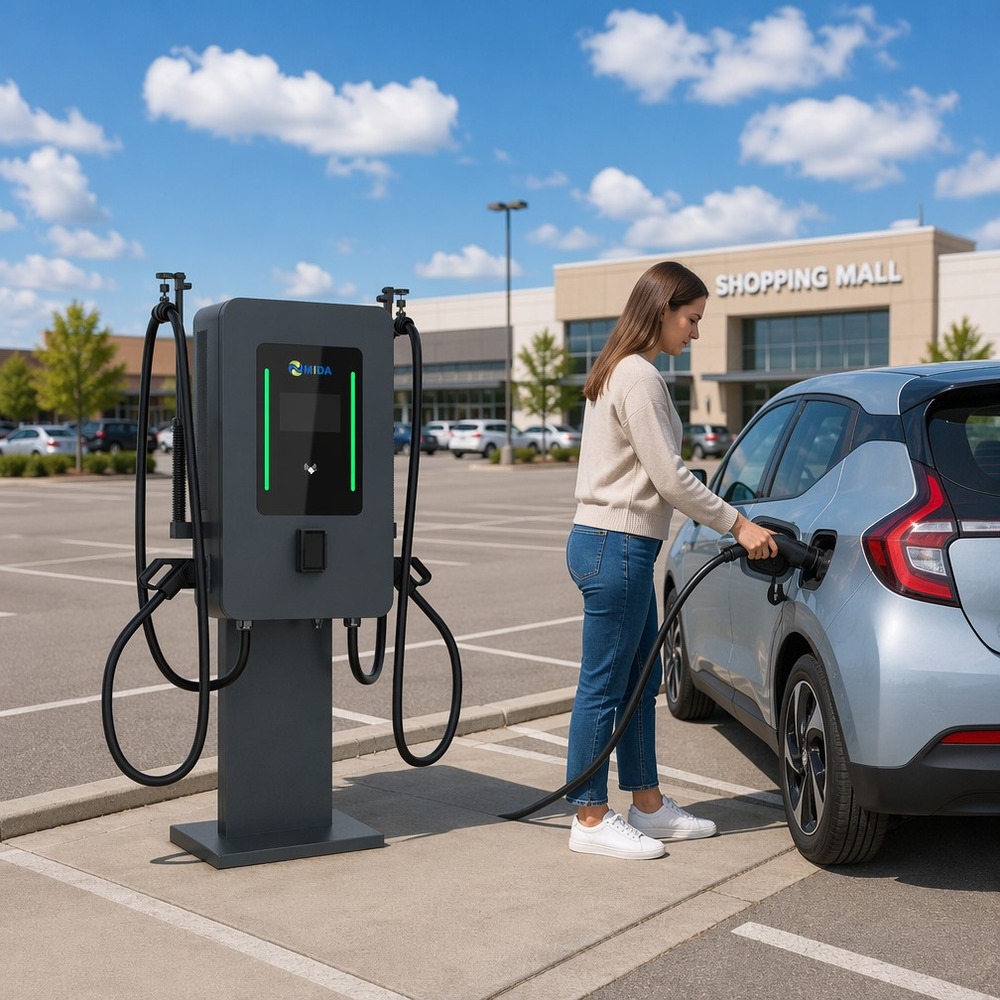
A charger that cannot be seen cannot acquire. Standard screens wash out in daylight and relegate the station to the status of an anonymous cabinet; high-brightness panels rated for outdoor use remain legible from across the parking lot, which turns the station into a beacon and the screen into a billboard. The 55-inch format in the AD20 series is visible at distances that let a driver approaching the mall’s entrance see the promotion before choosing a parking row—an effect no printed sign or wall-mounted LED board can replicate at the same cost. For malls competing with neighboring centers for the same EV-driving catchment, this visibility is the difference between being chosen and being bypassed.
| Session Stage | Duration | Retail Opportunity | Screen Action |
|---|---|---|---|
| Approach & park | 1–3 min | Beacon effect, impulse direction | Tenant promo + wayfinding loop |
| Session start (plug-in) | 0–2 min | First purchase decision | Time-limited offer push |
| Active charging | 20–40 min | Coffee, meal, top-up basket | Countdown + redemption QR |
| Return & unplug | 2–5 min | Return visit hook | Loyalty / next-visit offer |
Selecting the Right Hardware for a Mall Deployment
Hardware selection determines both the traffic yield and the operating economics, and malls differ enough that a single specification does not fit every zone. The 2026 selection process weighs power class, connector count, screen format, payment stack, and network compatibility as a combined decision.
Power Class and Dual-Gun Throughput
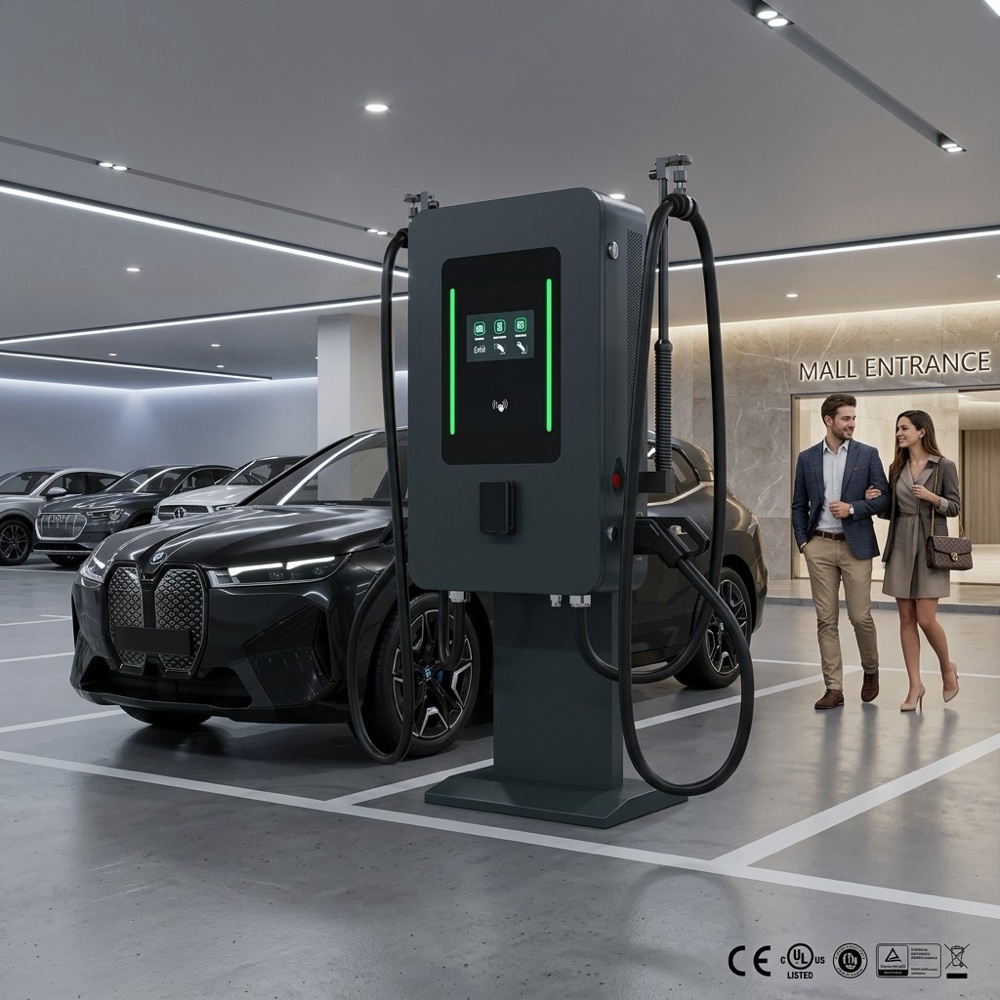
For a mall anchor lot, the 120kW–180kW bracket is the default because it balances session speed, grid cost, and bay turnover. The smart advertising EV charger for mall use, rated 120kW–180kW with OCPP 1.6J and dual plugs, is built around exactly this profile: two connectors on one unit mean two vehicles charging simultaneously, and at 1000V DC output both sessions complete within the target window. Dual-gun configuration is not a convenience feature; it is the difference between one waiting customer per bay and two, which directly multiplies the foot-traffic yield of every square meter of parking the mall commits to charging.
Screen Format and Placement
The screen format should match the viewing environment. Outdoor lots justify the 55-inch high-brightness format, while covered parking or mall entries can run 43-inch units with standard brightness. The 240kW dual-gun station with an advertising multimedia player screen suits high-traffic zones where a single unit must serve a long queue and a large audience simultaneously. Placement rules are simple: the screen faces pedestrian flow, the unit sits within 150–300 meters of the anchor or food court, and the charger is visible from the entrance drive aisle so the beacon effect works.
Placement Rules in Practice
Face the screen toward pedestrian flow and keep the unit within sight of the entrance aisle.
Payment and Network Compatibility
Mall customers arrive with different payment habits, so the station must accept RFID cards, mobile APP payments, and POS credit cards without friction. OCPP 1.6J/2.0.1 compliance keeps the station inside roaming networks and energy-management systems, and 4G/WiFi/Ethernet connectivity allows the property team to update tariffs and content remotely. The commercial advertising charger with APP operation and a floor-stand design illustrates the lighter end of the range for convenience and supermarket formats, where a smaller footprint and simpler grid connection outweigh raw power.
| Mall Zone | Recommended Class | Screen | Rationale |
|---|---|---|---|
| Anchor parking lot (outdoor) | 180–240kW, dual gun | 55″ high-brightness | Max throughput + beacon visibility |
| Supermarket / convenience entry | 120–180kW, dual plug | 43–55″ | Top-up baskets, short sessions |
| Covered parking / valet | 60–120kW, APP-based | 32–43″ | Grid-friendly, indoor brightness |
| Hotel & mixed-use adjacencies | 120kW waterproof | 43–55″ | Overnight + daytime sessions |
High-Brightness Displays as Merchandising Surfaces
The display is not decoration; it is a merchandising surface with a guaranteed audience and a known dwell time. A 20–40 minute session produces dozens of exposures per driver, and the format supports the full retail playbook: awareness (tenant branding), persuasion (time-limited offers), navigation (wayfinding to the store), and conversion (QR codes that redeem in-store or in-app).
Malls that operate the screen as a merchandising channel report the strongest results. The playbook pairs the charger display with the mall’s existing loyalty program: a charging driver sees a “20% off at the food court, redeem within 30 minutes” message, scans the code, and the redemption event is tracked back to the charging session. Because the AD20 series runs on Android-based 4K players with cloud content management, the property team can rotate offers by time of day, tenant, and traffic pattern without touching the hardware—the same platform that manages charging data manages the merchandising calendar.
The Promotion Playbook for Charging Zones
Property owners that treat charging zones as a merchandising channel follow a consistent playbook:
- Time-box every offer. “Valid during your charging session” converts urgency into action; open-ended offers produce no measurable lift.
- Couple the charger with the food court. The session window aligns almost perfectly with a quick-service meal; food-court redemption is the fastest way to prove foot-traffic value to tenants.
- Use wayfinding as the base layer. Before selling ad slots, the screen should always answer the driver’s first question: where do I go with my 30 minutes?
- Sell slots to tenants first, brands second. Tenant advertising keeps fill high, relevance local, and the sales process inside the mall.
- Track redemption end-to-end. QR codes and loyalty integration turn screen impressions into auditable purchase events, which is the data tenants and advertisers will demand.
- Refresh content on a schedule. A screen that shows the same offer for a month trains drivers to ignore it; weekly refresh keeps the merchandising surface alive.
Measuring Success: The KPI Framework
Mall operators measure charging zones with a KPI framework that bridges parking, retail, and media. The core metrics below allow a property team to report the zone’s contribution in the same language as the rest of the asset—visits, spend, and yield per square meter:
| KPI | Definition | 2026 Benchmark (Mall Context) |
|---|---|---|
| Sessions per bay per day | Completed charging sessions | 6–12 at 120–180kW with dual guns |
| Visits per session | % of drivers entering the mall | 60–80% in anchor-adjacent placements |
| Redemption per screen | QR/loyalty redemptions per week | Targeted promotions: 3–8% of sessions |
| Media yield per screen | Advertising revenue per quarter | USD 600–2,000 at retail fill rates |
| Bay payback | Months to recover capex | 24–36 months with media revenue |
Common Pitfalls and How to Avoid Them
The most common failure in mall charging programs is not hardware; it is placement and management. Chargers hidden in the far corner of the lot capture sessions but no foot traffic, and screens left on static content for months forfeit the merchandising value that justifies the hardware premium. The second most common failure is under-powering: a 60kW unit that serves one vehicle for an hour and a half produces almost no incremental visits, while the same bay at 180kW with dual guns produces a steady stream of short, shopping-ready sessions. The third failure is treating the screen as a cost rather than an inventory: malls that never assign a content owner and never sell the slots leave the revenue line on the table. Each of these failures is avoidable with the selection and operating practices described above, and each avoided failure is measurable in the KPI framework.
FAQ
1. How does a DC fast charger increase mall foot traffic?
A 120kW–180kW charger produces a 20–40 minute session, the ideal duration for a coffee, meal, or supermarket top-up. Drivers who charge at a mall are measurably more likely to enter the mall than drivers passing by, and repeat charging visits build a loyalty effect over time.
2. Why does high-brightness matter for a mall charger screen?
Outdoor lots are sunlit for most of the day. High-brightness panels remain legible in direct sunlight, so the station works as a visible beacon that pulls drivers across the parking lot and as a merchandising surface tenants can rely on.
3. What power rating should a mall choose?
120–180kW with dual plugs is the 2026 default for anchor lots; 180–240kW suits very high-traffic zones; 60–120kW suits covered parking and convenience formats where grid cost is the constraint.
4. Can a mall sell advertising on charging screens?
Yes. The screen inventory can be sold to tenants and local brands, and the same display carries mall-owned promotions, wayfinding, and loyalty offers. Well-managed screens generate a meaningful revenue line that shortens payback to 24–36 months.
5. How do drivers pay at mall charging stations?
AD20-series stations accept RFID cards, mobile APP payments, and POS credit cards, so walk-up shoppers and app-based EV drivers both have a frictionless path; OCPP 1.6J/2.0.1 compliance keeps the station in roaming networks.
6. How many cars can one dual-gun charger serve per day?
At 120–180kW with dual-gun intelligent distribution, a well-placed mall unit typically completes 6–12 sessions per bay per day, with both guns serving simultaneously during peak hours.
7. What is the payback period for a mall advertising charger?
With charging fees plus advertising and sponsored-session revenue, typical payback is 24–36 months, compared with 60–84 months for a conventional charger of the same power. Location quality and content management are the dominant variables.
Conclusion: The Charging Zone as a Retail Channel
High-brightness DC fast chargers have moved malls past the question of whether to offer charging and into the question of how to make the charging zone a productive retail channel. The answer combines three elements: power classes that produce shopping-ready session windows, high-brightness displays that acquire attention and merchandise the visit, and cloud management that runs the whole zone like any other mall asset. Deployments built around the 120–180kW smart advertising charger with dual plugs for mall use, scaled up with 180–240kW multimedia stations for supermarket formats, and completed with waterproof 120kW stations with smart LCD screens for mixed-use and hotel adjacencies cover the full mall ecosystem. In 2026, the parking lot is not the end of the customer journey; with the right hardware, it is the beginning.
Post time: Aug-25-2026