
Microgrids and EV Charging: Leveraging Distributed Energy to Slash Peak Power Costs
Quick Answer
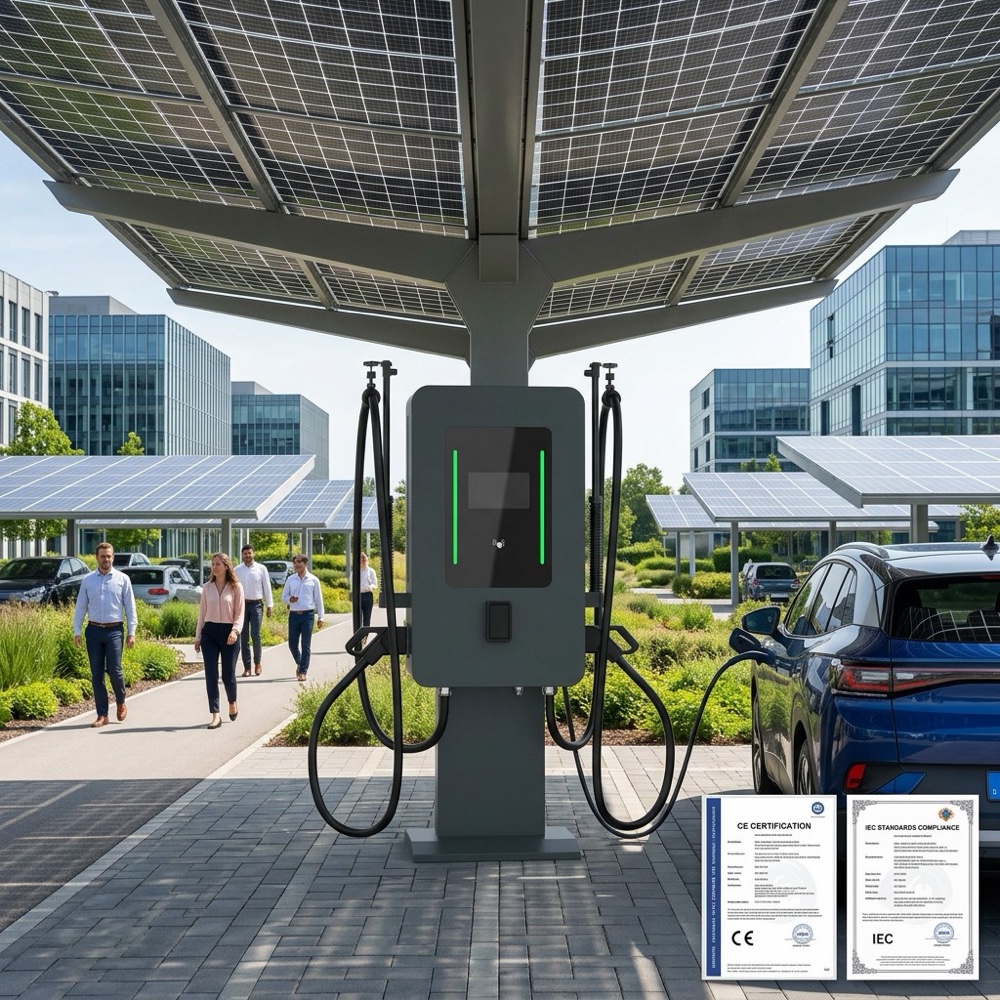
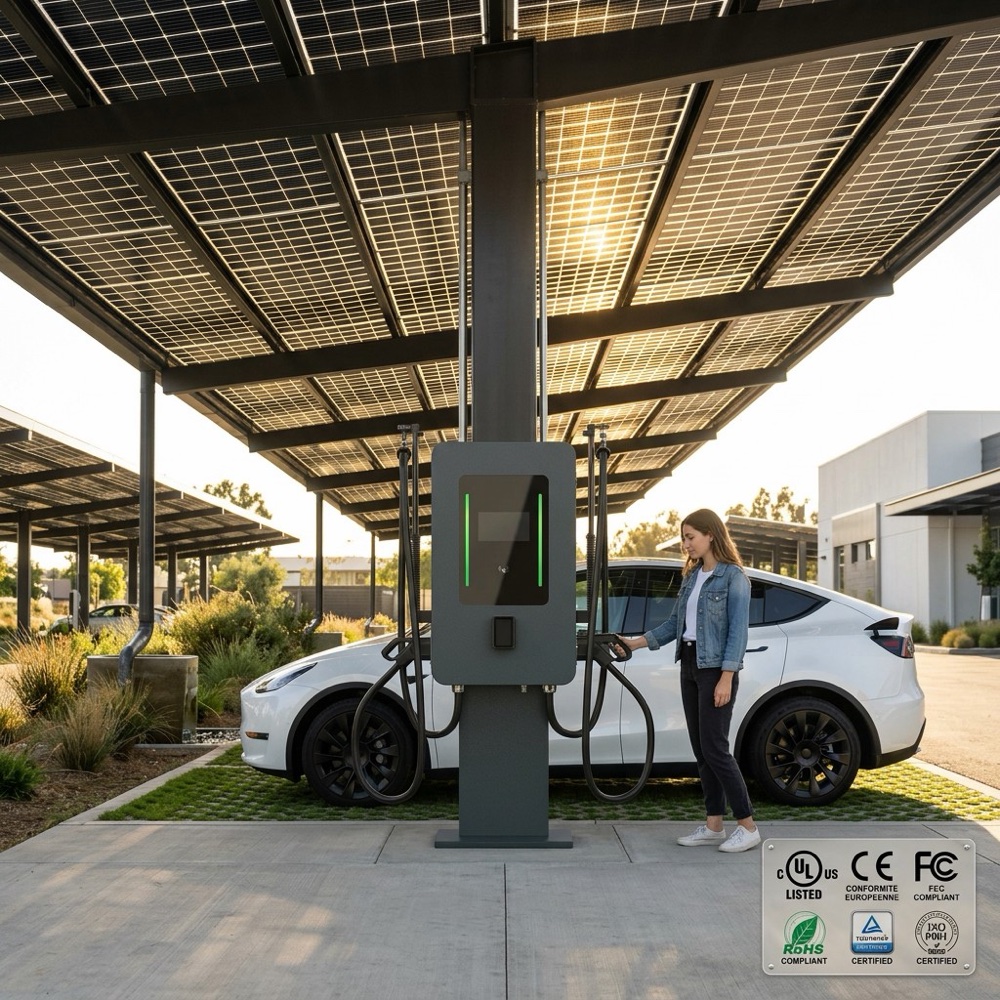
A charging microgrid pairs EV charging loads with on-site distributed energy resources — typically solar PV, battery energy storage (BESS), and an energy management system (EMS) — behind a single utility connection. Its primary commercial purpose is not energy independence; it is cost control. By shifting solar generation into charging sessions, discharging batteries during utility peak windows, and capping the site’s maximum import from the grid, a microgrid attacks the two charges that dominate charging-station economics: demand charges (per-kW) and time-of-use energy premiums. Operators routinely cut total electricity cost per kWh delivered by 20–40% on a C&I tariff, and in demand-charge-heavy markets the payback on a modest solar-plus-storage package lands between 4 and 7 years. This article covers the architectures, sizing math, control requirements, and procurement decisions behind a cost-effective charging microgrid.
Key Takeaways
- Peak power costs — demand charges and ToU energy premiums — typically make up 40–60% of a commercial DC fast charger’s electricity bill, which is why grid-only sites struggle to profit.
- A microgrid does not replace the grid; it manages the interface with it. The EMS decides, minute by minute, whether to buy, self-generate, or discharge stored energy against the site’s charging load.
- BESS is the highest-leverage component: it shaves demand spikes, arbitrages ToU rates, and can also ride through outages — but only if the EMS is integrated with the chargers’ load-management layer.
- PV-to-charger direct coupling is efficient only when charging demand overlaps solar output; without storage or smart scheduling, daytime-only solar leaves night charging fully exposed to grid prices.
- Procurement for microgrid sites must specify OCPP-compliant chargers with adjustable power limits and remote scheduling, because the EMS can only shape the load that the chargers allow it to shape.
The Peak Demand Problem: Why Grid-Only Charging Is Expensive
Utility tariffs for commercial and industrial (C&I) customers contain two distinct charges — and EV charging penalizes both. The energy charge bills every kWh; the demand charge bills the highest kW draw averaged over a 15-minute interval in the billing month. A single 120kW dual-gun DC fast charger pulling full power for consecutive sessions can push a site’s peak demand from a few hundred kilowatts to well above half a megawatt — and that peak is billed for the entire month.
Consider a concrete example. A commercial site with an 80kW baseline load installs two 80kW dual-gun chargers. Two trucks charging simultaneously at full power for 40 minutes push the site’s 15-minute demand from 80kW to 240kW. On a typical C&I tariff with a USD 12 per kW demand charge, that single event adds USD 1,920 to the month’s bill. Time-of-use (ToU) premiums compound it: evening charging often coincides with the most expensive energy of the day, multiplying both bill components at once.
This is the core insight behind charging microgrids: the demand is not the problem — the timing and simultaneity of it are. Distributed energy resources reshape exactly those two things: solar shifts supply into the day, a battery shifts it to the evening peak, and an EMS caps grid import, converting an unpredictable load into a flat, low-cost one.
What a Microgrid Contributes: PV, Storage, and Control
A charging microgrid is not a single product but a system of three cooperating assets, each attacking a different line item on the electricity bill.
Solar PV: Shifting Supply Toward the Charging Window
Photovoltaic generation is cheapest where it is generated: behind the meter, at wholesale-cost parity. For daytime-heavy charging profiles — employee fleets, logistics hubs, ride-hail depots — PV can cover 30–60% of annual charging energy at a levelized cost well below retail tariffs. But solar is time-bound: the charging load that matters most for cost — the evening peak — sits beyond solar’s reach. The fix is storage (shifting solar hours forward) or tariff design that prices daytime energy attractively; both exist in a microgrid, neither in a grid-only site.
Battery Energy Storage: The Peak-Shaving Engine
BESS is the component that makes the economics work. A battery sized to the site’s worst 15-minute demand spike can cap import at the configured ceiling, shaving the demand charge to zero for spikes shorter than the battery’s duration. The same battery arbitrages ToU rates: it charges from solar or cheap off-peak energy and discharges during peak windows, converting a USD 0.28/kWh peak purchase into a USD 0.10/kWh off-peak one. Modern grid-scale cabinets at charging sites are typically 100–500 kWh, containerized or skid-mounted, with inverters that accept both DC from PV and AC from the grid. Because the load is DC-adjacent, some integrators now use DC-coupled architectures that feed solar straight into the charger’s DC bus, eliminating an inversion step and recovering 3–6% efficiency versus AC-coupling.
The Energy Management System: Orchestration Layer
The EMS is the brain: it ingests tariff data, solar forecasts, battery state-of-charge, and real-time charger load, then issues setpoints every few seconds. In a well-integrated site it talks to the chargers through the same OCPP interface the charge point management system uses, because modern stations such as intelligent dual-gun wallbox DC fast chargers with built-in load balancing accept remote power-limit commands. Without that, the EMS guesses about the load it is shaping, and the demand cap becomes a soft target.
Resilience as a Side Benefit
Islanding capability — the ability to keep charging during a grid outage — is rarely the primary business case, but it is frequently the deciding one. Sites with a synchronous or hybrid inverter and a battery can run chargers in islanded mode for hours or days, converting a total revenue halt into a competitive advantage. This matters most for logistics depots and highway corridors where a grid failure strands trucks and drivers — turning the resilience conversation from insurance cost into revenue protection.
Cost Structure: Grid-Only vs. Microgrid-Enabled Charging
| Cost Component | Grid-Only Site | Microgrid-Enabled Site |
|---|---|---|
| Energy charge (kWh) | Full retail rate on 100% of energy | Retail rate on grid import only; solar and stored energy at levelized cost (typically 40–60% lower) |
| Demand charge (kW) | Billed on worst 15-minute peak, unmanaged | Capped at EMS-configured ceiling; spikes absorbed by battery |
| ToU premium | Full exposure to peak-hour rates | Peak energy supplied from storage charged off-peak or by solar |
| Network upgrade cost | Often required (transformer, service capacity) for multi-charger sites | Deferred or avoided; import cap keeps service within existing capacity |
| Backup / outage cost | Full revenue loss during outages | Islanded operation maintains charging during outages |
| Total delivered kWh cost (typical C&I) | USD 0.18–0.35/kWh | USD 0.10–0.22/kWh |
| Capital investment | Chargers + grid connection only | Chargers + PV + BESS + EMS (higher upfront) |
The table makes the trade-off explicit: the microgrid trades capital for operating cost. The case is strongest where peak-to-off-peak spreads are wide, demand charges are high, or a transformer upgrade would otherwise be needed. There the incremental capital pays back in 4–7 years, and kWh cost drops roughly a quarter to a third from day one.
Architectural Options for Charging Microgrids
Not every site needs the same topology. Three patterns cover most commercial deployments.
Behind-the-Meter Grid-Tied Solar + Storage
This is the default: PV and BESS sit behind the utility meter, the EMS caps import, and there is no intentional islanding. It is the cheapest configuration, the easiest to permit, and captures 80% of the cost benefit — demand capping, ToU arbitrage, and solar self-consumption — without islanding’s safety and coordination burden. It suits most parking-lot, fleet-depot, and destination sites.
Island-Capable Microgrid
Adding a transfer switch and islanding-capable inverters lets the site disconnect from the grid and keep charging from PV and storage. The premium is 15–30% over grid-tied hardware plus engineering and code compliance, justified only where outages, load criticality, or fleet SLAs demand continuity — typically highway corridors and cold-chain depots.
Fleet Depot vs. Public Hub Sizing
Fleet depots charge predictably — same vehicles, same windows, night-heavy schedules — making them ideal for storage-heavy designs that charge off-peak and discharge during the depot’s concentrated block. Public hubs face stochastic demand, so their EMS reacts to arrivals rather than a schedule; they benefit more from daytime PV and all-hours demand-capping. The hardware is often identical, but the control strategy differs.
Sizing the System: From Load Profile to kW of PV and kWh of Storage
Sizing starts with the charging load profile, not solar irradiance. First, build the site’s 15-minute demand profile from telemetry or expected session patterns — this defines the demand ceiling and the load shape. Second, size the battery to shave peaks: a rule of thumb is 30–60 minutes of the maximum charging draw, so a 240kW peak suggests 120–240kWh of usable storage before arbitrage duration is added. Third, size PV to the annual energy target: 1kW of DC PV in a mid-latitude market yields roughly 1,300–1,600kWh per year, so a site consuming 300,000kWh annually that wants 40% solar self-generation needs roughly 80–95kW.
Usable capacity matters more than nameplate rating: depth-of-discharge limits, round-trip efficiency (typically 88–94%), and EMS reserve policies all reduce usable energy. An experienced integrator also models the interaction between demand capping and ToU arbitrage, because both draw on the same battery. Hardware that reports session-level telemetry cleanly, such as the OCPP 1.6J smart commercial dual-gun wall-mounted DC fast charging stations in the MIDA commercial range, provides the metering data that makes sizing accurate rather than speculative.
Control and Communication: Making Chargers and Microgrid Talk
The microgrid only saves money if the EMS can act on the charging load in real time, which requires three protocol layers to work together. OCPP connects chargers to the charge point management system (CSMS); the EMS integrates with the CSMS or charger power-limit registers to issue curtailment commands; and the battery and PV inverters expose their state through Modbus, SunSpec, or IEC 61850. The point to watch is the charger: if it cannot accept a remote power-limit command without dropping the session, the business case erodes.
For fleet sites, the control loop extends into scheduling: a depot that staggers vehicle starts smooths its own load curve before the battery touches it. Fleet-preferred dual-gun wall-mounted DC fast chargers with CCS2/GBT interfaces and professional dual-gun DC fast charging stations built for fleet management both support the remote scheduling and power modulation that let an EMS treat charging as a controllable resource. Specifying those capabilities in the tender — remote power limiting, OCPP integration, session telemetry — separates a microgrid that works on paper from one that works on the meter.
The Business Case: Payback, Tariffs, and Risk
The economics concentrate in three levers. Demand-charge elimination is the largest: capping a site’s peak from 240kW to 80kW on a USD 12/kW tariff saves about USD 1,920 per month in the earlier example. ToU arbitrage adds a second stream: discharging a 200kWh battery through two peak hours daily at a USD 0.18/kWh spread yields roughly USD 22 per day, or USD 8,000 per year. Solar self-consumption adds the third: each behind-the-meter kWh displaces retail energy worth USD 0.12–0.28/kWh. Summed across a mid-size site, the three levers routinely produce USD 30,000–80,000 of annual savings against USD 150,000–400,000 of PV-plus-storage capital — a 4–7 year payback before incentives or avoided grid upgrades are counted.
Risk management is part of the case. Tariffs change; a site hardwired to one structure is exposed. The mitigation is control flexibility: an EMS with tariff-agnostic logic and chargers that accept demand-response signals. Demand-response programs can also pay sites to curtail during grid events — a revenue line that requires exactly the power-limiting capability needed for demand capping. For outdoor installations, weather-sealed hardware such as IP55 weatherproof dual-gun wall-mounted DC EV charging points protects the asset whose utilization pays for the whole microgrid.
A Practical Implementation Checklist
- Obtain 12 months of site load data before sizing; a charging microgrid sized on guesses is a capital error that repeats for 20 years.
- Model the tariff twice: once with today’s rates and once with a stress case, because the business case lives or dies on demand charges and ToU spreads.
- Specify charger power-limiting: every charger must accept remote power-limit commands over OCPP without interrupting active sessions.
- Choose an EMS with open integration (Modbus/SunSpec for inverters, OCPP or API for chargers) so no vendor owns the control layer.
- Design for islanding readiness even if islanding is not purchased now — the switchgear and wiring choices are cheap early and expensive later.
- Plan the battery environment: thermal management, fire code compliance, and setback distances affect site layout as much as electrical design.
- Define the demand cap contractually: the EMS vendor should commit to a maximum import ceiling in the performance specification.
Frequently Asked Questions
Q1. How much can a microgrid actually reduce EV charging electricity costs?
Operators on C&I tariffs typically see total delivered kWh cost fall 20–40%, driven mainly by demand-charge elimination and ToU arbitrage. The exact figure depends on tariff structure, solar resource, and how well the charging schedule aligns with PV output.
Q2. Do I need solar, or can I start with battery storage alone?
Storage alone captures the two largest savings — demand capping and ToU arbitrage — and is often the right first step, especially at night-heavy fleet depots. PV adds a third stream and shortens payback at sites with daytime charging, but it can be phased in later behind the same EMS.
Q3. How big does the battery need to be?
A practical starting point is 30–60 minutes of the site’s maximum charging draw for demand capping, plus additional capacity if you want multi-hour ToU arbitrage. A 240kW charging peak suggests 120–240kWh of usable storage before arbitrage duration is added.
Q4. Will a microgrid let me charge during grid outages?
Only if the site is designed for islanding — transfer switching plus island-capable inverters. A grid-tied solar-plus-storage site typically shuts down with the grid unless intentional islanding is specified, so decide at design time.
Q5. What chargers work best in a microgrid?
Chargers that expose OCPP metering and accept remote power-limit commands integrate cleanly with an EMS. Dual-gun stations with load balancing add flexibility: the EMS can modulate total site draw while both guns stay in service.
Q6. How does the EMS coordinate with the charger management platform?
Typically through OCPP: the CSMS exposes session data and power-limit interfaces that the EMS consumes, or the EMS connects to the CSMS API. The key requirement is that load curtailment commands can be issued without dropping active charging sessions.
Q7. What are the biggest implementation mistakes?
Sizing on guesses instead of metered load data, buying chargers that cannot accept remote power limits, letting the inverter vendor own the EMS (which blocks charger integration), and skipping the tariff stress test. All four are procurement-stage decisions, not operational ones.
Post time: Sep-01-2026