
MIDA 2026: Pioneering the Next Gen of Commercial Advertising Chargers
Quick Answer: MIDA enters 2026 with the industry’s most complete portfolio of commercial advertising chargers — a product family spanning 60kW to 400kW, unified by a single design philosophy: charging hardware and digital media must be engineered as one system, not welded together. Across the MIDA 2026 lineup, operators find consistent integration of high-power DC fast charging, high-brightness advertising displays, OCPP-compliant networking, and multi-interface access control (RFID, APP, and card). The result is a product range that scales from a single supermarket bay to a national highway network while keeping one hardware standard, one software stack, and one operating playbook. For commercial operators, MIDA 2026 represents the convergence of infrastructure and media into a single, revenue-generating asset class.
Key Takeaways
- The MIDA 2026 portfolio covers every commercial power tier — 60kW, 120kW, 180kW, 240kW, 360kW, and 400kW — with advertising displays integrated as standard.
- Unified engineering across the range means one management platform, one spare-parts strategy, and one operator training program for sites of every size.
- Display technology across the lineup is built for commercial environments: large-format panels, high brightness, weather-sealed enclosures, and cloud-based content management.
- OCPP compliance and multi-interface access (RFID, APP, and on-screen control) make every MIDA station interoperable with existing networks and future platforms.
- Vertical-specific configurations — supermarket, parking lot, hotel, resort, public square, and office — reduce deployment risk by matching hardware to use case.
1. The 2026 Market Context
The commercial charging market reached an inflection point in 2026. Power is no longer the differentiator it was in 2024; 120kW and 180kW have become table stakes, and 240kW-plus is standard at high-traffic sites. What separates leading operators now is the ability to extract revenue from every minute a vehicle occupies a bay — through charging fees, through advertising, and through the operational efficiency of a unified platform.
MIDA’s response is a portfolio built around that exact economics. Rather than treating advertising as an optional extra on otherwise generic chargers, the MIDA 2026 range treats the display as a core subsystem with the same engineering rigor as the power module: certified, network-managed, and rated for continuous commercial duty. This matters because an advertising charger is only as durable as its weakest subsystem — a screen that fails in sunlight, or a media player that drops offline, destroys both the media revenue and the charging experience.
2. Power Architecture Across the Range
The MIDA 2026 lineup spans the full commercial power spectrum. Each tier addresses a distinct deployment archetype:
| Power Tier | Typical Deployment | Configuration | Screen |
|---|---|---|---|
| 60kW | Hotel parking, office top-up | Single or dual connector | Advertising LCD/multimedia |
| 120kW | Office buildings, smart city sites | Dual plug, APP/RFID | 43″–55″ advertising display |
| 180kW | Commercial parking lots, supermarkets, public squares | Dual guns/sockets | Large-format high-brightness |
| 240kW | Malls, CE-certified commercial sites | Dual guns, floor-mounted | Advertising LCD monitor |
| 360kW | Highway, resorts, destination hubs | Dual connectors, power sharing | Integrated digital signage |
| 400kW | Public flagship hubs, interchanges | High-power, multi-vehicle | Integrated digital signage |
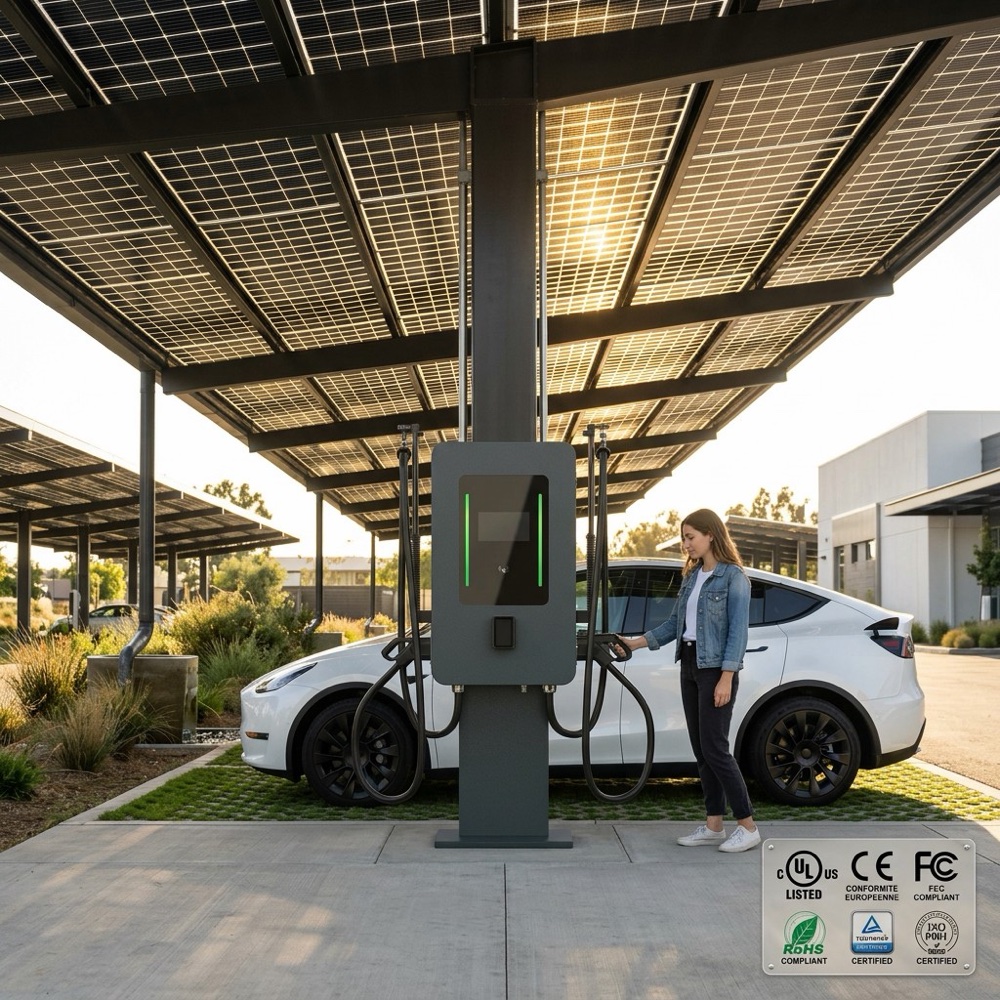
Two principles unify this range. First, power sharing across connectors is standard at higher tiers, so operators deploy fewer cabinets for the same throughput. Second, every tier is available with integrated advertising displays, so an operator can build a homogeneous fleet from 60kW office units to 400kW highway hubs without mixing product philosophies.
3. Display Technology as a Core Subsystem
The advertising screen is where MIDA 2026 separates from conventional charging hardware. Across the lineup, display engineering follows consistent commercial-grade standards:
- Large-format panels: From 43-inch urban units to 55-inch flagship displays, sized to command attention at parking distances.
- High brightness: Panels rated for outdoor and semi-outdoor environments remain legible in direct sunlight — the difference between an advertising asset and a dark rectangle.
- Multimedia players: Integrated players support video loops, HTML5 content, scheduling, and remote updates through the cloud management platform.
- Durable enclosures: Weather-sealed housings with IP54 or better protection keep displays and electronics operating reliably for years in exposed sites.
- Dual-purpose content: The same screen guides the user through charging and carries advertising, so media value and service quality reinforce each other.
The High Efficiency 240kW Dual-Gun Station with Advertising Multimedia Player Screen and the CE-Certified 240kW Station with Advertising LCD Monitor illustrate this standard at the high-volume commercial tier: dual guns maximize bay utilization, while the integrated media system keeps the bay earning even between sessions.
4. Connectivity and Access: One Platform, Every Interface
MIDA 2026 hardware is built for integration. Every station in the range supports the access and networking patterns that commercial operators actually run:
- OCPP compliance: Stations integrate with any OCPP-compatible backend — operator-owned, roaming-network, or third-party platform — keeping procurement options open and future-proof.
- RFID card access: Credential-based authentication for fleets, employees, and subscription members, with central provisioning.
- APP control: Discovery, live status, session start, payment, and history for public and roaming users.
- Cloud media management: Content scheduling, zoning, playback verification, and remote diagnostics from one dashboard.
- CE certification and commercial compliance: Stations meet the electrical safety and EMC requirements for commercial deployment across major markets.
This integration depth is the reason the 240kW Commercial Floor-Mounted Station with Advertising Display fits as readily into a mixed-use development as into a dedicated commercial parking operation: the access mix, billing model, and media strategy are configured in software, not hardwired at the factory.
5. Vertical Solutions: Matching Hardware to Use Case
A charging station deployed in a supermarket forecourt faces different demands than one at a resort or an office campus. MIDA 2026 addresses this with vertical-specific configurations that share a common platform:
| Vertical | Key Requirements | Representative MIDA Configuration |
|---|---|---|
| Supermarket / retail | High turnover, shopper media, dual connectors | 180kW–240kW with multimedia display |
| Commercial parking lot | Dual guns, large screen, robust build | 180kW dual-gun large-screen station |
| Office building | Employee access, branded content | 120kW smart-city station, 43″ display |
| Hotel / resort | Aesthetic integration, guest experience | 120kW waterproof LCD station; 360kW destination hub |
| Public square | High-brightness display, weather durability | 180kW high-brightness smart charger |
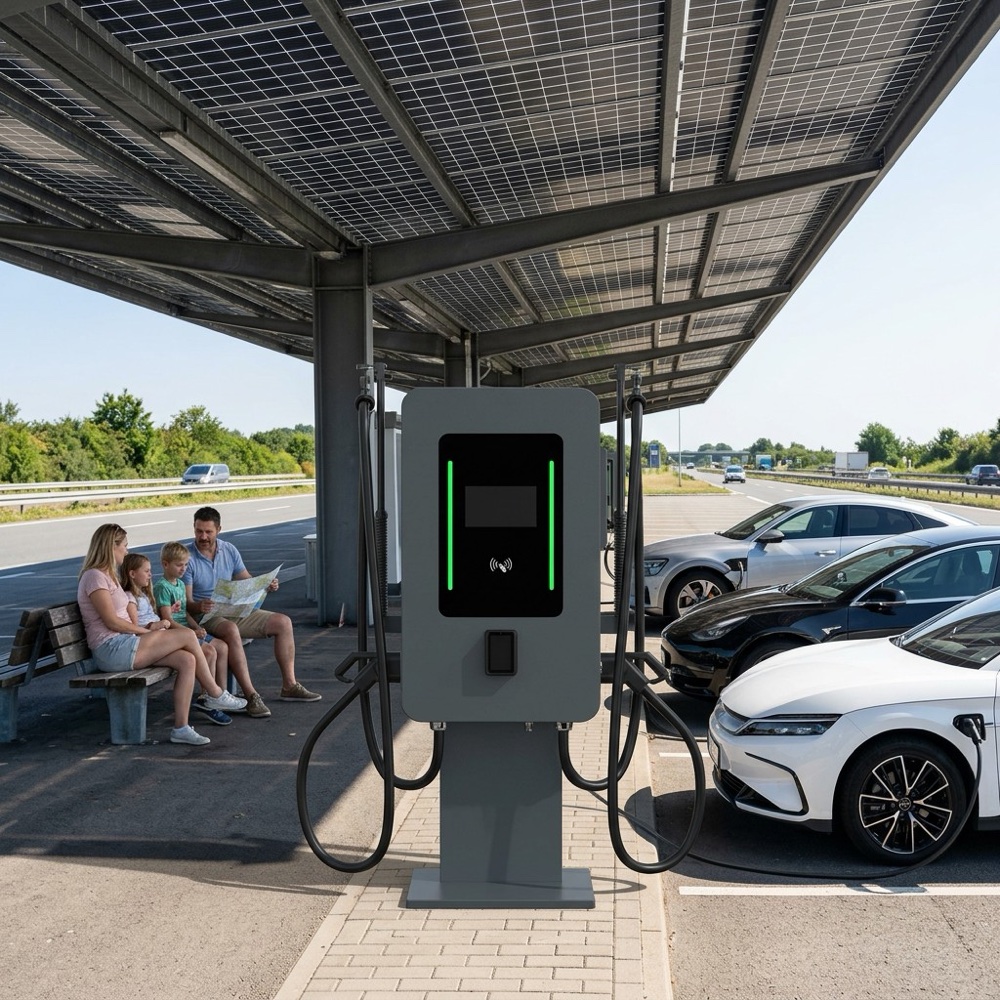
| Highway / interchange | Ultra-fast power, media at scale | 360kW–400kW integrated signage stations |
The 180kW Dual-Gun Advertising Pile with Large Screen is the archetype of this vertical thinking: built for commercial parking lots where vehicles arrive at all hours, it combines dual-gun flexibility with a large display that keeps the bay productive as a media surface around the clock.
6. The Operator Economics of Standardizing on MIDA
Beyond per-unit specifications, the strongest argument for the MIDA 2026 portfolio is fleet-level economics. Operators who standardize on one product family capture compounding benefits:
- One management platform: Energy, media, and diagnostics in a single dashboard across every site.
- One training program: Staff learn one system, whether they operate a hotel unit or a highway hub.
- One spare-parts strategy: Shared display and power components across tiers reduce inventory cost.
- Scalable media inventory: A homogeneous fleet lets operators sell corridor-wide or national advertising packages with consistent screen quality.
- Future-proof networking: OCPP-compliant, upgradeable stations accommodate new backends, roaming agreements, and media features without forklift hardware changes.
For the retail and supermarket segment specifically, the Professional Advertising DC EV Charger 180kW–240kW with Multimedia Display closes the loop on the MIDA 2026 story: a high-turnover station whose media screen is pre-configured for shopper-oriented campaigns — the definitive next-generation commercial advertising charger.
7. Quality, Certification, and Long-Term Reliability
Commercial charging hardware operates under conditions that consumer equipment never faces: near-continuous duty cycles, outdoor exposure, and the expectation of a decade or more of service. MIDA 2026 stations are engineered with this reality in mind, and the proof is in the specification detail rather than the marketing language. Electrical safety and electromagnetic compatibility certification — including CE marking on key models — is a baseline requirement for commercial deployment in most markets, and it is documented per model rather than claimed generically. Weather-sealed enclosures rated at IP54 or higher protect power electronics and displays from rain, dust, and humidity, while wide-temperature operation keeps stations running through both heat waves and freezing winters.
Reliability also depends on the components operators cannot see. Industrial-grade connectors rated for tens of thousands of insertion cycles, power modules with active thermal management, and displays with anti-burn-in protection all determine whether a station still earns revenue in year seven or becomes a service liability. Operators should request failure-rate data, spare-parts commitments, and warranty terms in writing, and should favor vendors whose product families share common components — a MIDA-specific advantage, since the same display and power modules appear across multiple power tiers, simplifying the spares inventory for multi-site fleets.
Finally, longevity is a software question as much as a hardware one. Stations deployed in 2026 will serve through multiple backend migrations, new roaming agreements, and evolving media formats. OCPP compliance and upgradeable media players ensure that MIDA 2026 hardware can adopt new capabilities without a forklift replacement — the practical definition of future-proofing in a fast-moving market.
8. The Roadmap Beyond 2026
The MIDA 2026 portfolio is not a static catalog; it is a platform designed to absorb the industry’s next transitions. Three developments define the roadmap. The first is higher power density: as vehicle architectures move toward 800V and beyond, stations in the 360kW–400kW class will increasingly operate at their full rated output, and the power-sharing architectures already embedded in MIDA hardware will scale to serve that demand. The second is deeper media intelligence: expect tighter coupling between charging telemetry and advertising systems, enabling event-triggered campaigns, session-funded charging, and automated inventory pricing based on real-time site occupancy.
The third development is standards evolution. OCPP 2.0.1 adoption, roaming interoperability, and emerging smart-charging protocols will continue to reshape how networks communicate, and MIDA’s compliance strategy keeps every station compatible with the platforms operators choose. For commercial buyers, the practical implication is simple: hardware purchased under the MIDA 2026 program remains a revenue-generating asset through the middle of the next decade, with the power, media, and networking headroom that earlier generations of advertising chargers simply do not offer.
9. Frequently Asked Questions
Q1. What is the full power range of the MIDA 2026 commercial lineup?
The portfolio spans 60kW, 120kW, 180kW, 240kW, 360kW, and 400kW, covering everything from hotel and office top-up charging to highway flagship hubs.
Q2. Are advertising screens standard on all MIDA 2026 models?
Yes. Integrated advertising displays are a core subsystem across the range, from 43-inch urban panels to 55-inch flagship screens, all managed through the cloud platform.
Q3. Which access methods do MIDA stations support?
Professional models support RFID card readers, APP control, and on-screen guidance, with OCPP compliance ensuring compatibility with major roaming networks and backends.
Q4. Can one operator manage different MIDA power tiers with a single platform?
Yes. The unified management stack handles charging operations, media content, and diagnostics for the entire portfolio, so a 60kW office unit and a 400kW highway hub run on the same system.
Q5. Are MIDA 2026 stations certified for commercial deployment?
Key models carry CE certification and are engineered to commercial standards, including weather-sealed enclosures (IP54 or higher) and high-brightness outdoor-rated displays.
Q6. How do MIDA stations support advertising revenue?
Each display connects to the cloud media platform, allowing operators to sell local, regional, or national campaigns, run sponsored charging, and verify playback for advertisers.
Q7. What makes MIDA 2026 different from earlier advertising charger generations?
Display, networking, and access are engineered as one integrated system from the start — rather than assembled from separate components — which delivers higher reliability, simpler operations, and a consistent media experience across the entire fleet.
Post time: Aug-25-2026