
Smart City Integration: How to Seamlessly Connect MIDA Charging Stations with Existing Urban Management Systems
Quick Answer
Smart city integration is a data problem, not a cabling problem. MIDA DC charging stations connect to urban management systems through three standardized layers: OCPP for the charger-to-network link, open APIs for the network-to-city-platform link, and IoT/telemetry gateways for real-time field data such as occupancy, power, and status. A municipality that already operates parking management, traffic signals, energy dashboards, or a mobility-as-a-service platform can ingest charging data through the same integration patterns it uses for those systems — typically REST APIs, message queues, and OCPI for roaming — with no proprietary lock-in. The result is a charging network that reports live availability to wayfinding apps, participates in demand response, supports the city’s carbon accounting, and feeds the same city data platform that manages streetlights and parking. This article details the integration architecture, the use cases that deliver the fastest municipal value, and a roadmap from pilot to city-wide rollout.
Key Takeaways
- Charging infrastructure integrates with city platforms through OCPP (charger to network), REST APIs (network to platform), and IoT gateways (field telemetry) — the same patterns used by existing urban systems.
- The highest-value municipal use cases are live availability feeds for wayfinding, demand response participation, parking-lot occupancy correlation, and automated ESG/carbon reporting.
- Open standards and data governance — OCPI for roaming, OAuth-secured APIs, and defined data-sharing agreements — prevent vendor lock-in and protect citizen data.
- MIDA’s OCPP-compliant, network-managed dual-gun stations fit the integration stack as drop-in components, with outdoor-rated hardware for street-level and car-park deployments.
- A staged roadmap — inventory, use-case definition, CSMS selection, integration testing, pilot, then scale — reduces risk and builds the business case with real utilization data.
What Urban Management Systems Expect from Charging Infrastructure
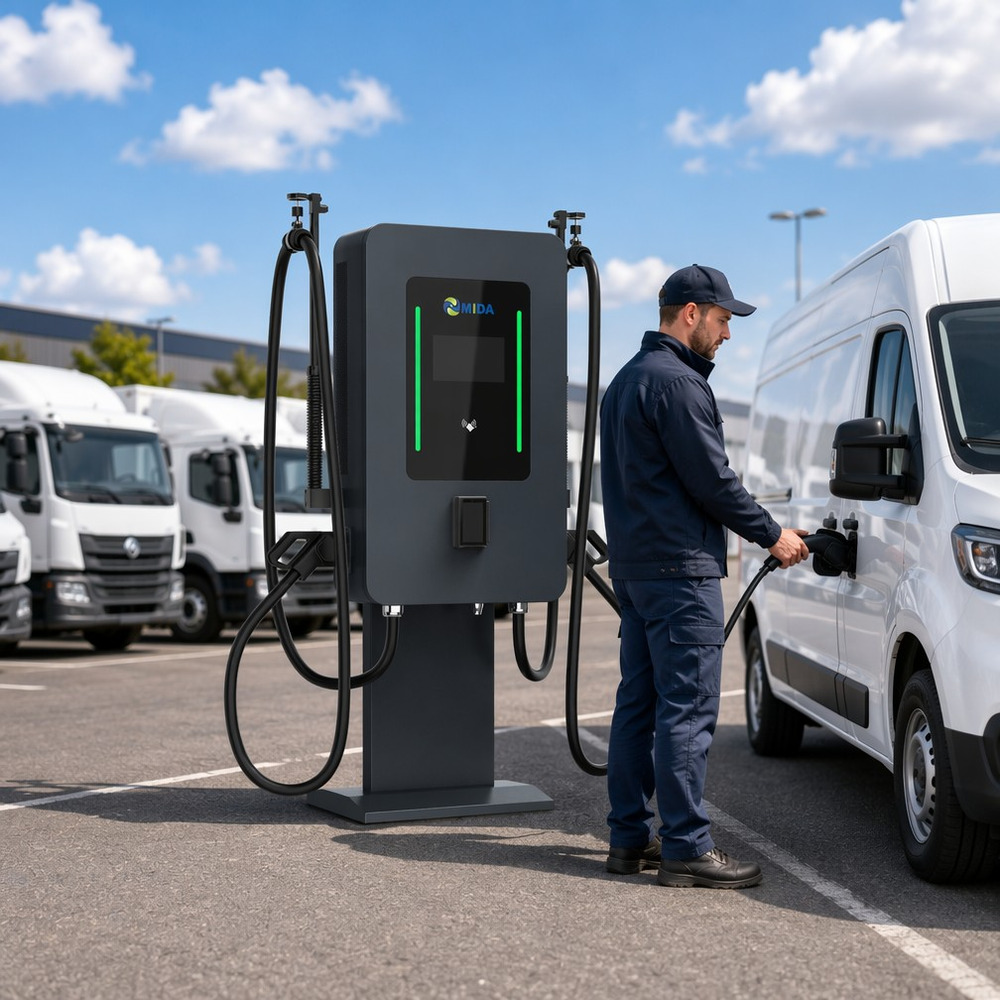
A modern city runs on data platforms that unify parking, traffic, utilities, public safety, and mobility services. When charging infrastructure enters that ecosystem, every department involved has different expectations. The parking department wants live bay occupancy to guide drivers and enforce time limits. The energy department wants power consumption, peak demand, and flexibility signals to manage the grid connection. The mobility team wants session and availability data to feed routing apps and roaming networks. The sustainability office wants energy and carbon data for reporting. The common thread is that none of these stakeholders want to log into a separate charging vendor portal — they want the charging network to behave like any other connected urban asset, publishing data to the city’s platform and accepting commands through it.
Meeting that expectation requires the charging vendor to expose its network through the same integration patterns the city already uses. MIDA stations are engineered with this in mind: OCPP compliance for the protocol layer, cloud-managed networking for remote operation, and dual-gun configurations that maximize utilization in constrained urban spaces.
The Integration Stack: OCPP, APIs, and IoT Gateways
Charging data flows through three layers, and each layer has a well-established integration pattern. The first layer is the charger-to-network link, standardized by OCPP (Open Charge Point Protocol). MIDA’s OCPP-compliant stations — such as the OCPP 1.6J dual-connector EVSE for smart car parks and the OCPP smart-network charging piles for public facilities — report session starts, metering, faults, and status to the charge point management system (CSMS). Because OCPP is vendor-neutral, the CSMS can be the city’s own platform or a contracted provider; the city is never locked to the hardware vendor for its backend.
The second layer is the network-to-platform link, where the CSMS publishes data to the city’s integration layer. This is typically a REST API with OAuth authentication, delivering availability, session, and energy data in JSON, or pushing events through message queues for real-time consumers. The third layer is field telemetry: IoT gateways that expose sensor-level data — connector state, enclosure temperature, power quality, current utilization — to the city’s IoT platform, often via MQTT. Together, the three layers give the city everything from billing-grade session records to millisecond-level operational telemetry, with no proprietary protocol required.
Choosing an Integration Approach
Cities evaluating how to wire charging networks into their platforms face three architectural options, and the choice materially affects cost, flexibility, and security.
| Integration Approach | Data Coverage | Vendor Lock-in | Security & Governance | Effort |
|---|---|---|---|---|
| Direct proprietary API from charger vendor | Limited to vendor-defined fields | High — data and controls bound to one vendor | Vendor-controlled | Low |
| OCPP + CSMS + open REST API | Full session, metering, and status data | Low — CSMS can be re-tendered | City-defined API governance, OAuth | Medium |
| OCPP + CSMS + IoT gateway (MQTT) | Full data plus real-time field telemetry | Low | City IoT platform policies apply | Medium-high |
The middle path — OCPP with an open-API CSMS — is the recommended default for most municipalities: it preserves the ability to switch backends, delivers billing-grade data, and keeps integration effort proportionate. The IoT-gateway path adds real-time granularity for advanced use cases such as dynamic load management across a district or grid-interactive charging, and is justified where the city already operates a unified IoT platform.
Whichever path a city chooses, the integration contract should be explicit about the outcomes it buys. The clearest formulation ties deliverables to operations: live availability data in the city’s wayfinding channels, session and energy records in the sustainability dashboard, demand-response commands honored within defined time limits, and roaming sessions settled through OCPI. When these outcomes are written into the service agreement with the charging operator, the integration ceases to be an abstract architecture discussion and becomes a measurable municipal service — which is precisely how charging networks earn their place alongside parking, traffic, and streetlight systems in the urban management portfolio.
Real-World Integration Use Cases
Four use cases deliver the fastest measurable value to cities. Live availability feeds are the first: session and status data published to the city’s wayfinding and parking applications, so drivers can see which bays are free before they arrive — reducing search traffic and bay idle time. A city running this use case typically integrates the CSMS API with its parking guidance system, mapping charging bays like parking spaces.
Demand response is the second: when the utility or grid operator issues a flexibility signal, the city’s energy platform commands the CSMS to throttle or shift charging across the network. This requires smart-charging capability in the protocol stack and is most practical where the city operates municipal fleets on its own chargers. Parking-lot occupancy correlation is the third: combining charging data with license-plate or space sensors lets the city enforce time limits, validate EV-parking privileges, and optimize where new bays are installed. The fourth is automated carbon and ESG reporting: energy delivery by site, by month, aggregated into the city’s sustainability dashboards without manual spreadsheet work — a small feature that removes a recurring administrative burden for the sustainability office.
Data Governance, Security, and Standards
Connecting charging infrastructure to city platforms makes it part of critical municipal infrastructure, which raises the security bar. The integration should follow the same rules as the city’s other connected assets: OAuth 2.0 or mutual-TLS for every API consumer, role-based permissions so the parking team cannot command the energy team’s sessions, and full audit logging of all commands issued through the platform. For roaming between networks, OCPI is the industry standard and should be specified from the start, so that a driver from another city’s network can use municipal bays under their existing account — a decisive factor for a city that wants seamless regional mobility.
Data governance matters equally. Session data includes personal information — vehicle, location, time — and its handling is regulated under GDPR in Europe and similar regimes elsewhere. The city’s data-sharing agreement with the charging operator should define exactly which fields are shared, for which purposes, with which retention period, and through which technical controls. Open standards do not remove the need for a written agreement; they make the agreement enforceable.
A Deployment Roadmap for Municipalities
A city-wide charging integration succeeds in stages. The first stage is inventory and discovery: document existing charging assets, their protocols, and the city platforms that should consume charging data. The second is use-case definition: prioritize the two or three use cases above that map to current political and budgetary priorities — availability feeds and carbon reporting are usually the quickest wins. The third is CSMS selection: procure or contract a charge point management system with open APIs, OCPI support, and a demonstrated integration track record with city platforms. The fourth is integration testing: stand up a sandbox, connect one or two stations, and validate data flows, authentication, and fault handling before any wider rollout. The fifth is the pilot: deploy a defined zone — a municipal car park, a transit hub, or a district — and measure availability, utilization, and operational effort. Only then does the city scale to the full network, with the pilot’s data informing both bay placement and budget requests.
Throughout the roadmap, hardware selection should favor the same attributes a network operator would choose: OCPP compliance, remote management, outdoor durability, and dual-gun throughput. The OCPP smart EVSE stations for municipal parking lots, the IP55 outdoor mini dual-gun DC charging stations, and the smart commercial dual-gun wall-mounted charging stations in MIDA’s range are designed for exactly this environment: network-managed, weather-rated, and standardized on OCPP so that municipal backends treat them like any other compliant EVSE.
Frequently Asked Questions
Q1. What protocols are used to integrate EV chargers with city platforms?
The standard stack is OCPP for the charger-to-network link, REST APIs or message queues for the network-to-city-platform link, and OCPI for roaming between networks. IoT gateways using MQTT add real-time field telemetry where needed.
Q2. Does integrating MIDA stations require proprietary software from the vendor?
No. MIDA stations are OCPP-compliant and network-managed, so they connect to any OCPP-compatible CSMS. The city or its contracted operator chooses the backend, and data flows onward through open APIs.
Q3. Can charging stations feed real-time availability to city parking apps?
Yes. Session and status data from the CSMS API can be published to parking guidance and wayfinding applications, showing live bay availability just like parking-space sensors.
Q4. How does charging infrastructure participate in demand response?
The city’s energy platform sends flexibility signals to the CSMS, which dispatches smart-charging profiles to stations — throttling or shifting load across the network according to grid conditions.
Q5. What security measures are needed for city integration?
OAuth 2.0 or mutual-TLS for all API consumers, role-based permissions, full audit logging, and TLS transport for all data in motion. The same controls the city applies to its other critical connected infrastructure.
Q6. Is OCPI required for roaming between different networks?
OCPI is the de facto industry standard for network-to-network roaming. Specifying it from day one lets drivers from other networks use municipal bays under their existing accounts, which is essential for regional mobility.
Q7. How long does a typical city integration project take?
A focused pilot connecting a single car park or district typically completes in two to four months, including sandbox testing and data validation. City-wide rollout then follows in phases, guided by pilot results.
Post time: Sep-01-2026