
The Future of Highway Service Areas: Ultra-Fast Megawatt Advertising Stations
Quick Answer: Highway service areas are being rebuilt around a new anchor tenant: ultra-fast EV charging. With regulatory mandates pushing 150kW-plus charging along major corridors and battery technology enabling 10-to-20-minute charging sessions, service area operators are moving toward megawatt-class hubs — multi-dispenser sites fed by 360kW to 400kW stations today and megawatt charging system (MCS) architectures tomorrow. These hubs convert the traditional fuel stop into a high-value dwell-time economy: drivers arrive, charge rapidly, and spend 15 to 30 minutes in retail, food, and services. Integrated advertising screens on each charging station monetize that captive audience, turning highway charging infrastructure from a cost center into a media network with national reach.
Key Takeaways
- Regulatory frameworks such as the EU AFIR and the US NEVI program mandate reliable high-power charging along highway corridors, making ultra-fast hubs a compliance requirement, not an option.
- 360kW–400kW stations deliver 80% charge in roughly 10–20 minutes for most passenger EVs, aligning charging time with natural service area dwell time.
- Megawatt-class sites use modular power cabinets, dual-connector dispensers, and dynamic load management to serve multiple vehicles simultaneously without grid penalties.
- Integrated digital signage monetizes charging sessions through national campaigns, regional tourism content, and local concession advertising.
- Site design must prioritize high-brightness displays, robust weather protection, and redundant connectivity to operate reliably in highway environments.
1. The Highway Stop Is Being Reinvented
For a century, the highway service area was organized around the combustion engine: a fuel forecourt, a shop, and a restroom. The electric era dismantles that model. An EV that needs 20 minutes of charging does not want a drive-through experience; it wants a place where time passes comfortably and productively. Service area operators who understand this transition are redesigning their sites around the charging forecourt, placing retail, food service, and amenities within a short walk of every dispenser.
The economics justify the redesign. Charging revenue per square meter of forecourt now rivals or exceeds fuel margins, while the enforced dwell time converts drivers into shoppers with measurable uplift in food and beverage spend. Industry data across Europe and North America consistently shows that charging customers spend more per visit than conventional fuel customers, precisely because they have time to spend.
This is where the 360kW Ultra-Fast Charging Station with Integrated Advertising Digital Signage enters the picture. Built explicitly for highway deployment, it combines ultra-fast power delivery with a large integrated display — turning every charging bay into both a service point and a communication surface.
2. Regulation Is Driving the Build-Out
The pace of highway charging deployment is no longer left to market forces alone. In the European Union, the Alternative Fuels Infrastructure Regulation (AFIR) requires fast charging stations of at least 150kW every 60 kilometers along the TEN-T core network, with full implementation milestones through 2026 and beyond. In the United States, the National Electric Vehicle Infrastructure (NEVI) program funds high-power charging along designated corridors, mandating four or more 150kW ports every 50 miles. Both frameworks create a compliance-driven pipeline of highway charging projects.
Operators responding to these mandates are not installing minimum-spec hardware. They are future-proofing with higher power tiers, multiple connectors, and media capabilities — because the marginal cost of installing a 360kW station instead of a 150kW station is small relative to the site-level investment in grid connection, civil works, and amenities. The result is a fast-approaching generation of megawatt-class hubs.
3. What Megawatt Charging Actually Means in 2026
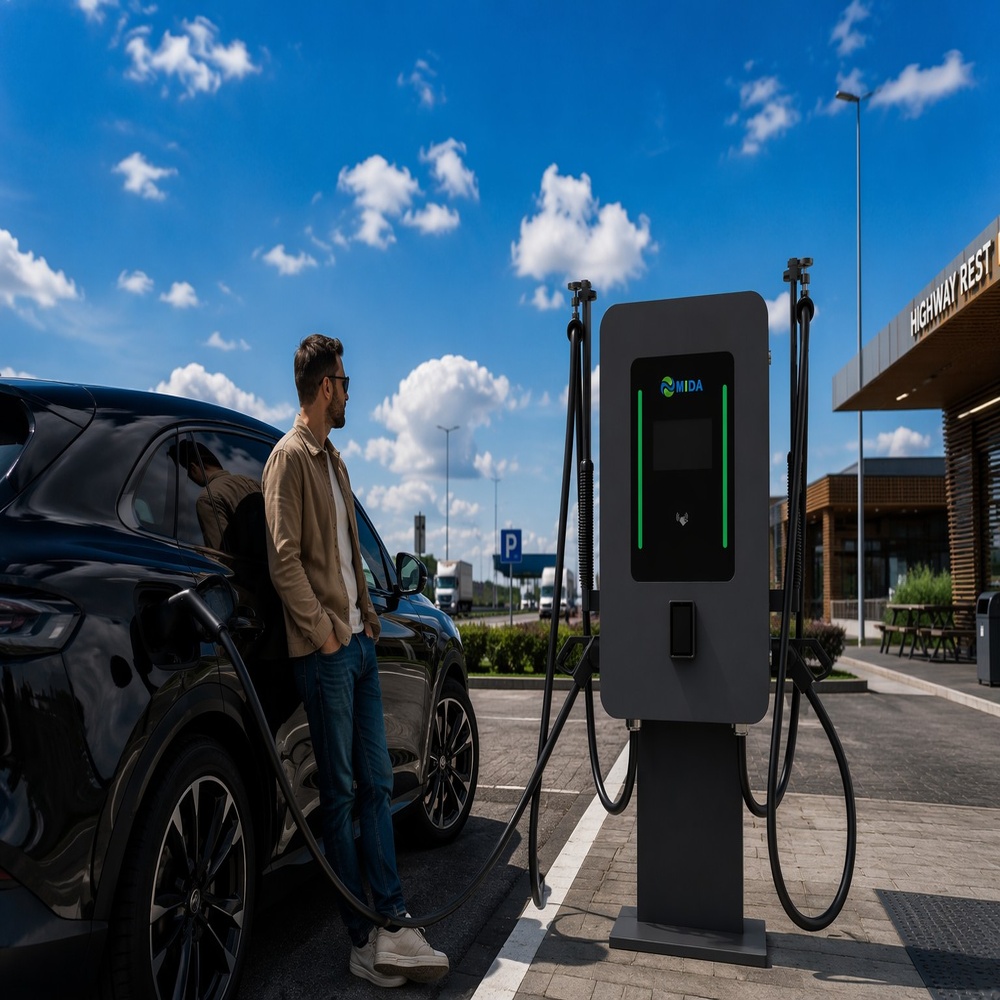
“Megawatt charging” is often discussed as a future technology, but its building blocks are already in deployment. A megawatt-class highway site does not require a single megawatt dispenser; it requires the aggregate capacity to deliver high power to many vehicles simultaneously. The practical architecture combines:
- High-power stations (360kW–400kW): Each station delivers ultra-fast sessions to one or two vehicles, with dynamic power sharing across connectors.
- Multiple stations per site: Four to eight dispensers are typical for highway hubs, fed by a shared grid connection and medium-voltage transformers.
- Battery buffers: Stationary storage flattens demand peaks, reducing grid connection costs and enabling higher peak power than the utility connection alone would allow.
- Megawatt Charging System (MCS) readiness: Charger-to-vehicle communication and power electronics designed for the emerging MCS standard will support heavy-duty trucks at 1MW and beyond as that segment electrifies.
The High Power 400kW Electric Vehicle Charging Station with Digital Signage exemplifies the high-power tier of this architecture. At 400kW, it is one of the highest-output commercially deployed stations in its class, and its integrated advertising screen adds the media layer that pure-power competitors lack.
4. Power Tier Comparison for Highway Deployments
| Configuration | Typical Charge Time (10–80%) | Vehicles Served Simultaneously | Best Use Case |
|---|---|---|---|
| 150kW single connector | 30–45 minutes | 1 | Secondary corridors, legacy sites |
| 360kW dual connector, power sharing | 15–25 minutes | 2 (share 360kW) | Primary highway hubs, phased rollout |
| 400kW dual connector, power sharing | 12–20 minutes | 2 (share 400kW) | High-traffic interchanges, flagship sites |
| Multiple 360–400kW stations + battery buffer | 10–20 minutes per vehicle | 8–16 | Megawatt-class regional hubs |
For operators planning phased growth, the Efficient 400kW DC Fast Charger with Integrated Advertising Screen provides a path from a single high-power bay to a multi-station hub. Because power sharing and cloud management are built in, additional dispensers can be added as traffic grows without re-architecting the site.
5. The Advertising Window: 15 Minutes of Captive Attention
The business case for highway advertising stations rests on a simple arithmetic: a driver charging for 15 to 20 minutes is a captive, high-income audience with time to engage with a screen. Unlike a billboard that competes with the road ahead, a charging screen sits directly in the driver’s line of sight during the entire session. Content can be sequenced — safety information, then brand messaging, then local concession offers — creating a structured media experience that out-performs passive signage.
For service area operators, this creates a national media asset. A chain of highway hubs can offer advertisers a network of high-visibility screens along entire corridors, with centralized content management ensuring every display runs the same campaign simultaneously. Regional tourism boards, automotive brands, food and beverage companies, and financial services firms are natural buyers of this inventory. The revenue stream is incremental to charging income and requires almost no additional capital once the stations are installed.
6. Hardware Built for the Highway Environment
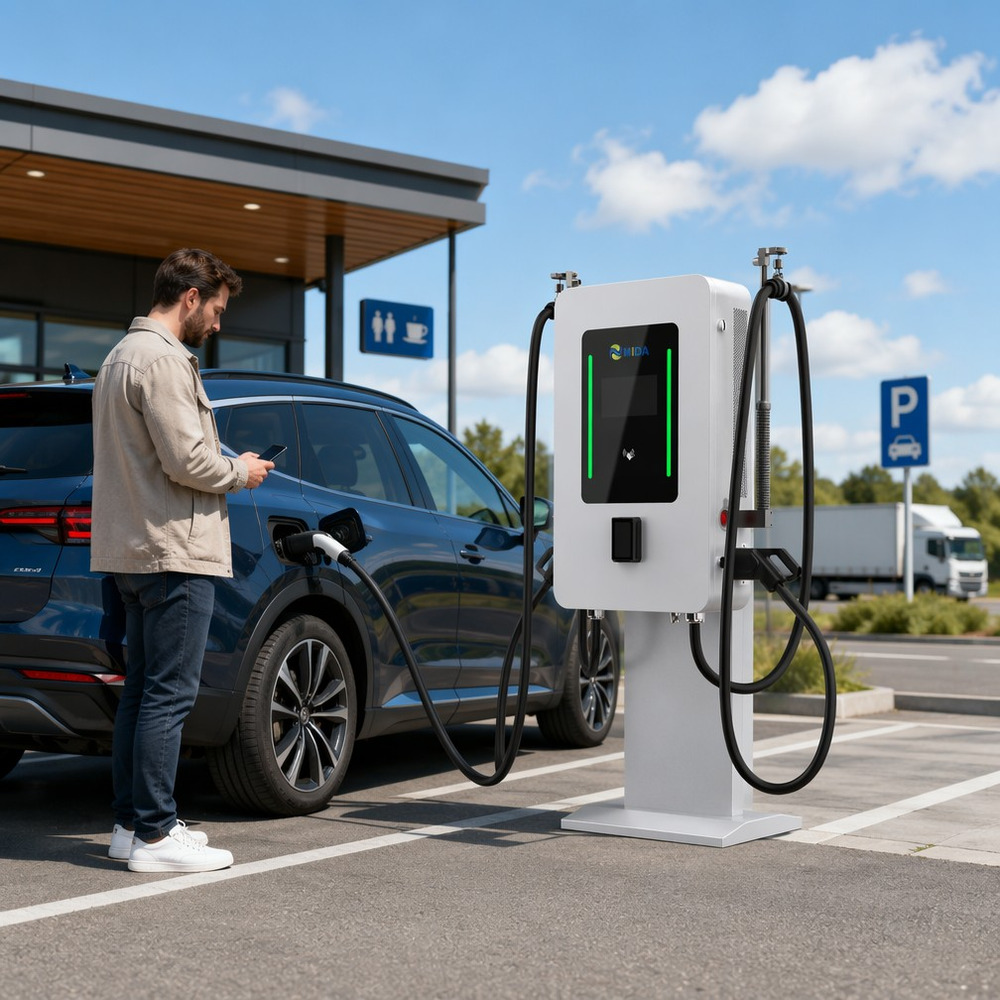
Highway service areas are among the harshest environments for electronics: temperature extremes, direct sun, rain, snow, salt spray, and dust. Charging stations deployed there must meet specifications far beyond those of urban or mall units. The critical requirements are:
- High-brightness displays (≥1500–2500 nits): Content must remain legible in full sunlight, or the advertising value collapses.
- Ingress protection of IP54 or higher: Sealed enclosures protect power electronics and displays from rain and particulate ingress.
- Wide operating temperature range: Reliable operation from freezing winters to summer heat peaks, with active thermal management.
- Dual connectors and power sharing: Maximize utilization by serving two vehicles per station, essential at busy highway sites.
- OCPP compliance and remote management: Operators must monitor, update, and troubleshoot across a dispersed network from a single platform.
The Dual-Connector 360kW Floor-Mounted Advertising Station demonstrates how the same hardware platform serves both highway and destination environments — a design that lets operators standardize on one station type across very different site types, simplifying training, spares, and content management.
7. Deployment Scenario: A Regional Highway Hub
Consider a service area operator upgrading a flagship interchange site. The current facility has 12 fuel bays and a 400-square-meter retail building. The upgrade plan reserves the entire frontage for charging: eight 360kW dual-connector stations, backed by a 1.2MWh battery buffer and a 2MW grid connection. Each station carries a high-brightness advertising display.
The construction phase is phased to avoid revenue disruption: the first four stations open within six months, and the remaining four follow as utilization grows. Cloud management is commissioned from day one, so the operator can monitor session data, energy flows, and media performance from a single dashboard. Advertising inventory is sold in monthly packages to regional and national brands, with local concessionaires receiving preferential pricing.
Eighteen months after opening, the operator reports charging utilization above 25%, retail revenue per charging customer well above the fuel-customer baseline, and advertising income covering a material share of the site’s energy costs. The same playbook is then replicated across the operator’s next three sites, creating a standardized, scalable hub model.
8. The Highway Hub Business Case
Highway charging hubs justify their capital intensity through three interlocking revenue streams, and each stream depends on the design decisions made at the planning stage. The first stream is charging revenue itself: ultra-fast power commands premium per-kWh pricing, and high utilization across a well-located hub produces strong gross margins. The second stream is retail uplift: charging customers spend more per visit than fuel customers because they have time to browse, eat, and shop — a dynamic that anchors the service area’s concession model. The third stream is media: integrated screens convert every session into advertising inventory, with national corridor packages commanding the highest rates.
Operators should model all three streams before committing to a site. A conservative five-year projection for a six-station hub typically includes charging revenue growing with EV penetration, retail uplift correlated with session duration, and media revenue ramping as the network grows. The table below illustrates the relative contribution of each stream across the maturity curve of a typical highway site.
| Revenue Stream | Year 1 | Year 3 | Year 5 |
|---|---|---|---|
| Charging fees | 55–65% of site revenue | 50–60% | 45–55% |
| Retail and F&B uplift | 30–40% | 30–40% | 30–40% |
| Advertising and media | 5–10% | 10–15% | 15–20% |
The media share grows for a specific reason: as the operator standardizes more sites on the same advertising hardware and cloud platform, the network’s inventory becomes attractive to regional and national advertisers. Early movers who install display-equipped ultra-fast stations — rather than bare power cabinets — capture this optionality at almost no incremental hardware cost.
9. Frequently Asked Questions
Q1. What is the difference between 360kW and megawatt charging?
A 360kW station serves individual vehicles at ultra-fast rates, while “megawatt” describes aggregate site capacity or the emerging MCS standard for heavy trucks. Megawatt-class sites combine multiple 360–400kW stations with battery buffers to deliver very high aggregate throughput.
Q2. How long does an EV actually need to charge at a 400kW station?
For most modern passenger EVs, a 10–80% session completes in roughly 12 to 20 minutes, depending on the vehicle’s own charging curve. This aligns closely with the natural 15–30 minute dwell time of a highway service area visit.
Q3. Are advertising screens on highway chargers durable enough for outdoor use?
Yes, when specified correctly. High-brightness panels (1500–2500 nits) with IP54 or higher protection and wide-temperature operation are designed specifically for outdoor deployment in demanding environments.
Q4. Do I need a megawatt grid connection to build a highway hub?
Not necessarily. Battery buffers and load management reduce peak demand, allowing operators to achieve high aggregate throughput with a smaller grid connection than the raw power would suggest.
Q5. Can advertising content be managed across multiple highway sites?
Yes. Cloud-based media management platforms allow operators to schedule campaigns, localize content, and monitor playback across an entire network of sites from a single dashboard.
Q6. What protocols do highway stations use for integration?
OCPP (typically 1.6J or 2.0.1) is the standard for charger-to-network communication, enabling roaming, billing, and remote diagnostics. Media content is managed separately through the cloud CMS layer.
Q7. How much revenue can advertising add to a highway charging site?
Results vary with location and traffic, but advertising typically adds a meaningful incremental margin on top of charging fees, and at high-traffic hubs it can cover a substantial share of site energy or operating costs.
Post time: Aug-25-2026