
The Rise of Smart City Infrastructure: 4K Signage Integrated Charging
Quick Answer: Smart city infrastructure is converging on a single principle in 2026: every street asset should serve more than one function. 4K signage integrated charging stations embody this shift by combining DC fast charging with civic-grade digital displays, so one unit delivers mobility, wayfinding, emergency alerts, and municipal messaging at the same footprint a charging pole alone would occupy. Cities and public operators are adopting these stations because they convert infrastructure spend into revenue-generating media assets, because high-brightness 4K panels remain legible in daylight, and because OCPP 1.6J/2.0.1 cloud management lets a single control room operate charging, content, and energy data across the whole urban network. The 400kW-class public hub is the flagship of this category, but the same architecture scales down to 120kW neighborhood stations, making signage-integrated charging the fastest-growing format in municipal EV tenders of 2026.
Key Takeaways:
- Multi-function is the new standard — one pole now does charging, signage, wayfinding, and civic alerts, collapsing the cost of separate street furniture.
- 4K high-brightness panels are city-grade — outdoor legibility in direct sunlight is what turns a display into a usable public information surface, not a decoration.
- Revenue offsets municipal budgets — advertising concessions on public charging screens can subsidize network operating costs and lower the public subsidy per station.
- One control room, one network — OCPP 1.6J/2.0.1 plus cloud content management unifies charging operations and digital messaging under a single operator.
- Tiered power architecture — 120kW neighborhood stations, 180kW district stations, and 360–400kW transport-hub stations let cities scale with demand density.
What “Smart” Actually Means for Urban Charging in 2026
Smart city is an overused label, but in charging infrastructure it has a precise meaning: networked, remotely managed, multi-functional hardware that shares data with city systems and earns its footprint. A smart charging station in 2026 is not merely connected; it is an integrated node that reports utilization to traffic departments, accepts dynamic energy pricing from grid operators, and communicates with citizens through an embedded display. The rise of 4K signage integrated charging follows directly from this definition, because the display is what turns a utility asset into a civic interface.
The market signal is unambiguous. Municipal request-for-proposal (RFP) documents for EV infrastructure increasingly include digital signage as a scored requirement rather than an option, and urban planners now treat the charging station as a piece of street furniture that must justify its visual and spatial footprint. A single pole that charges vehicles, shows bus and transit updates, broadcasts emergency information, and carries revenue-generating advertising is far easier to approve, fund, and defend in public consultation than a dedicated charger next to a dedicated advertising pillar next to a dedicated wayfinding map.
The Multi-Functional Street Asset
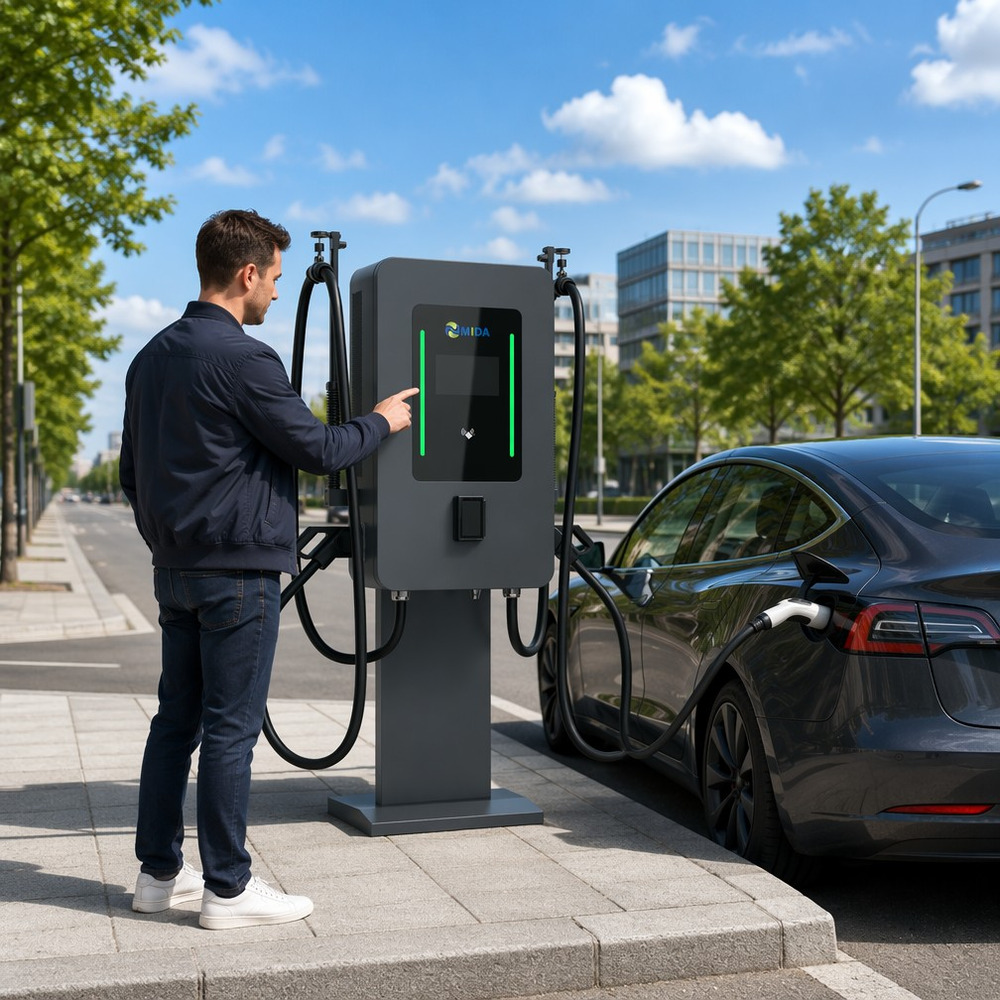
The economics of urban furniture favor consolidation. Every pole, cabinet, and screen installed on public land carries permitting costs, maintenance contracts, and visual clutter. The signage-integrated charger collapses three or four assets into one enclosure: the charging electronics, the display, the network gateway, and the structural mounting are engineered as a single unit. Floor-mounted designs in the MIDA AD20 series eliminate mast and wall-mount works, and the IP54-rated enclosure is built for continuous outdoor operation across all four seasons.
The functional payoff shows up in daily operations. The same screen that sells advertising space during the day carries civic messaging at night; the same network connection that reports charger health delivers content updates; the same power connection that charges vehicles feeds the display without a second utility service. For a city operator running dozens of sites, the consolidation removes entire categories of cost: fewer cabinets to secure, fewer vendors to coordinate, fewer failure points between systems that previously had no reason to talk to each other.
Why 4K Signage Belongs in Public Infrastructure
Display resolution and brightness are not cosmetic specifications in the public realm; they determine whether the asset can actually perform its civic function. A standard indoor monitor fails outdoors within months, and a low-brightness panel is illegible in daylight, which defeats both the safety messaging and the advertising value. The 4K high-brightness panels used in signage-integrated charging stations are engineered for outdoor viewing distances: a 55-inch screen at 1000+ nits remains readable in direct sun, while 4K resolution keeps text sharp when citizens approach to read departure times or emergency instructions.
The public-safety argument is the one that wins budget committees. During extreme weather, traffic incidents, or public health events, a city needs to reach people where they are—not only through phones, but through fixed urban displays that cannot be ignored. A network of charging stations with integrated screens becomes a redundant alert channel that works even when cellular networks are congested, because the stations can fall back to Ethernet backhaul. This civic function is delivered at near-zero marginal cost, since the display is already installed for commercial purposes.
| Civic Use Case | Content Type | Example Timing |
|---|---|---|
| Emergency alerts | Weather warnings, evacuation routes, shelter info | Storms, heat events, incidents |
| Mobility information | Transit departures, bike-share availability, parking guidance | Peak commuting hours |
| Wayfinding | District maps, landmark directions, accessibility routes | Tourist and event periods |
| Municipal campaigns | Health, energy conservation, community notices | Rolling campaigns |
| Commercial advertising | Local business spots, programmatic DOOH | Off-peak civic windows |
The Technical Backbone of a City Charging Network
City networks fail when operators cannot see them. The technical foundation of signage-integrated charging is therefore the management stack: OCPP 1.6J and 2.0.1 compliance for charging operations, and a cloud content platform for the displays. MIDA’s AD20 stations support both, with communication over 4G, WiFi, or Ethernet and payment via RFID, mobile APP, and POS terminals. This combination means a city can integrate the stations into existing roaming networks, energy management systems, and even traffic-control dashboards without proprietary lock-in.
The 360–400kW Transport Hub Class
The flagship of the category is the 360–400kW class, designed for transport hubs, public squares, and highway-adjacent nodes where throughput is the binding constraint. At 400kW with 1000V DC output and dual-gun intelligent distribution, a single station serves two vehicles at high speed while the 55-inch display commands the space. These stations are the natural centerpiece of a city’s flagship charging corridor: they handle the highest volumes, generate the most media impressions, and signal to citizens that the city is investing in visible, modern infrastructure.
Designing for the Hub Floor
Floor-mounted enclosures and dual-gun distribution keep the hub floor uncluttered and queuing orderly.
The 120–180kW District and Neighborhood Class
Not every location needs 400kW. Neighborhood stations in the 120kW–180kW range serve residential districts, office campuses, and municipal parking lots at a fraction of the grid cost, and their 32–43-inch displays still deliver the civic messaging and local advertising functions. The Smart City 120kW station with a 43-inch display is the archetype of this tier: enough power for realistic daily use, a screen large enough to be a civic surface, and a grid footprint that fits existing street infrastructure. A well-designed city network deliberately mixes tiers, placing 400kW units where demand is dense and 120–180kW units where the population is thinner.
| Deployment Tier | Typical Location | Power Class | Screen | Primary Function |
|---|---|---|---|---|
| Neighborhood | Residential lots, municipal offices | 60–120kW | 32–43″ | Daily charging + local messaging |
| District | Public squares, libraries, commercial streets | 120–180kW | 32–43″ | Charging + wayfinding + ads |
| Transport hub | Train stations, airports, city entrances | 360–400kW | 55″ | High-throughput charging + civic signage |
Funding Models: Making Public Networks Pay for Themselves
Public charging networks rarely pencil out on charging revenue alone in their first years, which is why the advertising capability changes the funding conversation. A city that owns the signage rights on its charging network controls a new municipal media channel with predictable value, and that value can be structured into the operating model in several ways.
Public–Private Partnerships
In the most common 2026 structure, a city grants a concession to a private operator that finances, installs, and operates the stations, including the screens; the operator keeps advertising revenue and shares a portion with the city, while the city sets civic-content quotas and service-level targets. The operator gains a long-term asset with two revenue lines, and the city gains infrastructure without upfront capital.
Advertising Concessions and Local Media Lots
Where the city owns the network directly, the signage inventory can be tendered separately to a media operator. The revenue offsets operating costs and, in high-traffic districts, can cover maintenance for the entire neighborhood tier. Cities that bundle charging-site advertising with existing DOOH concessions report the fastest uptake, because media buyers already have budgets and processes for urban screens.
Grant and Co-Funding Programs
Many jurisdictions co-fund charging infrastructure through energy-transition grants, and signage-integrated stations qualify on the same basis as conventional units while additionally satisfying digital-inclusion and smart-city grant criteria. The multi-function argument is increasingly decisive in scoring: reviewers weight projects that serve mobility, communication, and safety simultaneously.
| Funding Model | Capital | Operating Risk | City Control | Best Fit |
|---|---|---|---|---|
| Public–private concession | Private | Operator | Medium (contractual) | Large networks, fast rollout |
| Municipal ownership + media tender | Public/co-funded | City, offset by media | High | Districts with strong ad demand |
| Grant + operator co-investment | Mixed | Shared | Medium–high | Pilot corridors, equity goals |
Design and Placement Guidelines for Urban Operators
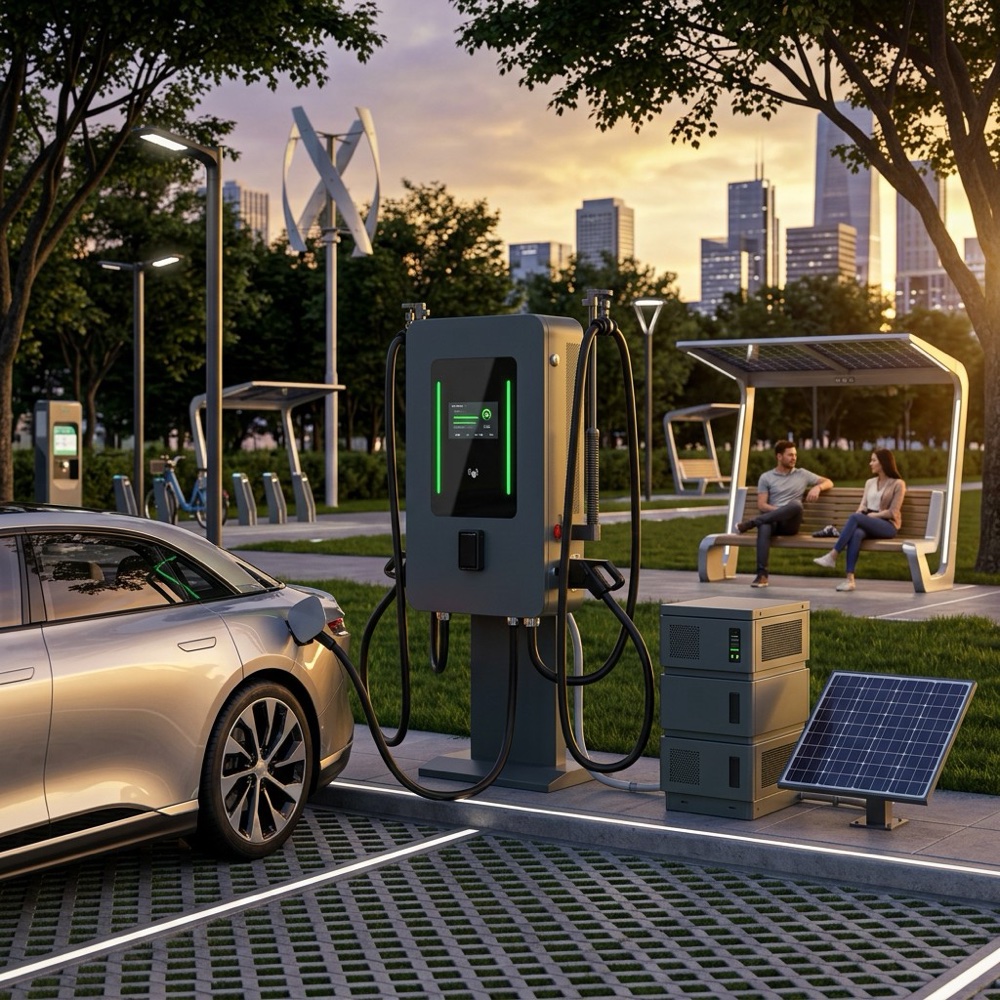
Placement determines whether a signage-integrated station serves the city or simply occupies it. Urban operators in 2026 apply a consistent set of siting rules drawn from both charging and DOOH best practice:
- Orient the screen toward pedestrian flow, not the curb; the display’s civic and commercial value scales with eyes, while the charger only needs vehicle access.
- Protect accessibility. Maintain clear pedestrian paths, compliant curb cuts, and APP-based guidance for users with visual impairments; the station must never block the footway.
- Cluster rather than scatter. Two to four stations in a visible hub outperform the same units spread across a district, for both utilization and media value.
- Co-locate with existing amenities—transit stops, public toilets, and covered waiting areas—so charging sessions coincide with useful dwell time.
- Reserve a civic content quota. Contractually guarantee 10–30% of screen time for municipal messaging so the public benefit is permanent, not discretionary.
- Plan power early. 360–400kW hubs need dedicated transformers; engaging the utility at the planning stage avoids 12–18 month connection delays.
A City Rollout Blueprint
A representative 2026 city rollout sequences the network in three phases. Phase one selects five to ten anchor sites—a central square, two transport hubs, three district commercial streets—and installs 360–400kW units at the hubs and 120–180kW units on the streets, using the 400kW public charger with integrated digital signage and the 180kW high-brightness station built for public squares as reference configurations. Phase two extends the network along commuter corridors with 360kW ultra-fast signage stations, where session throughput and highway visibility maximize both charging revenue and media impressions. Phase three fills neighborhood gaps with the 400kW integrated-screen solution for commercial parking areas where demand justifies the highest power density. Across all phases, a single OCPP-compliant management platform tracks energy, sessions, uptime, and content delivery, giving the city one dashboard for the entire civic network.
FAQ
1. Why do smart city charging stations need 4K signage?
Because the display doubles as civic infrastructure: wayfinding, transit updates, emergency alerts, and municipal campaigns. 4K high-brightness panels stay legible in direct sunlight and keep text sharp at pedestrian viewing distances, which is what makes the display a dependable public information surface rather than a decorative one.
2. Can cities generate revenue from charging station screens?
Yes. The screen inventory can be sold as advertising, either directly to local businesses or through DOOH programmatic networks. Revenue offsets operating costs and, in high-traffic districts, can cover maintenance for an entire neighborhood charging tier.
3. How do 4K signage integrated chargers handle emergency alerts?
Operators push alerts to every screen from the cloud platform in seconds. Because stations use 4G, WiFi, or Ethernet backhaul, the network can carry public-safety messaging even when cellular congestion degrades phone-based alerts.
4. What power levels suit different parts of a city?
60–120kW serves residential and office neighborhoods; 120–180kW serves district streets, squares, and public lots; 360–400kW serves transport hubs and high-density corridors. Tiers are designed to match demand density while controlling grid connection costs.
5. Are these stations compatible with existing city charging platforms?
Yes. The stations are OCPP 1.6J and 2.0.1 compliant and support RFID, APP, and POS payment, so they integrate with roaming networks, energy management systems, and most municipal charging platforms without proprietary lock-in.
6. Do public advertising chargers require special weather protection?
No. The units are built with IP54-rated enclosures and 24/7-rated components for continuous outdoor operation, including rain, dust, and temperature extremes, so no additional shelters or cabinets are required.
7. How should a city structure a public–private partnership for these stations?
Concession models work best: the private operator finances and operates the stations and keeps advertising revenue, while the city sets civic content quotas (typically 10–30% of screen time), service levels, and pricing rules. This delivers infrastructure without upfront municipal capital.
Conclusion: The Charging Station as Civic Node
The rise of 4K signage integrated charging marks the point where EV infrastructure stopped being single-purpose utility hardware and became part of the city’s communication fabric. By combining high-power DC charging with high-brightness 4K displays and OCPP-certified cloud management, the category delivers mobility, civic messaging, and commercial media from a single footprint—and gives cities the funding model to build it without draining public budgets. From 120kW neighborhood units to 400kW transport hubs, the architecture is consistent, scalable, and future-proof. For planners writing 2026 RFPs, the question is no longer whether signage belongs on charging infrastructure; it is which tier of signage-integrated station belongs in each district.
Post time: Aug-25-2026