
V2G and V2X Implementation in DC Wallbox Infrastructure: Future-Proofing Your Energy Strategy
Quick Answer
Vehicle-to-everything (V2X) — and its most commercially developed form, vehicle-to-grid (V2G) — turns parked EV batteries into distributed energy assets that discharge power back into buildings, sites, or the grid. For B2B operators, the strategic question is not whether bidirectional capability will arrive, but how to build charging infrastructure that can host it when vehicles, standards, and tariffs mature. A future-proofed DC wallbox deployment starts with hardware that is bidirectional-ready: wide-voltage DC output (150–1000 V), standardized communication via ISO 15118-20 and OCPP 2.0.1, certified metering, and islanding protection for safe discharge. In 2026, early V2G projects are already earning revenue from demand-charge reduction, energy arbitrage, and frequency services, while the regulatory frameworks that enable them — new EU and US grid codes and rate structures — are being finalized. This article explains the V2X landscape, the technical requirements, and the procurement decisions that keep energy strategy open for the next decade.
Key Takeaways
- V2X spans four value flows — vehicle-to-grid (V2G), vehicle-to-building (V2B), vehicle-to-home (V2H), and vehicle-to-load (V2L) — each with distinct economics and hardware demands.
- Bidirectional DC charging requires power electronics capable of reverse current flow, communication via ISO 15118-20, and coordination through OCPP 2.0.1 for smart, safe discharge.
- Fleet and facility operators unlock the earliest returns through demand-charge reduction and tariff arbitrage, where discharging a 60–100 kWh battery during peak windows cuts energy bills measurably.
- Wide-voltage DC wallboxes (150–1000 V) with dual connectors and load balancing are the correct foundation because they serve today’s one-way charging at full efficiency and future bidirectional vehicles without replacement.
- Battery degradation, grid-connection rules, and tariff design — not connector hardware — are the variables that determine a V2X business case in 2026.
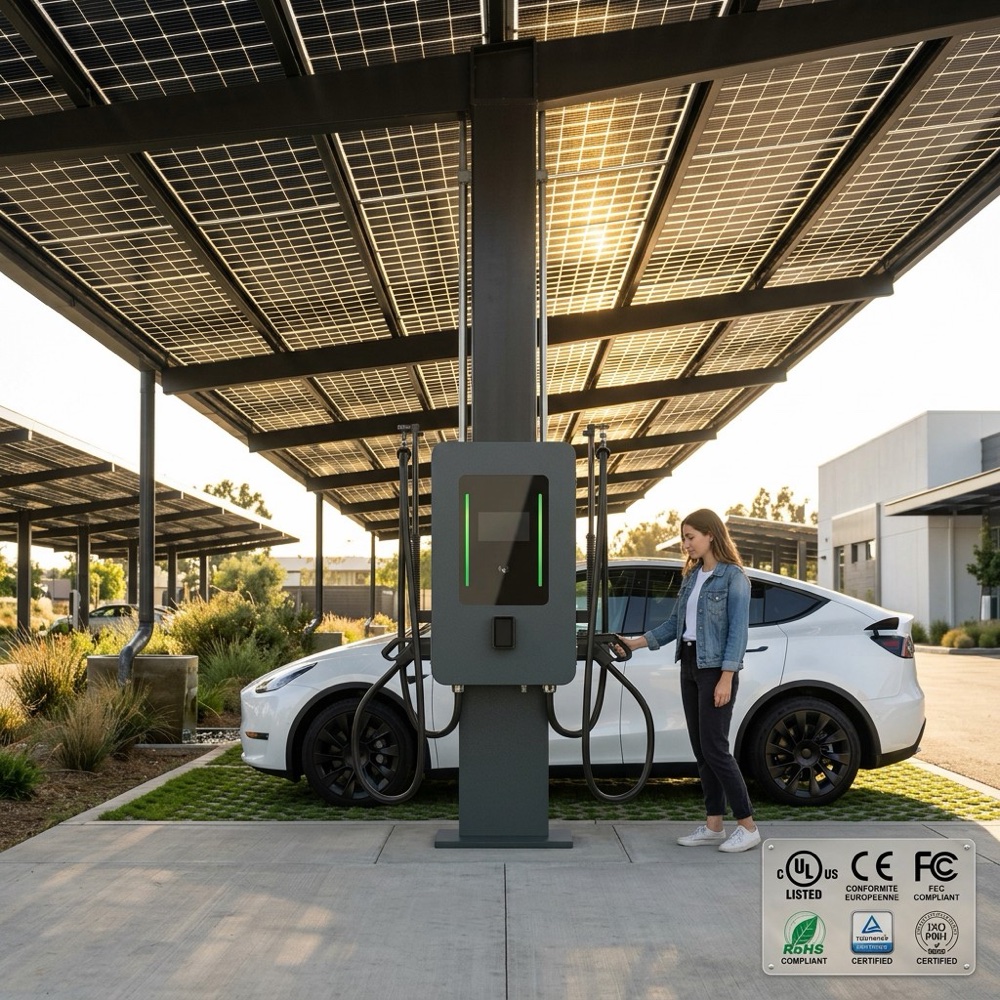
From One-Way Charging to Bidirectional Energy Flows
Every EV charger sold before roughly 2023 shares a defining assumption: energy flows in one direction, from the grid into the vehicle. Bidirectional charging reverses that assumption. When a vehicle is parked — which is more than 90% of the time for most cars and a large share of the time even for commercial vans — its battery becomes dispatchable storage: capable of exporting energy to the building it is plugged into, to other loads, or back to the distribution grid. The scale is not trivial. A single 80 kWh fleet van connected to a 20 kW bidirectional port can shave 20 kW of building peak for four hours; a ten-vehicle depot can shift hundreds of kilowatt-hours across a day.
The commercial logic is straightforward. Grid operators pay for flexibility; commercial buildings pay heavily for peak demand; and renewable-heavy grids increasingly punish consumption during low-supply windows. A bidirectional charger lets the site owner monetize the vehicle battery in whichever market or tariff structure is most favorable — and to switch strategies as tariffs evolve. This is why the industry shorthand “V2X” refers not to a single application but to a portfolio of them.
The V2X Landscape: V2G, V2B, V2H, and V2L
Each V2X variant targets a different counterparty and value stream. Vehicle-to-load (V2L) is the simplest: the vehicle powers external equipment — tools, mobile units, site lighting — typically through an onboard inverter at 3–10 kW. Vehicle-to-home (V2H) exports to a residence, primarily for backup and self-consumption of rooftop solar. Vehicle-to-building (V2B) serves commercial facilities with demand-charge reduction and peak shaving, generally at 10–30 kW per vehicle through AC or DC interfaces. Vehicle-to-grid (V2G) is the broadest: exporting to the distribution network under a grid-services contract, whether for frequency regulation, capacity markets, or utility demand-response programs. The table below compares the four flows.
| Application | Energy Direction | Typical Power per Vehicle | Primary Value | Key Enablers |
|---|---|---|---|---|
| V2L (vehicle-to-load) | Vehicle to external load | 3–10 kW | Portable power, site operations | Onboard inverter, standard socket |
| V2H (vehicle-to-home) | Vehicle to home | 7–11 kW | Backup, solar self-consumption | Bidirectional AC/DC converter, islanding switch |
| V2B (vehicle-to-building) | Vehicle to building | 10–30 kW | Peak shaving, demand-charge reduction | Site energy management, OCPP 2.0.1 coordination |
| V2G (vehicle-to-grid) | Vehicle to distribution grid | 10–125 kW (DC) | Frequency services, capacity, arbitrage | Grid codes, metering, aggregator contract |
Standards and Protocols That Make It Possible
Bidirectional operation is not simply a matter of hardware; it requires a coordinated standards stack. On the vehicle-to-charger link, ISO 15118-20 defines bidirectional power transfer, dynamic charging control, and the certificate flows needed for secure authorization — the successor to the ISO 15118-2 functions that already underpin Plug & Charge. On the charger-to-network link, OCPP 2.0.1 provides the message infrastructure for dispatching, metering, and reporting discharge sessions to a charge point management system, which in turn interfaces with the aggregator or utility. The earliest deployed V2G fleets used the CHAdeMO protocol, which supported bidirectional power transfer from its early revisions; the CCS ecosystem is now converging on ISO 15118-20 as its bidirectional path, with compatible vehicles arriving from major OEMs through 2026–2027.
For the site, additional layers matter: energy management software that decides when to discharge, bidirectional metering that settles energy in both directions, and islanding protection that guarantees the charger cannot back-feed the grid during a utility outage. None of these are exotic technologies — they are the same components that industrial battery energy storage systems have used for years — but they must be specified deliberately rather than assumed.
What DC Wallbox Infrastructure Needs for V2G
A DC wallbox that can host future bidirectional vehicles differs from a one-way unit in four specific ways. First, the power stage: the AC/DC converter must be a bidirectional topology that can invert DC from the vehicle back to synchronized AC at the site boundary — a design decision, not a firmware flag. Second, the voltage window: a wide range such as 150–1000 V matches the battery voltages of current and announced bidirectional vehicles, including 400V and 800V architectures; a narrow-range unit silently excludes part of the future fleet. Third, communication: ISO 15118-20 readiness and OCPP 2.0.1 support are the hooks that let an energy management system command discharge with the same reliability it commands charging. Fourth, protection and metering: bidirectional metering, isolation monitoring, and anti-islanding features are prerequisites for grid-connected discharge and for the certifications that utilities will demand.
The practical implication for procurement is that a dual-gun wallbox with wide-voltage output, intelligent load balancing, and OCPP networking — the same hardware class deployed for today’s fast charging — is also the correct foundation for tomorrow’s V2G. Units such as the smart commercial dual-gun wall-mounted DC fast charging stations, the 80kW dual-gun wallboxes with intelligent load balancing, and the intelligent dual-gun wallbox chargers with load balancing for multi-vehicle use build the site-level intelligence and voltage flexibility that bidirectional vehicles will plug into.
The Business Case in 2026: Where V2X Earns First
The earliest commercial V2X deployments are earning money in three places. Demand-charge reduction is the most dependable: a commercial site paying demand charges of USD 15–30 per kW per month can shave 50–100 kW of peak for two to four hours using fleet batteries, saving thousands of dollars per month with a small, dispatchable fleet. Tariff arbitrage is second: charging during low-price windows and discharging during high-price windows captures the spread, which is widening as renewable penetration increases price volatility. Frequency regulation and capacity markets are third, and they pay the highest rates but demand aggregation, strict availability commitments, and grid-code compliance that most single-site operators are not yet equipped to meet.
Three variables temper the economics. Battery degradation from cycling remains a negotiation point between the fleet owner and the site owner — modern LFP and high-nickel chemistries tolerate thousands of cycles, but the cost of extra cycling must be priced into the V2X contract. Tariff design in many markets still treats discharge unfavorably or is being revised; early adopters should model both current and projected rates. And grid connection rules determine whether a site may export at all — some distribution networks cap or prohibit back-feed, which is why V2B (discharging into the building, no grid export) is often the fastest path to revenue for commercial sites.
Future-Proofing Your Procurement Today
The cost of preparing for V2X is small when done at specification time and large when done retrospectively. The specification language below captures the essentials:
- Bidirectional-ready power stage: require converters with bidirectional topology or a documented upgrade path, not a vague “V2G future” commitment.
- Wide voltage range: specify 150–1000 V DC output to cover 400V and 800V bidirectional vehicles.
- Communication stack: require OCPP 2.0.1 support and ISO 15118-20 readiness with a named firmware roadmap.
- Site integration: confirm the charger can be commanded by an energy management system via open APIs or Modbus/OCPP smart-charging profiles.
- Protection and metering: specify bidirectional metering, isolation monitoring, and anti-islanding protection with corresponding certification evidence.
For operators standardizing on a hardware platform, the high-efficiency wall-mounted dual-gun DC EV chargers and the compact mini dual-gun DC fast charging stations illustrate the network-managed, dual-connector wallbox format that keeps capital efficient today while preserving the integration surface that V2X programs will use tomorrow. The energy strategy decision is not about buying bidirectional hardware this quarter — it is about refusing to buy hardware that makes bidirectional capability impossible later.
Frequently Asked Questions
Q1. What is the difference between V2G and V2X?
V2X is the umbrella term for all vehicle-to-everything energy flows — V2G, V2B, V2H, and V2L. V2G specifically means exporting energy from the vehicle to the distribution grid, usually under a grid-services contract.
Q2. Can existing AC wallboxes support V2G?
Some AC bidirectional wallboxes exist for V2H applications, but most V2G deployments use DC connections because the vehicle’s onboard charger is typically one-way. DC bidirectional stations move the two-way power electronics into the charger, where they are easier to certify and control.
Q3. Does V2G damage electric vehicle batteries?
Bidirectional discharge adds cycling, which contributes to battery aging, but modern battery chemistries and thermal management make controlled V2G cycling manageable. The cost is priced into the business case and can be mitigated by limiting depth of discharge and operating within moderate power windows.
Q4. Which protocol enables bidirectional charging?
ISO 15118-20 defines bidirectional power transfer and dynamic control on the vehicle-to-charger link, while OCPP 2.0.1 coordinates discharge sessions on the charger-to-network link. Early bidirectional fleets used CHAdeMO.
Q5. What is demand-charge reduction in the V2B context?
Commercial electricity bills often include a charge based on the highest 15-minute power draw in the month. V2B discharges fleet batteries during those peak windows, lowering the measured peak and therefore the demand charge for the entire month.
Q6. Do I need a special tariff to make V2G profitable?
Yes, tariff structure is decisive. Time-of-use rates with a meaningful day-night spread make arbitrage viable, and utility programs that pay for export or for availability make grid services profitable. Check your market’s tariff and grid-connection rules before committing.
Q7. Should I buy bidirectional chargers now even if my vehicles are not bidirectional yet?
Not necessarily. The efficient strategy is to buy bidirectional-ready infrastructure — wide voltage range, OCPP 2.0.1, load balancing, open APIs — and upgrade the power stage or firmware when bidirectional vehicles and tariffs justify it, rather than paying the bidirectional premium before it earns.
Post time: Sep-01-2026