
Why B2B Fleet Operators are Choosing All-In-One Media Chargers
Quick Answer: B2B fleet operators are choosing all-in-one media chargers in 2026 because a charging station that also carries a smart display and a cloud management stack solves three fleet problems at once: energy cost control, operational communication, and asset utilization. A single 180kW–240kW unit with an integrated advertising screen serves depot and hub duty cycles, displays driver alerts and safety messaging without a separate signage network, and monetizes idle time through third-party media when fleet vehicles are not charging. The all-in-one architecture also collapses procurement and maintenance: one vendor, one enclosure, one OCPP-certified management platform for energy, sessions, and content. For fleet operators whose vehicles idle on site for predictable windows, the media charger is not a marketing gimmick; it is a utilization play that turns parked hardware and waiting time into a measurable revenue and communication asset.
Key Takeaways:
- One asset, three jobs — charging, driver-facing communication, and third-party media revenue are consolidated in a single floor-mounted unit.
- Depot screens replace paper and signage — safety briefings, shift notices, and load-management alerts reach drivers at the exact moment they are next to their vehicle.
- Idle time becomes billable — fleet vehicles occupy bays for predictable windows; the display turns those windows into advertising inventory with near-zero marginal cost.
- OCPP + cloud is the integration key — 1.6J/2.0.1 compliance and 4G/WiFi/Ethernet connectivity let the charger talk to telematics, ERP, and energy systems.
- RFID/APP/POS access covers every driver type — badge-in for employees, APP for contractors, and card for occasional users on the same hardware.
The Fleet TCO Problem That Media Chargers Solve
Fleet electrification in 2026 is an asset-management exercise, not a vehicle purchase. Operators who ran the numbers on total cost of ownership (TCO) discovered that energy procurement, charger utilization, and driver productivity dominate the financial outcome more than the price of the vehicles. The all-in-one media charger addresses all three line items from a single piece of hardware, which is why procurement teams are specifying it in tenders alongside the trucks and vans themselves.
The utilization problem is the sharpest. A depot charger that serves a shift-change peak of two hours a day sits idle for the other twenty-two. A hub charger serving en-route vehicles may be busy only during defined windows. Every idle hour is capital that returns nothing. The media charger attacks this directly: the display monetizes idle time through advertising or internal communication, and the dual-gun configuration doubles the throughput of the busiest hours. Operators who previously accepted 10–20% utilization on depot hardware now model 30–50% with combined energy and media yield, and the payback math follows.
What “All-In-One” Means in Fleet Operations
All-in-one media chargers integrate three subsystems that fleet operators previously bought separately: the DC charging core, the digital display, and the management platform. Consolidation matters operationally because it removes interfaces. A charger from one vendor, a signage network from a second, and a reporting dashboard from a third means three contracts, three maintenance schedules, and three failure modes. The integrated unit has one enclosure, one power connection, one network gateway, and one support chain.
The Charging Core
The charging core is specified for fleet duty: 1000V DC output, dual-gun intelligent power distribution, and power classes from 60kW for light-duty depots to 400kW for heavy-truck and high-turnover hubs. The 180kW–240kW bracket is the fleet sweet spot because it completes a typical 40–80kWh top-up in 20–40 minutes, matching driver rest and loading cycles. Floor-mounted designs in the AD20 series suit depots because they eliminate wall-mount constraints and keep the unit serviceable from all sides.
The Display and Its Fleet-Specific Jobs
The display is where the all-in-one concept earns its keep in a fleet context. The same 32–55-inch high-brightness 4K panel that carries third-party advertising during idle windows delivers driver-facing content during shift changes: safety briefings, route notices, charging-slot assignments, and real-time load-management messages. Because content is managed from the cloud, a depot manager can push a revised briefing to every bay in seconds, which is impossible with printed signage and far more reliable than email-to-cab communication for shift workers.
The Management Platform
The management platform ties energy and content together. OCPP 1.6J and 2.0.1 compliance means the charger participates in the operator’s existing energy-management and roaming systems, while the Android-based media player accepts playlists from the same platform that schedules charging. The 60kW–180kW advertising charging station with a cloud management system illustrates the light-depot configuration, where cost control and remote management matter more than peak power.
| Capability | Separate Systems | All-In-One Media Charger |
|---|---|---|
| Vendors / contracts | Charger + signage + software (3+) | 1 |
| Power and network connections | Separate per subsystem | Shared, single gateway |
| Driver-facing communication | Printed signs / separate screens | Integrated display, cloud-pushed |
| Idle-time revenue | None | Advertising inventory on existing screen |
| Maintenance schedule | Multiple | Single enclosure, single SLA |
Depot and Hub Deployment Patterns
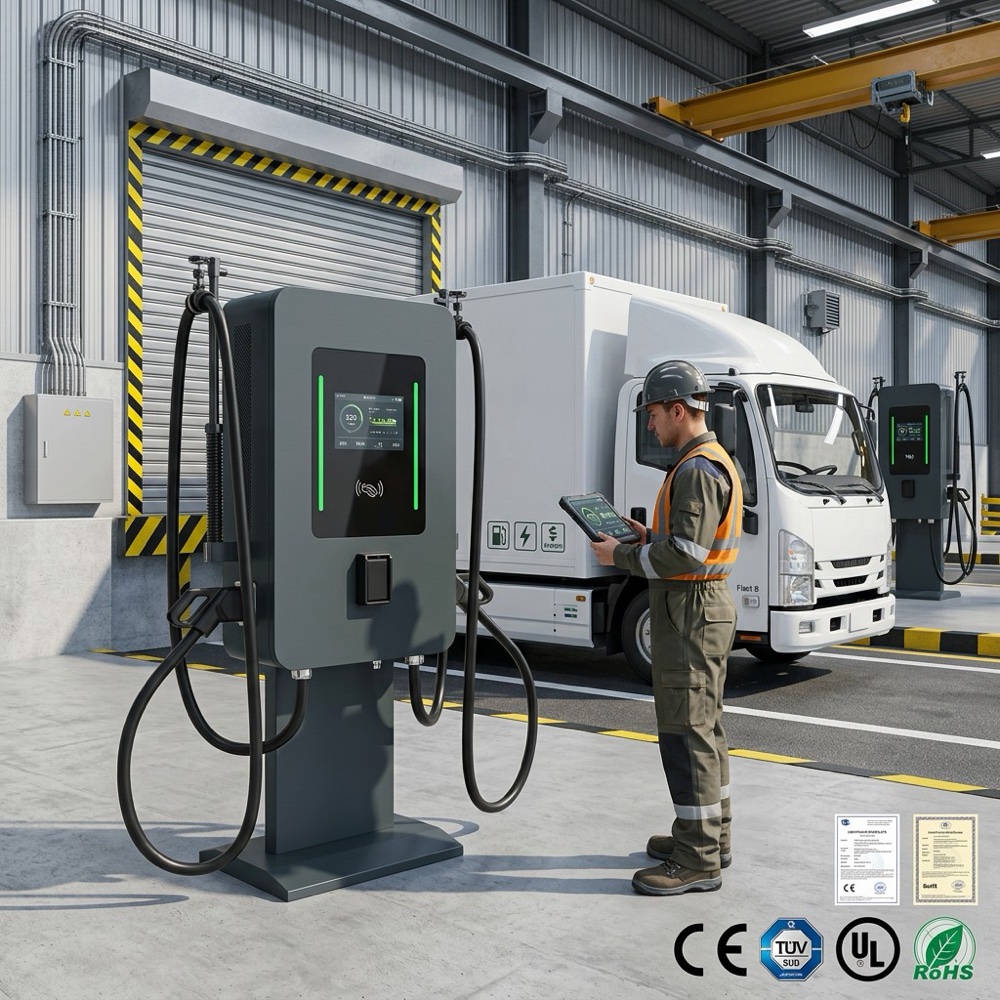
Fleet charging divides into two rhythms, and the media charger is specified differently for each. The depot pattern is characterized by predictable peaks: vehicles return in waves, charge for defined windows, and leave on schedule. The hub pattern is characterized by opportunistic sessions: vehicles arrive en route, charge for 20–40 minutes, and depart. Both patterns benefit from dual-gun throughput, but they differ in power class and screen content strategy.
The Depot Pattern
Depots favor 180–240kW units with RFID badge access so drivers authenticate with the same credential they use for gates and fuel. Screen content in depots is dominated by internal communication: shift handover notices, safety reminders, charging-slot allocation, and load-shedding instructions when the site’s power budget is tight. The 240kW floor-mounted commercial DC station with an advertising display screen is a strong depot reference: CE certification shortens permitting, dual-gun distribution handles wave arrivals, and the display carries both internal messaging and, during off-peak windows, third-party media.
Badge-First Access
RFID badge authentication ties charging to existing depot credentials and access logs.
The En-Route Hub Pattern
En-route hubs favor the same power classes but a different content mix. Drivers arriving mid-shift need navigation, wait-time information, and quick-service options, so the screen leans toward operational wayfinding and, where third-party media is sold, local services advertising. The high-power 240kW station with advertising screen and OCPP protocol fits this pattern: high throughput keeps the queue moving, and OCPP compliance lets the hub operator aggregate sessions with the wider network.
The Operational Use Cases for Fleet Screens
Fleet operators deploy the integrated display across a defined set of use cases, each with a measurable operational outcome:
- Safety and compliance briefings. Push daily or shift-specific safety content to every bay; log that content was displayed, supporting compliance records.
- Load-management visualization. Show live power-budget status so drivers know when to delay plug-in and avoid site overloads during peak energy pricing.
- Slot and queue allocation. Display which bay is next, which connector is available, and estimated wait time, cutting idle queuing at shift change.
- Driver and contractor notices. Route changes, gate codes, and policy updates reach drivers at the vehicle, not in an email they will read tomorrow.
- Third-party advertising in idle windows. Sell off-peak screen time to local suppliers and services; the inventory is a direct revenue line on the charging asset.
- Energy-cost nudges. Show live tariff windows so drivers can shift sessions to cheaper periods, reducing the site’s average energy cost per kWh.
| Fleet Use Case | Content | Operational Outcome |
|---|---|---|
| Shift-change communication | Briefings, slot allocation | Faster bay turnover, fewer queuing delays |
| Safety compliance | Daily briefs, incident notices | Verifiable content delivery records |
| Energy management | Live tariff and load status | Lower average cost per kWh |
| Idle-time monetization | Local advertising | New revenue on underused assets |
ROI for Fleet Operators
The fleet ROI case combines four lines: energy cost control, avoided signage spend, driver productivity, and third-party media revenue. Energy cost control comes from load management and tariff-aware scheduling, both of which the platform supports natively. Avoided signage spend is direct: a depot that previously maintained printed boards, wall screens, and a content agency replaces them with the charger displays at near-zero marginal cost. Driver productivity gains are harder to quantify but appear in queue times and briefing compliance. Third-party media revenue is the smallest line early on but the most scalable, because it monetizes hours that otherwise return nothing.
| Value Line | Mechanism | 3-Year Estimate (per 240kW bay) |
|---|---|---|
| Energy cost control | Tariff-aware scheduling, load limits | USD 2,000–6,000 saved |
| Avoided signage & comms spend | Replaces printed boards and wall screens | USD 1,500–5,000 saved |
| Media revenue (idle windows) | Third-party advertising on display | USD 1,000–6,000 earned |
| Throughput gain (dual gun) | 2 vehicles per bay at peak | Higher fleet availability |
Technical Requirements Checklist
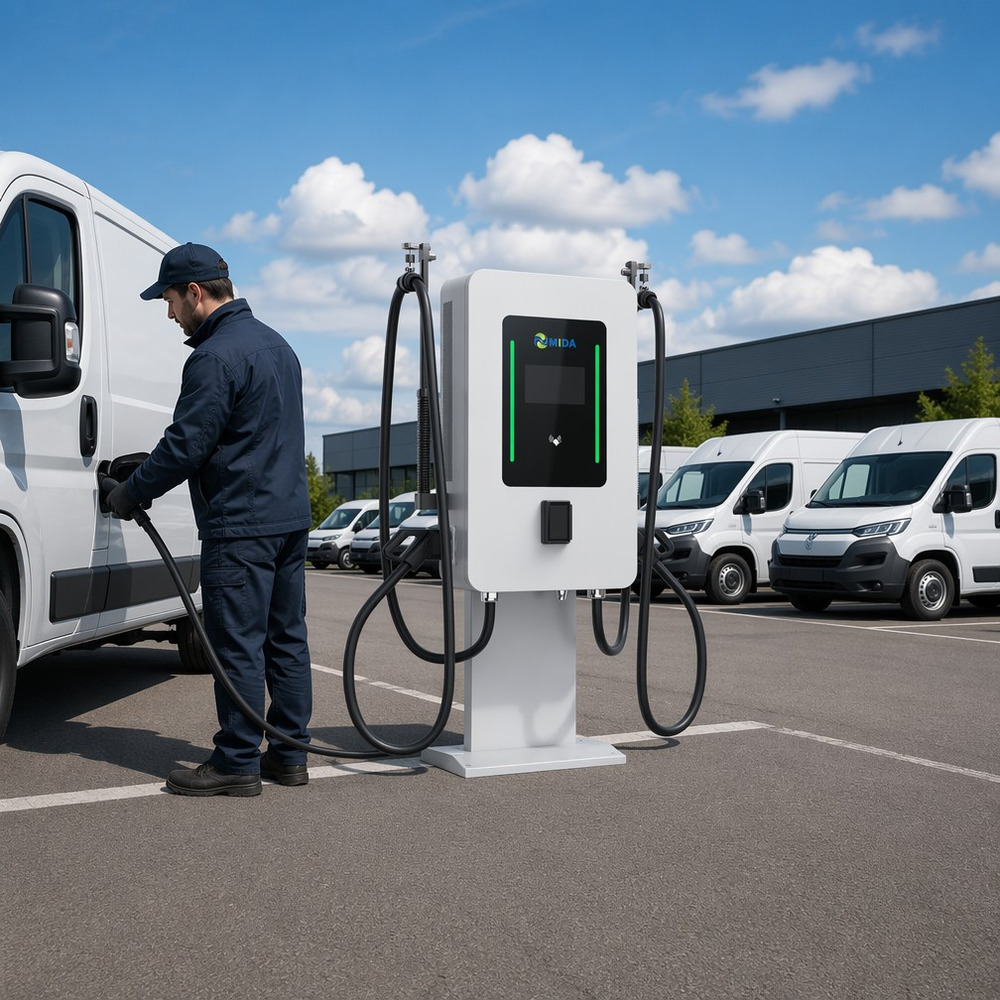
Fleet operators writing an all-in-one media charger tender should verify the following requirements before award:
- OCPP 1.6J and 2.0.1 compliance with documented certification, so the charger joins roaming and energy-management systems without custom integrations.
- 1000V DC output and dual-gun intelligent distribution to cover mixed fleets and two-vehicle peak arrivals.
- Multi-credential access — RFID for employees, mobile APP for contractors and ad-hoc users, POS for public use, all on one unit.
- High-brightness outdoor-rated display (32–55-inch 4K) for daylight legibility in open depots and hubs.
- Cloud content management with role-based access, so depot managers control messaging without touching charging operations.
- IP54 or better enclosure rating and 24/7-rated components for continuous commercial duty.
- Remote diagnostics and OTA updates to minimize truck rolls across distributed sites.
Integration with Telematics and Energy Systems
The all-in-one charger reaches its full value only when it participates in the operator’s wider systems. OCPP compliance gives the energy team session data in standard format, which feeds load forecasting and tariff optimization. The dual-socket 180kW variant with RFID card reader, such as the 180kW dual-socket station with RFID and a smart media display, is a practical bridge between fleet and public use: fleet drivers badge in, while walk-up users authenticate by APP or card, and both session types land in the same reporting stream. Operators increasingly connect charger data to vehicle telematics, so a vehicle’s state of charge on arrival can pre-allocate a bay, and to energy-management systems, so charging windows respond to real-time grid signals. The professional 120kW floor-stand station with APP control demonstrates the lighter integration profile for service fleets and business parking, where APP-based access and remote monitoring carry most of the value.
FAQ
1. Why would a fleet operator pay for a screen on a charger?
Because the screen serves three purposes: driver-facing safety and shift communication, load-management visualization, and third-party advertising revenue during idle windows. It replaces separate signage spend and monetizes hours when the charger would otherwise return nothing.
2. What power class do fleet operators choose?
Light-duty depots typically deploy 60–120kW; mixed and heavy-duty operations choose 180–240kW; high-turnover en-route hubs evaluate 360–400kW. Dual-gun distribution is standard so two vehicles can charge during peak arrival waves.
3. Can fleet drivers and the public share the same charger?
Yes. AD20-series stations support RFID badges for employees, mobile APP for contractors and ad-hoc users, and POS cards for public access, with all session types reported through the same OCPP-compliant platform.
4. How does the screen help control energy costs?
The display can show live tariff windows and load-budget status, nudging drivers to delay plug-in during peak pricing, while the OCPP platform feeds session data to load forecasting and energy-management systems.
5. Do all-in-one media chargers integrate with existing telematics?
Yes. OCPP 1.6J/2.0.1 compliance provides session data in a standard format that telematics and energy platforms can consume, enabling bay pre-allocation by state of charge and grid-responsive scheduling.
6. What maintenance burden does the display add?
Very little. The display is integrated into a single IP54-rated enclosure with the charging core, content updates over the air, and remote diagnostics that reduce truck rolls compared with separate signage networks.
7. What certifications should a fleet tender require?
Require CE certification, IP54 weather rating, documented OCPP 1.6J/2.0.1 compliance, and 24/7 commercial-duty components. These protect permitting, outdoor reliability, and integration with roaming and energy systems.
Conclusion: The Charger as a Fleet Asset, Not an Expense
B2B fleet operators are choosing all-in-one media chargers because the category finally aligns hardware with how depots and hubs actually operate. The charging core handles fleet duty cycles; the integrated display replaces an entire separate signage stack and monetizes idle time; and the OCPP-certified cloud platform ties energy, content, and telematics together under one contract and one support chain. The adoption is visible across the AD20 series, from CE-certified 240kW floor-mounted stations anchoring depots to dual-socket 180kW RFID stations bridging fleet and public use. In 2026, the question for fleet operators is no longer whether charging hardware should carry a display; it is which operating model—internal communication, media revenue, or both—each bay should be assigned to.
Post time: Aug-25-2026