
Optimizing Zero Downtime for Urban Logistics Fleets with Dual-Gun DC Charging Infrastructure
Quick Answer
Zero downtime for urban logistics fleets is achievable when charging infrastructure is engineered around vehicle availability, not energy throughput. Dual-gun DC charging infrastructure delivers this by enabling opportunity charging inside the working shift: a van that returns to the depot for 25–40 minutes between delivery waves can recover 40–60% of state of charge without leaving the duty cycle. Combined with overnight depot charging, scheduled power sharing, and OCPP-driven session orchestration, dual-gun wallboxes let fleet operators compress charging into existing dwell windows, keep vehicles on the road for 20+ hours per day, and hold fleet availability above 98%. The optimization lever is the charger’s dual connector and scheduling intelligence, which together convert idle bay time into productive charging time.
Key Takeaways
- Zero downtime is a scheduling and infrastructure problem: dual-gun DC chargers let fleets charge during natural 20–40-minute shift gaps instead of dedicating off-shift charging windows.
- Opportunity charging at 40–80kW recovers 40–60% state of charge in 25–40 minutes, which is sufficient for most urban delivery wave structures.
- Dual-gun power sharing maximizes utilization of scarce depot bays and grid capacity, reducing the infrastructure required for a given fleet size.
- OCPP 1.6J telemetry and fleet management integration enable predictive session planning, remote diagnostics, and uptime above 98% at the charger level.
- Redundancy design — dual connectors, distributed deployment, and sparing strategy — protects the depot from single-point failure during peak waves.
Defining Zero Downtime in the Urban Delivery Context
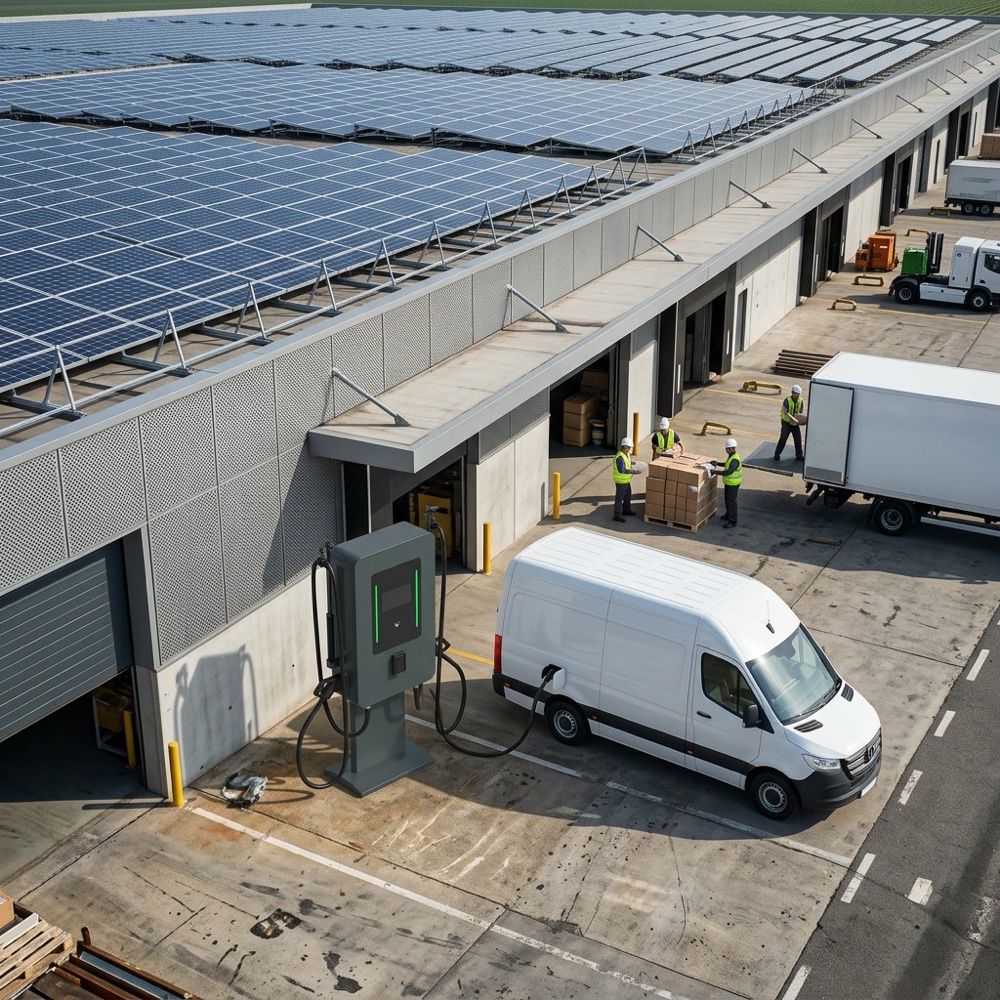
In passenger charging, “downtime” usually means a broken charger. In urban logistics, the meaning is stricter: downtime is any minute a vehicle cannot perform its scheduled route because of charging. Delivery economics are unforgiving — a modern urban fleet generates revenue only while vehicles are moving, and every idle vehicle hour carries a direct cost in missed stops, late penalties, and extra labor. Operators targeting zero downtime are therefore not optimizing charging for its own sake; they are optimizing the intersection of vehicle availability, bay availability, and grid capacity.
Urban logistics differs from long-haul trucking in three structural ways. Routes are short (80–200km per day), return-to-depot frequency is high (two to five returns daily), and dwell windows between waves are short but predictable. This creates an ideal profile for DC opportunity charging: power high enough to add meaningful range in minutes, yet modest enough that multiple wallboxes fit within a typical warehouse service capacity.
Why Dual-Gun DC Charging Is the Right Architecture
Opportunity charging inside the duty cycle
The core insight of zero-downtime design is that charging should happen when the vehicle is already idle. A dual-gun DC wallbox enables this by making every depot return productive. When a van pulls in at 10:40 with 32% state of charge and departs at 11:15, a 40–80kW session adds 15–25kWh — enough for the next 60–90km wave. Over a five-return day, these micro-sessions aggregate into 80–120kWh delivered without a single dedicated charging block. The vehicle never leaves its revenue-generating schedule, and the depot needs no overnight staging area beyond the normal parking layout.
Power sharing doubles bay productivity
Depot bays are expensive real estate, and grid connections are hard-won. A dual-gun wallbox serves two vehicles per bay, with the controller allocating power according to each session’s urgency. During a compressed midday wave, the charger can deliver full 80kW to one vehicle while the second is topped up at lower power, then reverse the priority as vehicles swap. The effect is that a depot with eight wallboxes can support 16 vehicles in rotation — a 2x reduction in charging footprint and connection capacity compared with single-gun layouts.
Comparing Charging Strategies for Urban Fleets
Fleet operators choose among three primary strategies; the table summarizes how each contributes to availability.
| Strategy | Charging Window | Typical Power | Availability Contribution | Depot Capex | Best Scenario |
|---|---|---|---|---|---|
| Overnight depot charging (AC/DC) | Off-shift, 6–8 hours | 7–22kW AC or 40kW DC | Baseline range for daily routes | Low | Stable routes with full overnight dwell |
| Midday opportunity charging | Shift gaps, 20–40 min | 40–80kW DC | Extends range; enables 2nd/3rd wave | Medium | Multi-wave urban delivery |
| Mixed dual-gun scheduling | Overnight + all gaps | 40–80kW DC, shared | Highest; 20+ hour vehicle availability | Medium–High | High-utilization fleets targeting zero downtime |
The mixed strategy is where dual-gun infrastructure earns its keep. Overnight sessions handle the base load at low cost per kilowatt-hour, while daytime micro-sessions absorb the unpredictable demand of surge waves, returns, and route extensions. Because both modes run on the same hardware, the depot avoids the complexity of managing two parallel charging estates.
The Uptime Engineering Stack
OCPP 1.6J session orchestration
Zero downtime cannot be delivered with dumb chargers. OCPP 1.6J provides the session-level control that fleet schedulers need: remote start/stop, real-time status polling, transaction records, and firmware management. When integrated with a fleet management platform, the charger becomes a controllable asset: the dispatcher can reserve a bay, trigger a boost session before a departing wave, and receive alerts the moment a session faults. fleet-preferred dual-gun wall-mounted DC fast chargers with CCS2/GBT standards ship with this integration surface as standard, which is why they dominate 2026 depot tenders.
Remote diagnostics and predictive maintenance
Charger-level uptime above 98% requires knowing about a fault before the fleet does. Modern wallboxes report component temperatures, power module status, connector cycle counts, and communication health to the backend. Fleet operators use this telemetry to schedule maintenance during low-activity night windows, replace connectors on a cycle-count basis rather than after failure, and pre-stage spare units for high-traffic depots. The combination of dual connectors and modular power modules means a connector failure does not take the whole bay offline — the second gun keeps serving vehicles while the failed connector is swapped.
Scheduling algorithms for multi-wave operations
The scheduling layer decides which vehicle gets power when multiple vehicles share a bay rotation. Modern depot software solves this as a constraint problem: each vehicle has a departure time, an energy target, and a charging curve; each charger has a power budget and two guns. The optimizer minimizes the number of under-charged departures by assigning power in proportion to urgency and by preferring vehicles whose charging curves are still in their high-power region. Because dual-gun wallboxes expose per-gun power control, the optimizer can schedule two sessions per unit simultaneously rather than serializing them — a scheduling granularity that single-gun estates simply cannot offer, and one that typically lifts depot throughput by 20–40% in multi-wave operations.
Redundancy by design
Depot architects designing for zero downtime distribute risk rather than concentrate it. Rather than one large 240kW cabinet serving four bays, the same site is often served by three dual-gun 80kW wallboxes: if one unit fails, the fleet loses two bays out of six instead of four out of four, and the remaining units can carry the load with power sharing. This distributed philosophy extends to electrical design — separate feeders, surge protection, and metering per group of units — and to operations, where a shared spare-unit pool per city hub shortens mean time to repair from days to hours.
Planning Capacity for a Zero-Downtime Depot
A practical design method starts from the fleet schedule rather than the charger brochure. The planner lists every vehicle, its daily energy requirement, its expected return times, and the available dwell windows. From this, the planner derives two numbers: peak simultaneous demand at the depot, and the energy that must be delivered inside the shortest guaranteed window. The first number sizes the grid connection and load management system; the second sizes the charger power per bay. In most urban cases, the math lands on 40–80kW per bay, which is precisely the envelope of modern dual-gun wallboxes — professional 80kW dual-gun wall-mounted DC fast charging stations designed for fleet management, paired with OCPP 1.6J dual-connector wall-mounted DC charging stations, and access-managed with RFID-controlled dual-gun commercial DC chargers where shift-based authorization is required. Premium 80kW dual-gun wallbox DC fast charging stations serve as the high-throughput backbone of the depot, while the fleet-preferred 40–80kW units cover the secondary bays.
Two operational practices close the loop. First, reserve at least 10% of daily charging capacity as buffer for surge days, route extensions, and cold-weather energy demand. Second, enforce a session-priority policy in software: vehicles with the earliest departure get power priority, and lower-priority sessions are throttled — a capability that requires chargers with proper power-sharing and scheduling firmware, not just two physical connectors.
Measuring Zero Downtime: KPIs That Matter
- Vehicle availability rate: percentage of scheduled vehicle-hours actually served; the target is ≥98%.
- Charger uptime: percentage of time each wallbox is available and communicating; target ≥98.5% with redundant bays.
- Opportunity-charge share: percentage of total depot energy delivered during daytime gaps; a rising share indicates the schedule is compressing charging into dwell time.
- Bay utilization: sessions per bay per day; dual-gun deployments should exceed single-gun by 70–100%.
- First-time fix rate: percentage of charger faults resolved remotely or by the first dispatched technician; 80%+ indicates a healthy telemetry and sparing program.
Review cadence matters as much as the metrics themselves. The most effective 2026 operations review these KPIs weekly against the route plan, because delivery patterns shift faster than quarterly reviews can catch. When opportunity-charge share or bay utilization drifts, the corrective action is usually scheduling software tuning or a small hardware rebalance — both far cheaper than discovering the drift through missed departures.
FAQ
What does zero downtime actually mean for a delivery fleet?
It means vehicles never miss a scheduled route because of charging. Charging happens inside existing idle windows, so vehicle availability stays above 98% even during peak delivery seasons.
How much range can a 25-minute charge session add?
At 60kW average power, a 25-minute session adds roughly 25kWh — enough for 80–120km of urban driving, which typically covers one full delivery wave.
Why are dual-gun chargers better than single-gun units for depots?
Dual-gun units serve two vehicles per bay with shared power, doubling bay throughput and cutting the grid capacity and floor space needed to support a given fleet size.
Do we still need overnight charging if we use opportunity charging?
Yes. Overnight charging handles the energy base load at lower cost per kilowatt-hour; opportunity charging absorbs daytime variability. The two modes are complementary on the same dual-gun hardware.
How does OCPP help prevent charging downtime?
OCPP enables remote start/stop, live status monitoring, fault alerts, and firmware updates, so operators detect and resolve issues before they disrupt the fleet schedule.
What happens if a charger fails during the peak morning wave?
With distributed dual-gun deployment, a single unit failure costs only two bays, and remaining units cover the load via power sharing. A spare-unit pool plus remote diagnostics keeps recovery time to hours.
How should we size charger power for our depot?
Size from the schedule: identify the shortest guaranteed dwell window and the energy each vehicle needs in that window, then divide energy by time. For most urban multi-wave operations this lands at 40–80kW per bay.
Post time: Sep-01-2026