
Navigating the 800V Era: Why 1000V DC Wall-Mounted Chargers are the Future for B2B Fleets
Quick Answer
The 800V vehicle architecture is now mainstream in commercial fleets, and it is rendering 500V-class chargers obsolete. A 1000V DC wall-mounted charger future-proofs B2B fleet infrastructure because it charges 400V and 800V vehicles at their native voltages, eliminates onboard conversion losses, and sustains full power across the 150–1000V range as battery chemistries evolve. For fleet operators, the decision is total cost of ownership: 1000V-ready hardware avoids a forced mid-contract replacement cycle when the fleet mix shifts to 800V trucks and vans, and it cuts charge time on 800V vehicles by 30–45% compared with 500V equipment. Compact wall-mounted 1000V chargers also solve the space and permitting constraints of urban depots, making them the standard choice for 2026 fleet tenders.
Key Takeaways
- 800V vehicles now dominate new commercial EV launches, and charging infrastructure must support 150–1000V output to charge them at native battery voltage without onboard conversion losses.
- 1000V-ready chargers reduce charge time by 30–45% on 800V vehicles versus 500V-class hardware, directly improving fleet vehicle utilization.
- Wall-mounted form factor lowers depot capex by 30–50% versus pedestal cabinets and simplifies permitting in space-constrained urban sites.
- Dual-gun configurations with dynamic power sharing let fleets serve mixed 400V/800V fleets from a single unit, maximizing bay productivity.
- Procuring 1000V-capable equipment now eliminates the forced infrastructure replacement cycle that 500V buyers face by 2028–2029.
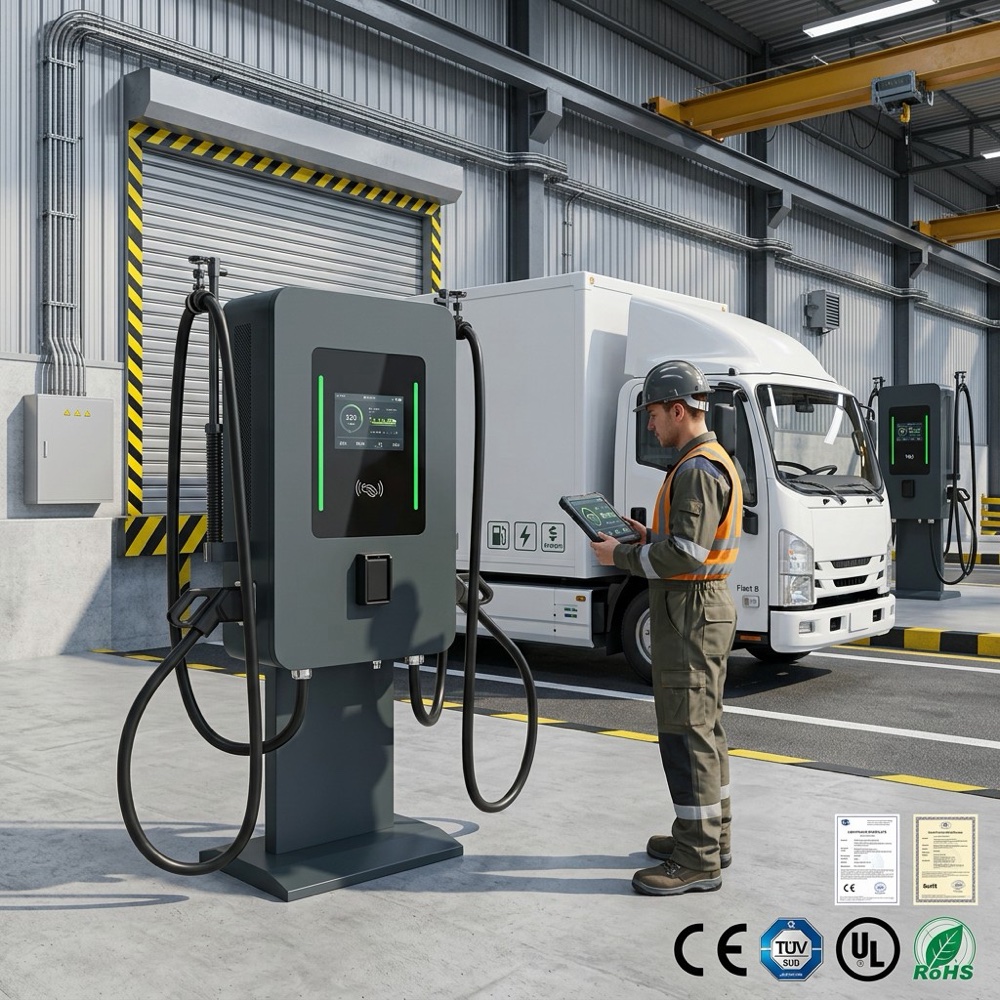
The 800V Shift Is No Longer a Premium Niche
Four years ago, 800V battery architecture was a differentiator reserved for high-end passenger EVs. In 2026, it is the default engineering direction for commercial vehicles. Major European, Chinese, and North American OEMs have moved their electric truck and delivery van platforms to 800V-class packs, drawn by three compounding advantages: thinner high-voltage cables that reduce weight and cost, lower current at equivalent power that shrinks thermal management requirements, and faster charging capability that restores range more quickly between shifts. Industry teardown data shows that more than 60% of new electric LCV and MDV platforms announced for 2026–2028 are 800V-based.
This shift changes the rules for charging infrastructure. The voltage rating of the charger, not its nominal power, is now the binding constraint on fleet performance. A charger that tops out at 500V can still deliver energy to an 800V vehicle, but only by relying on the vehicle’s onboard DC-DC converter to step voltage down — a conversion path that adds heat, extends charge time, and wastes energy. A 1000V charger connects directly to the 800V pack, eliminating the conversion entirely and unlocking the full power capability of both the vehicle and the charger.
Why Voltage Range Determines Fleet Productivity
Fleet productivity in electric operations is governed by a simple metric: energy delivered per hour of dwell. Voltage capability sits underneath that metric. When a 1000V charger feeds an 800V battery, the current draw at equivalent power is 25% lower than at a 600V operating point. Lower current means the vehicle’s battery management system can accept sustained high power for longer before thermal derating, which in turn shortens the 10–80% charge window.
The conversion-loss penalty of 500V chargers
Charging an 800V vehicle from 500V equipment forces the onboard converter to handle the full power flow. Conversion efficiency is typically 94–96%, which sounds acceptable until it is compounded across a fleet. On a 100kWh charge event, a 3% conversion loss wastes roughly 3kWh of energy per session and adds several minutes to every stop. Across 50 vehicles charging daily, that penalty compounds into measurable annual energy and labor cost — and into schedule risk when every depot minute is budgeted.
Native-voltage charging preserves battery health
There is a second, less visible cost: thermal stress. Every conversion step adds heat to components that were never designed as continuous-duty converters. Fleet telemetry from 2025 deployments shows that 800V vehicles charged through 500V infrastructure report higher average cell temperatures during fast charge and slightly faster capacity fade in accelerated-aging studies. Charging at native voltage keeps the thermal profile within the battery’s design envelope, protecting both warranty claims and residual vehicle value.
Comparing Charger Voltage Architectures for B2B Fleets
The table below compares the three architectures a fleet operator is likely to evaluate in 2026. The 1000V-ready column represents the current generation of wall-mounted DC fast chargers.
| Criterion | 500V-Class Charger | 750V-Class Charger | 1000V-Ready Wallbox |
|---|---|---|---|
| Output voltage range | 200–500V | 200–750V | 150–1000V |
| 800V vehicle compatibility | Converter-dependent (3–6% loss) | Partial; derates near pack ceiling | Native-voltage direct connection |
| Typical charge time, 100kWh pack (10–80%) | 75–90 min at 80kW | 55–70 min at 80kW | 45–55 min at 80kW; faster at higher power |
| Energy efficiency at system level | 88–92% | 92–94% | 94–96% |
| Future battery chemistries | Obsolete | Limited headroom | Headroom for next-gen packs |
| Depot capex profile | Low unit cost, high replacement risk | Medium | Higher unit cost, zero replacement risk |
| 2026 fleet suitability | Legacy-only | Transitional | Recommended |
The efficiency column is decisive at fleet scale. A 3–4% system-level efficiency gap between 500V and 1000V architecture, applied across millions of kilowatt-hours per year, often exceeds the entire hardware cost difference within the first two operating years. The same arithmetic justifies a modest premium for SiC-based power modules, which convert more grid energy into battery energy and shed less heat into the depot environment, lowering both energy bills and cooling load during summer peak periods.
Why Wall-Mounted 1000V Chargers Fit Depot Economics
Space, permitting, and installation
Urban depots are dense. Wall-mounted DC chargers attach to existing walls, structural columns, or security fences, eliminating the concrete pads, bollards, and trenching that pedestal installations require. For fleets retrofitting leased warehouses, wall mounting is often the only reversible option that satisfies landlords. Civil works on a typical pedestal site add 30–50% to total installed cost; wall-mounted layouts recover most of that delta, which matters when a fleet is deploying 20–60 charge points per site.
Dual-gun flexibility for mixed fleets
Few fleets are single-voltage. A 2026 delivery operation commonly mixes 400V vans with 800V trucks, and the mix shifts month to month. A dual-gun 1000V wallbox solves this with power-sharing logic: one gun can serve the 400V van while the other charges the 800V truck, with the controller allocating the unit’s 80kW intelligently between sessions. This flexibility keeps bays productive regardless of which vehicles arrive, and it is the reason procurement teams increasingly specify dual-gun configurations as standard.
Thermal design and 1000V-rated cable systems
High-voltage operation changes the thermal engineering of the charger itself. 1000V-rated power modules built on silicon carbide (SiC) switching devices run at higher efficiency and lower switching losses than IGBT-based designs, which allows manufacturers to fit 80kW of output into a wall-mounted enclosure cooled passively or by a sealed liquid loop. Buyers should verify the cooling architecture and ambient-temperature rating against depot conditions, because sustained high-power sessions on 800V trucks generate more module heat than mixed-load passenger sessions. Cable specification matters equally: only CCS2 or GBT connectors and charging cables rated for 1000V DC should be installed, because insulation and contactor ratings are voltage-dependent. Underrated cables create both efficiency losses and safety liabilities at fleet duty cycles, and they are a frequent finding in audits of first-generation fast-charging depots.
Total Cost of Ownership: The Case for Buying Ahead of the Curve
The strongest argument for 1000V equipment is the one most operators discover too late: replacement cost. Fleet infrastructure is depreciated over 8–12 years, but vehicle platforms turn over in 4–6. A depot built to 500V in 2024 will face a hard choice by 2028, when 800V vehicles dominate its incoming fleet: derate every charge event through conversion, or rip out and replace the power modules. Replacing the charging fleet is capital expenditure most operators have not budgeted.
Buying 1000V-ready hardware now converts that future risk into a minor line-item premium today. The incremental cost of 1000V-rated power electronics over 500V equivalents has collapsed as silicon carbide (SiC) devices became commodity components; the premium is now typically 5–15% of unit cost. Spread across a 10-year depreciation horizon, that premium is negligible next to the avoided replacement cycle, the energy savings from higher efficiency, and the productivity gain from faster charge sessions.
Selecting and Deploying 1000V Wall-Mounted Chargers
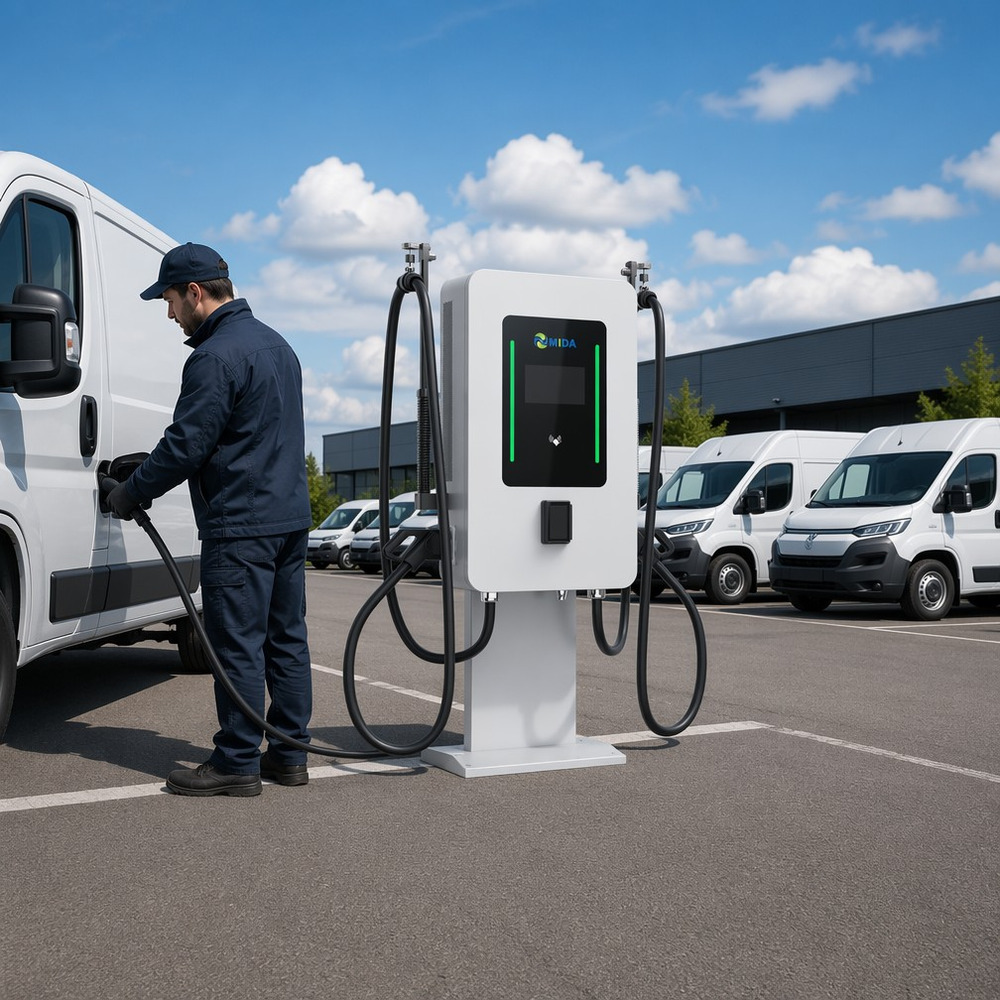
Fleet engineers evaluating equipment should verify four specifications before shortlisting: output voltage range covering at least 150–1000V; OCPP 1.6J or newer protocol support for depot management platforms; power-sharing behavior across both guns; and IP/IK ratings matched to the depot environment. A commercial-grade 80kW dual-gun wallbox DC fast charger with a 150–1000V wide voltage range covers most urban delivery fleets in a single SKU, while heavy-duty 80kW dual-gun wall-mounted DC charging piles suit highway-adjacent operations where robustness and CCS2/GBT connector coverage are priorities. Operators running mixed bus-and-van fleets typically standardize on universal 40–80kW dual-gun wallbox chargers that support 380V three-phase input, and premium 80kW dual-gun wallbox DC fast charging stations address high-utilization hubs where session throughput determines ROI. Where the fleet standardizes on CCS2/GBT connectors, fleet-preferred wall-mounted DC fast chargers offer the certification profile that depot insurers and OEM warranty teams expect.
FAQ
What is the difference between an 800V vehicle and an 800V charger?
An 800V vehicle runs its battery pack at roughly 650–850V nominal. An 800V-class charger is simply one whose output voltage range covers that band. A 1000V charger covers it with headroom, which is why it is the safer procurement choice.
Can a 500V charger charge an 800V electric truck?
Yes, but inefficiently: the truck’s onboard converter steps voltage down, adding 3–6% energy loss and extending charge time. The vehicle also cannot reach its peak charging power, so the session is slower than the truck’s capability.
How much faster is charging on 1000V infrastructure?
On an 800V vehicle, 10–80% sessions typically complete 30–45% faster than through 500V equipment at the same charger power, because native-voltage charging avoids converter derating and thermal limits.
Is a 1000V charger safe for 400V vehicles?
Yes. The charger negotiates voltage with the vehicle during handshake and only delivers the voltage the vehicle requests. The 150–1000V range simply defines the envelope it can serve.
What is the cost premium for 1000V-ready charging hardware?
With SiC-based power electronics now standard, the premium is roughly 5–15% over 500V equipment — far below the cost of replacing infrastructure when the fleet converts to 800V.
Do wall-mounted chargers perform as well as pedestal units at high power?
Yes. Wall mounting affects installation, not power electronics. A wall-mounted 80kW unit delivers identical power and efficiency; the difference is footprint, civil works, and permitting burden.
When should a fleet upgrade from 500V infrastructure?
As soon as 800V vehicles enter the fleet mix and before the share of such vehicles exceeds roughly 20%. Waiting compounds conversion losses and eventually forces an unplanned, expensive replacement cycle.
Post time: Sep-01-2026