
Beyond 800V: Exploring the Impact of MCS (Megawatt Charging System) on Heavy-Duty Fleet Electrification
Quick Answer
The Megawatt Charging System (MCS), developed by CharIN, is the charging standard that lets heavy-duty vehicles accept up to 3.75 MW of DC power — roughly ten times the output of a 350 kW CCS unit — through a single liquid-cooled connector at up to 1,250 V and 3,000 A. MCS matters because 800V passenger-car architectures do not scale to Class 8 trucks: a 600–1,000 kWh battery pack charged at 350 kW needs two hours or more, while a 45-minute regulatory break cannot be used productively unless the truck recovers several hundred kilowatt-hours in that window. With MCS, a 600 kWh battery can move from 10% to 80% state of charge in roughly 30 minutes. For fleet operators, the standard redefines route planning, depot design, grid connections, and total cost of ownership, and its commercial rollout between 2025 and 2028 is the single most important infrastructure development in heavy-duty electrification.
Key Takeaways
- MCS delivers 1–3.75 MW per connection (1,250 V / up to 3,000 A), compressing a heavy-duty charging session from hours to 20–40 minutes.
- 800V and 1000V architecture is the passenger and light-commercial baseline; MCS targets the truck segment where battery energy exceeds 400 kWh.
- Fleet duty cycles — not peak power — determine whether MCS is needed: distribution fleets can often rely on overnight and opportunity CCS charging; long-haul regional trucks need megawatt hubs.
- Every MCS bay implies a megawatt-scale grid connection, which makes battery buffers, local generation, and smart charging integral to site economics.
- Procurement strategy in 2026 is to build MCS-ready sites — oversized conduit, transformer headroom, and upgradeable dispensers — while deploying CCS and dual-gun DC chargers for today’s vehicles.
Why 800V Passenger Architecture Does Not Scale to Class 8 Trucks
The 800V platform transformed passenger EVs by enabling 350 kW charging at manageable cable and connector currents. A 100 kWh passenger battery at 350 kW charges in about 18 minutes on a good curve. Scale the same logic to a heavy-duty truck with a 600 kWh pack, and 350 kW delivers only about 0.58 kWh per minute — a 10–80% session takes roughly two hours. For a truck governed by driving-time regulations and 45-minute break windows, a two-hour charge is not a pause in the duty cycle; it is a lost shift.
This is the arithmetic that 800V cannot solve. The current at 800–1000V is bounded by cable weight, connector cooling, and thermal limits, and pushing more power by raising voltage alone runs into insulation and semiconductor constraints. The trucking industry therefore needed a dedicated high-power interface: a connector rated for thousands of amperes, liquid cooling, and a protocol that assumes a vehicle the size of a building is attached to the cable.
What the MCS Standard Actually Specifies
MCS is a CharIN-led standard for DC fast charging of commercial vehicles. Its headline specification is 1,250 V DC at up to 3,000 A, for a theoretical ceiling of 3.75 MW per connection — though first-generation commercial systems ship at 1–1.2 MW, with 2 MW and beyond following as power electronics and grid connections mature. Communication follows ISO 15118-20, which also underpins Plug & Charge and bidirectional capability. The connector is a single, ergonomically designed, liquid-cooled plug positioned at a height appropriate for truck drivers, and it is engineered for a far higher number of insertion cycles than passenger connectors because fleet equipment is handled thousands of times per year.
The standard also matters for what it is not. MCS does not replace CCS for passenger vehicles; the two standards coexist, and MCS dispensers in the field are expected to be backward-compatible so that a CCS vehicle can still charge at an MCS hub. This dual capability is a planning gift to site developers, who can build one high-power forecourt that serves trucks today and cars tomorrow.
The Duty-Cycle Math: Why Megawatts Matter
The value of MCS is best understood through the route plan, not the specification sheet. Consider a regional-haul truck with a 600 kWh battery targeting 500 km per day. The operator’s charging plan reserves a 40-minute window during the legally mandated driver break at midday. To recover the 400 kWh consumed since the morning departure, the charger must average 600 kW — comfortably inside a 1 MW MCS connection. The same plan at 350 kW CCS would require 74 minutes of charging, pushing into driving-time windows and adding a second break cycle to the schedule.
The comparison table below summarizes the power tiers a fleet operator can choose from today and in the near term.
| Charging System | Typical Power | Charge Time for 600 kWh (10–80%) | Grid Connection per Bay | Best Use Case |
|---|---|---|---|---|
| AC depot charging | 22–43 kW | 10–14 hours (overnight) | Standard LV | Depot overnight soak charging |
| CCS DC fast charging | 150–350 kW | 1.6–2.2 hours | LV / small MV | Distribution fleets, opportunity stops |
| MCS generation 1 | 1–1.2 MW | 30–45 minutes | MV transformer per hub | Regional-haul depots and corridor hubs |
| MCS full specification | 2–3.75 MW | 12–25 minutes | Dedicated MV or HV feed | Long-haul highway megawatt hubs |
Depot vs En-Route: Where MCS Delivers First
MCS deployment is not a single rollout but three distinct use cases with different economics. The first is the depot, where trucks return between shifts. Overnight AC and CCS charging handles most of the energy, and a single MCS bay covers the trucks that arrive with an unexpectedly low state of charge and must leave again within the hour — the classic “turnaround” charge. The second use case is the distribution center, where drivers make 30–45 minute dock windows; a 1 MW MCS connection converts that idle time into a near-full recharge. The third is the highway corridor, where long-haul trucks need a midday megawatt charge on route; these hubs require the heaviest grid investment and are the slowest to materialize.
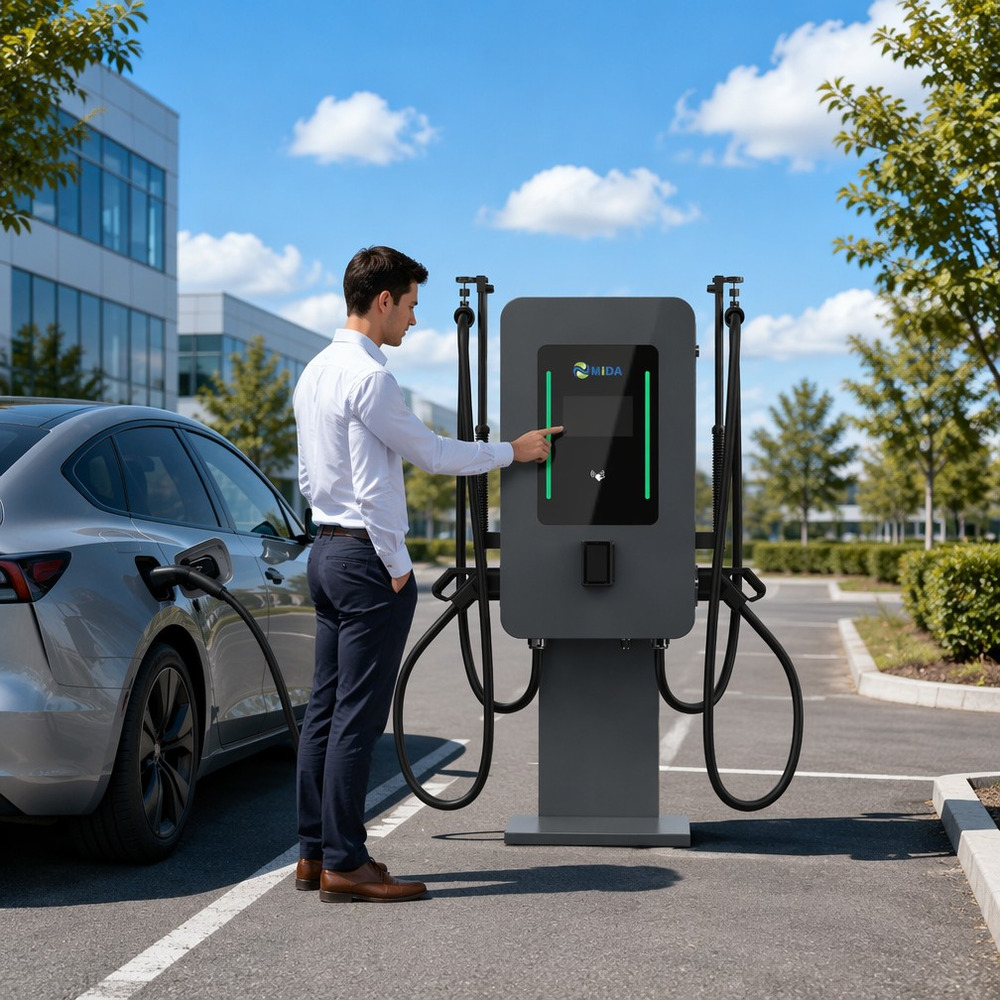
For fleets transitioning today, the pragmatic architecture combines both worlds: dual-gun DC wallboxes and CCS stations for current vehicles and overnight cycles, with MCS-ready conduits and transformer headroom reserved at the site boundary. Products such as the universal dual-gun DC chargers for electric buses and fleet vans and the fleet-preferred dual-gun wall-mounted DC fast chargers cover the 40–80 kW depot tier with the CCS2/GBT flexibility that mixed fleets need, while the site design keeps megawatt capacity open for the MCS era.
The Grid and Energy Storage Reality
A single 1 MW MCS bay draws as much power as a small supermarket. A four-bay hub at 2 MW average is a significant industrial load that most distribution networks cannot simply absorb. Site developers therefore treat the grid connection as a first-order engineering problem: medium-voltage service, transformer sizing, and demand-side management are planned before the dispensers are specified. Battery buffers at the site flatten peaks, letting the hub deliver megawatt-class sessions from a lower utility capacity while participating in demand response when the grid is stressed. Local solar, where land permits, offsets daytime load and improves the site’s carbon accounting.
This is also where smart charging — the standardized profiles described by OCPP 2.0.1 — becomes operationally essential. A megawatt hub that cannot throttle, schedule, and arbitrate power between bays is a liability; one that can becomes a flexible grid asset that utilities increasingly value.
Ecosystem Readiness in 2026
MCS is moving from pilot to product. CharIN published the MCS requirements and the connector specification, and field demonstrations across Europe and North America have validated megawatt sessions on production trucks. OEMs have announced MCS-capable truck platforms entering production through 2026–2028, and infrastructure vendors are shipping the first certified megawatt dispensers. The remaining bottlenecks are not technical: they are the utility interconnection queues, the cost of medium-voltage connections, and the slow standardization of vehicle-side acceptance. Fleet operators who delay all planning until trucks arrive will face a two-year infrastructure lag; those who prepare sites now will be ready when the first MCS vehicles hit their routes.
Procurement Strategy for Heavy-Duty Fleet Operators
For a fleet operator in 2026, the correct procurement posture is staged and intentional. First, secure the site: design the depot with conduit and transformer headroom sized for at least 1 MW per future MCS bay, because retrofitting civil and electrical infrastructure is dramatically more expensive than oversizing it once. Second, deploy today’s hardware for today’s trucks: dual-gun DC stations, CCS2/GBT wallboxes, and OCPP-managed load balancing keep the current fleet moving and generate the utilization data that justifies the megawatt investment. Third, specify upgradeable dispensers — units whose power modules and controllers can be exchanged for MCS capability rather than replaced. The heavy-duty 80kW dual-gun wall-mounted DC charging piles, the professional dual-gun smart EVSE for fleet management, and the premium 80kW dual-gun wallbox stations for fleet high-speed charging exemplify the networked, OCPP-managed hardware class that should form the backbone of that staged rollout.
Frequently Asked Questions
Q1. How fast can an MCS charger actually charge a truck?
A 1 MW MCS connection delivers roughly 16 kWh per minute at the cable. A 600 kWh truck battery moving from 10% to 80% — 420 kWh — completes in about 30–45 minutes, depending on the vehicle’s acceptance curve and the charger’s sustained output.
Q2. Is MCS compatible with CCS connectors and passenger cars?
MCS is a separate connector standard for heavy-duty vehicles, but MCS dispensers are expected to offer CCS compatibility so that passenger EVs can also use the bay. The standards coexist rather than compete.
Q3. Do I need MCS for a distribution fleet with 200 km daily routes?
No. Distribution fleets with predictable, shorter routes are typically served well by overnight depot charging and 40–80 kW opportunity charging. MCS becomes compelling when route energy demand exceeds what overnight charging can supply.
Q4. What grid connection does a megawatt charging hub require?
Each megawatt of sustained output needs roughly a 1 MVA medium-voltage service. Most hubs are planned with MV connections, battery buffers to flatten peaks, and smart charging to keep peak demand within the contracted capacity.
Q5. When will MCS trucks be commercially available in volume?
Production MCS-capable truck platforms are being announced by major OEMs through 2026–2028. Early field pilots are already operating, and corridor hub build-out is accelerating in the EU and North America.
Q6. How much does an MCS charger cost compared with a CCS charger?
MCS dispensers carry a significant premium over CCS units in the early market, driven by liquid-cooled connectors, higher-rated power electronics, and certification costs. Prices are expected to fall as volumes grow through 2028.
Q7. Should I future-proof my depot for MCS even if my current fleet is all CCS?
Yes. Conduit, transformer headroom, and civil works are the expensive, irreversible parts of a depot build. Oversizing them now typically costs a small fraction of a later retrofit and preserves every route-planning option as the fleet electrifies.
Post time: Sep-01-2026