
Cybersecurity for EV Charging Infrastructure: Protecting Large-Scale Networks from Cyber Threats
Quick Answer
An EV charging network is a distributed fleet of internet-connected power electronics, payment terminals, and grid interfaces — and therefore a distributed attack surface. The threat model spans compromised EVSE firmware, unauthenticated OCPP channels, breached charge point management systems (CSMS), roaming-hub manipulation, payment-card skimming, ISO 15118 certificate abuse, and coordinated load attacks that could destabilize local distribution grids. Industry CVEs and real-world incidents — remote code execution in commercial chargers, botnet enrollment of EVSE, and ransomware against charging backends — have moved cybersecurity from an engineering afterthought to a board-level procurement requirement. Defense requires a layered architecture: hardware roots of trust with secure boot, TLS 1.3 with mutual authentication on every charger-to-backend channel, OCPP security extensions and ISO 15118 PKI for vehicle links, network segmentation, centralized monitoring with intrusion detection, disciplined patch and firmware-signing processes, and physical tamper detection. This article maps the attack surface layer by layer, analyzes known incidents, compares mitigations per threat vector, and provides a 2026 security program for charge point operators, fleet owners, and enterprises running large networks.
Key Takeaways
- The EVSE is a full networked computer: remote code execution vulnerabilities in commercial chargers have been publicly disclosed, and firmware is the most common entry point.
- OCPP and roaming channels are the data highway for attacks: unauthenticated or weakly authenticated connections let attackers stop sessions, alter prices, or inject fake meter data.
- Grid impact raises the stakes: coordinated charging-load manipulation at scale is a credible, documented concern for distribution operators, not a theoretical scenario.
- Defense-in-depth beats point security: secure boot, mTLS, OCPP 2.0.1 security extensions, network segmentation, IDS/SIEM monitoring, and signed OTA updates must all be in place.
- Security is now a procurement criterion: enterprises should require NIST CSF / IEC 62443 alignment, SBOMs, signed firmware, and defined patching SLAs in every charger contract.
Why EV Charging Became a Prime Cyber Target
Charging infrastructure occupies a unique intersection: it is financially valuable (every session is a payment), physically exposed (unattended, outdoors, in public space), operationally critical (fleets and emergency services depend on it), and grid-connected (its aggregate load is measurable and exploitable). Unlike a data center, an EVSE sits in a parking lot with minimal physical protection; unlike a consumer IoT gadget, its compromise has financial and grid consequences. The attacker’s incentives are unusually rich: ransomware against a CSMS can halt an entire network; payment-data theft monetizes directly; session-price manipulation is hard to detect; and a botnet of thousands of chargers can be used for DDoS, crypto mining, or coordinated grid stress. Regulatory attention is following — the EU’s Cyber Resilience Act, ETSI EN 303 645, the NIS2 framework, and emerging charger-specific requirements in North America and Asia are turning security from best practice into legal obligation.
The Attack Surface, Layer by Layer
A modern network has six layers, each with distinct threats. The first is the EVSE device itself: firmware vulnerabilities, insecure debug ports, weak default credentials, and unsigned update mechanisms. The second is the charger-to-backend channel: OCPP over unencrypted or weakly authenticated connections permits session disruption, tariff tampering, and man-in-the-middle injection of fake session records. The third is the CSMS/backend: web application flaws, API abuse, and credential theft give attackers control of pricing, access control, and user data across the whole estate. The fourth is the roaming layer: OCPI hubs and eMSP integrations are high-value targets where one compromise can affect multiple operators. The fifth is the vehicle-to-charger link: ISO 15118 plug-and-charge introduces certificate-based trust that, if mishandled (stolen private keys, weak validation), enables impersonation and free charging. The sixth is physical and local: tampered enclosures, compromised maintenance laptops, and malicious USB or network ports at the site.
Firmware and Device-Level Threats
Device-level compromise is the most common entry. Publicly disclosed CVEs in commercial chargers include stack-overflow-based remote code execution reachable over the network, hardcoded credentials in management interfaces, and unsigned firmware that attackers can replace with malicious images. A compromised charger can report false meter data, disable itself, leak payment data, or act as a pivot into the operator’s network. The mitigations are architectural: secure boot with a hardware root of trust (TPM or secure element), signed and versioned firmware, encrypted storage for keys and certificates, disabled debug interfaces in production, and unique per-device credentials. Enterprises should treat a charger without secure boot and signed firmware the same way they treat a router without them — as unprocurable.
OCPP, CSMS, and Roaming Channels
The data channels are where attacks become systemic. OCPP 1.6J is functional over plain TCP, but production deployments must run it over TLS with client certificates so that only authorized chargers can connect; OCPP 2.0.1 adds security extensions, including secure firmware update, certificate management, and signed security events, which enterprises should specify even where the ecosystem still runs 1.6J. The CSMS itself needs web-application hardening, role-based access, audit logging, and rate limiting; a breached CSMS account with admin rights can reprice the entire network, unlock free sessions, or exfiltrate driver data. Roaming hubs concentrate risk — one hub compromise propagates to every connected operator — so hubs should require mutual TLS, contractual security audits, and incident-notification SLAs.
Known Incidents and Their Business Impact
The industry has already produced a public incident record. Researchers demonstrated remote attacks on major commercial charger brands (including EVlink and others with 2022–2023 CVEs) allowing full device takeover; a widely reported 2023–2024 campaign enrolled compromised EVSE into botnets; and multiple backend/API incidents have leaked driver account data or enabled session manipulation. In fleet contexts, a single ransomware event against a charging backend can idle hundreds of vehicles for days — at fleet margin of USD 10–20 per vehicle-hour, a two-day outage at a 200-truck depot is a six-figure loss before counting recovery costs. For grid operators, coordinated manipulation of large charging fleets (deliberately synchronizing demand spikes) is now a recognized risk in distribution planning. The business impact is therefore not hypothetical: it is measured in revenue, availability, liability, and regulatory exposure.
Defense-in-Depth Architecture for Large-Scale Networks
No single control suffices; the defense must be layered so that a failure at one level is contained by the next. The reference architecture runs from the silicon up: secure boot and trusted execution on the device; mutually authenticated TLS to the CSMS; segmented networks separating charger, payment, and office traffic; a central security operations function with intrusion detection and continuous monitoring; and disciplined lifecycle processes for firmware, keys, and certificates.
Hardware Roots of Trust and Secure Boot
Every charger should boot from a hardware root of trust: a secure element or TPM that validates the boot chain, stores device keys and certificates in tamper-resistant storage, and signs security events. This makes firmware substitution detectable, prevents credential extraction by physical attackers, and provides the identity anchor that mTLS and OCPP security depend on. Enterprises should verify that keys are unique per device, that production keys never leave the secure element, and that the vendor can rotate certificates remotely — certificate management is a capability, not a one-time setup.
Encrypted, Authenticated Communications
All charger-to-backend traffic should be TLS 1.3 with mutual authentication: the charger presents a device certificate, the backend presents its own, and both validate against pinned or OCSP-checked roots. OCPP sessions should ride on this channel, with JSON over WebSocket (1.6J) or the OCPP 2.0.1 security profile where supported. Vehicle-side, ISO 15118 plug-and-charge PKI must include proper certificate validation, revocation checking, and storage of vehicle contract data in hardware-backed secure storage. Roaming and eMSP integrations should use the same mTLS discipline, and any legacy plaintext OCPP or HTTP endpoints must be enumerated and retired as part of the migration plan.
Network Segmentation and Centralized Monitoring
Charger networks should be segmented from corporate IT and from each other by risk class: payment-handling systems, fleet operations, and public charging each in their own zone with firewall rules that allow only required flows. Centralized monitoring is the safety net: intrusion detection/prevention on charger subnets, a SIEM ingesting OCPP security events, charger telemetry, and backend logs, and alerting on anomalies such as a charger reporting energy while locked, abnormal session patterns, or failed certificate validations. Incident response should be rehearsed: isolation procedures for a compromised charger, key and certificate revocation runbooks, and a communication plan for drivers, fleets, and regulators.
Threat Vector vs. Mitigation: A Comparison Table
| Attack Vector | Typical Impact | Primary Mitigation | Supporting Standard/Framework |
|---|---|---|---|
| Firmware RCE / malicious update | Full device takeover, meter fraud, botnet enrollment | Secure boot, signed firmware, hardware root of trust | NIST SP 800-193, IEC 62443-4-1 |
| OCPP channel interception / injection | Session disruption, tariff tampering, fake meter data | TLS 1.3 + mutual TLS, OCPP 2.0.1 security extensions | OCPP 2.0.1, ETSI EN 303 645 |
| CSMS / backend breach | Network-wide control, data exfiltration, ransomware | Web-app hardening, RBAC, MFA, audit logging, segmentation | OWASP ASVS, ISO/IEC 27001 |
| Roaming hub compromise | Cross-operator fraud, credential abuse | mTLS between operators, hub security audits, notification SLAs | OCPI security profile, NIS2 |
| ISO 15118 PKI abuse / stolen keys | Impersonation, free charging, session hijack | Certificate validation, OCSP revocation, hardware key storage | ISO 15118-2/-20, CCS PKI |
| Payment data theft / skimming | Card fraud, PCI exposure | PCI DSS scope reduction, point-to-point encryption, tokenization | PCI DSS 4.0 |
| Physical tampering / malicious local access | Device compromise, key extraction | Tamper detection, sealed enclosures, secure elements, CCTV | IEC 62443-3-3 physical, NIST 800-53 |
| Coordinated load manipulation | Grid stress, demand-charge spikes, local outages | Load-management authZ, anomaly detection, grid-aware scheduling | IEC 61850 alignment, grid codes |
The table maps each vector to a concrete control and a reference framework, which is exactly how procurement should be structured: a checklist of required controls, each tied to a standard that the vendor must evidence. Vendors that cannot produce signed-firmware attestation, an SBOM, or a security-conformance statement should be excluded at the shortlist stage, because retrofitting security into a deployed fleet is an order of magnitude more expensive than specifying it.
Building the Security Program: A 2026 Checklist
- Make security a contractual requirement: demand NIST CSF / IEC 62443 alignment, a software bill of materials (SBOM), signed firmware, and evidence of secure boot in every charger RFP.
- Require OCPP security and mTLS: specify OCPP 2.0.1 security extensions where available, and mutual TLS with per-device certificates everywhere else; retire plaintext endpoints in the migration plan.
- Deploy ISO 15118 PKI properly: validate certificates at every session, check revocation, and store keys in hardware-backed secure storage on both charger and vehicle side.
- Segment networks and centralize monitoring: separate charger, payment, and IT zones; run IDS on charger subnets and feed OCPP security events into a SIEM with alerting.
- Define patching and incident SLAs: contractual timeframes for firmware updates, a vulnerability disclosure process, and rehearsed incident-response and certificate-revocation runbooks.
- Protect the physical layer: tamper-evident enclosures, secure mounting, and site surveillance — the cheapest attack is still a crowbar and a compromised maintenance port.
- Audit the supply chain: require signed firmware provenance and component traceability, and re-verify vendor claims with an independent penetration test before large rollouts.
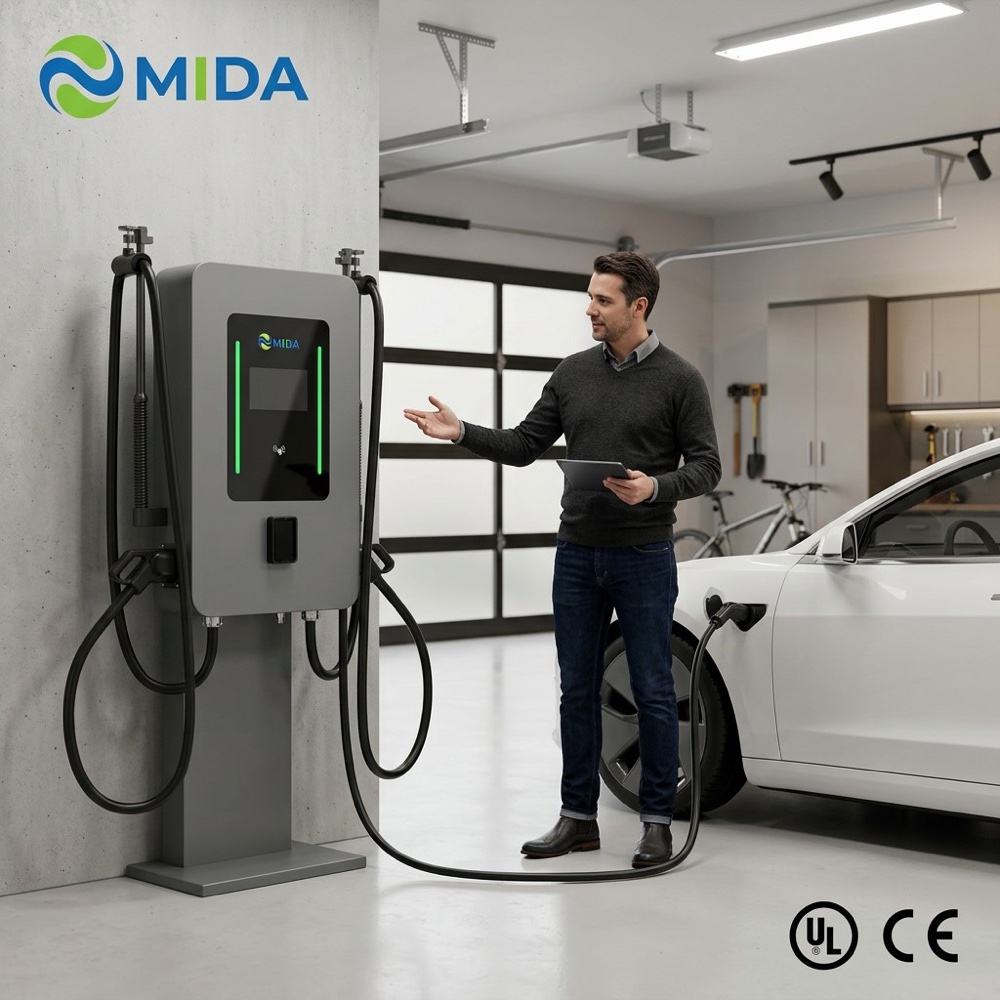
Security posture must be evaluated on the actual deployed estate, because connectivity choices determine exposure. OCPP smart network dual-gun wall-mounted DC fast charging stations are designed around authenticated network management, and APP-monitored 80kW dual-gun wallbox DC fast charging stations expose the telemetry that security operations centers need for anomaly detection. APP-controlled dual-gun DC fast charging stations with CE/TUV certification bring third-party-tested device security, professional dual-gun DC fast charging stations built for fleet management support the access-control and audit requirements of corporate fleets, and high-efficiency APP-connected dual-gun wall-mounted DC fast chargers demonstrate that remote management and security controls belong in the same product, not in tension.
Frequently Asked Questions
Q1. Are EV chargers actually being hacked in the real world?
Yes. Publicly disclosed CVEs have demonstrated remote code execution on commercial chargers, botnet campaigns have enrolled compromised EVSE, and backend/API incidents have affected multiple operators. The pattern matches other connected-infrastructure sectors: financially motivated attackers follow the money, and charging touches money directly.
Q2. What is the most common attack path into a charging network?
Device-level compromise — firmware with vulnerabilities or weak default credentials — followed by unauthenticated or weakly authenticated OCPP/management channels. Both are prevented by secure boot, unique per-device credentials, and mutually authenticated TLS.
Q3. Can hackers actually destabilize the power grid through chargers?
Coordinated manipulation of large charging fleets — synchronizing demand spikes across thousands of chargers — is a recognized risk in distribution planning. It requires significant access, but the consequence (local transformer stress or demand-charge spikes) makes load-management authorization and anomaly detection essential controls.
Q4. What is the difference between OCPP 1.6J and OCPP 2.0.1 security?
OCPP 1.6J over TLS with client certificates provides authenticated transport, which is sufficient when implemented correctly. OCPP 2.0.1 adds native security features: secure firmware updates, certificate management, signed security events, and a defined security profile — a stronger baseline for new deployments.
Q5. How does ISO 15118 plug-and-charge affect security?
It introduces certificate-based vehicle identity, which is a major security improvement over RFID or app-based access — but only if certificates are validated, revocation is checked, and keys are stored in hardware-backed secure elements. Mishandled PKI turns it into a new attack surface.
Q6. What should I put in a charger procurement contract regarding security?
Evidence of secure boot and signed firmware, an SBOM, OCPP security and mTLS conformance, a defined patching SLA with vulnerability-disclosure process, incident-notification commitments, independent penetration-test results, and rights to audit — ideally aligned to NIST CSF or IEC 62443.
Q7. Is cybersecurity a legal requirement for charging networks yet?
Increasingly so. The EU Cyber Resilience Act and NIS2, ETSI EN 303 645, and emerging national charger-security rules in North America and Asia are converting best practice into obligation. Enterprises should treat security conformance as a compliance item, not an option, when deploying from 2026 onward.
Post time: Sep-01-2026