
The Psychology of Destination Charging: Why Professional Buyers Prefer 80kW Wallboxes over Pedestal Stations
Quick Answer
Professional buyers of destination charging — facility managers, property owners, and hospitality operators — overwhelmingly prefer 80kW dual-gun wallboxes over pedestal stations because the wallbox aligns with how destination sites actually generate value: through discretion, dwell, and guest experience, not raw throughput. Pedestal stations read as industrial utility; wallboxes read as integrated building infrastructure. The 80kW power class matters too: it is fast enough to make a 30–45-minute stay meaningful for most EVs, yet modest enough in footprint, noise, and grid impact to win approvals from architects, landlords, and permitting authorities. Add the dual-gun configuration’s ability to serve two parking bays from one wall, and the wallbox wins on installation cost, vandalism resistance, aesthetics, and perceived service quality — the four decision drivers professional buyers weigh most.
Key Takeaways
- Destination charging succeeds on guest experience and dwell time; the 80kW wallbox delivers meaningful charge in a typical stay while reading as building infrastructure rather than utility hardware.
- Wall-mounted dual-gun units cut installed cost by 30–50% versus pedestal stations, chiefly by eliminating concrete foundations, trenching, and bollard protection.
- Wall mounting reduces vandalism, cable theft, and vehicle collision risk, which lowers insurance and maintenance line items over the asset’s life.
- Professional buyers factor permitting and landlord acceptance into product choice; wallboxes face fewer aesthetic and zoning objections than pedestal cabinets.
- The dual-gun format doubles the bays served per unit, improving payback for destination sites with moderate, spread-out demand.
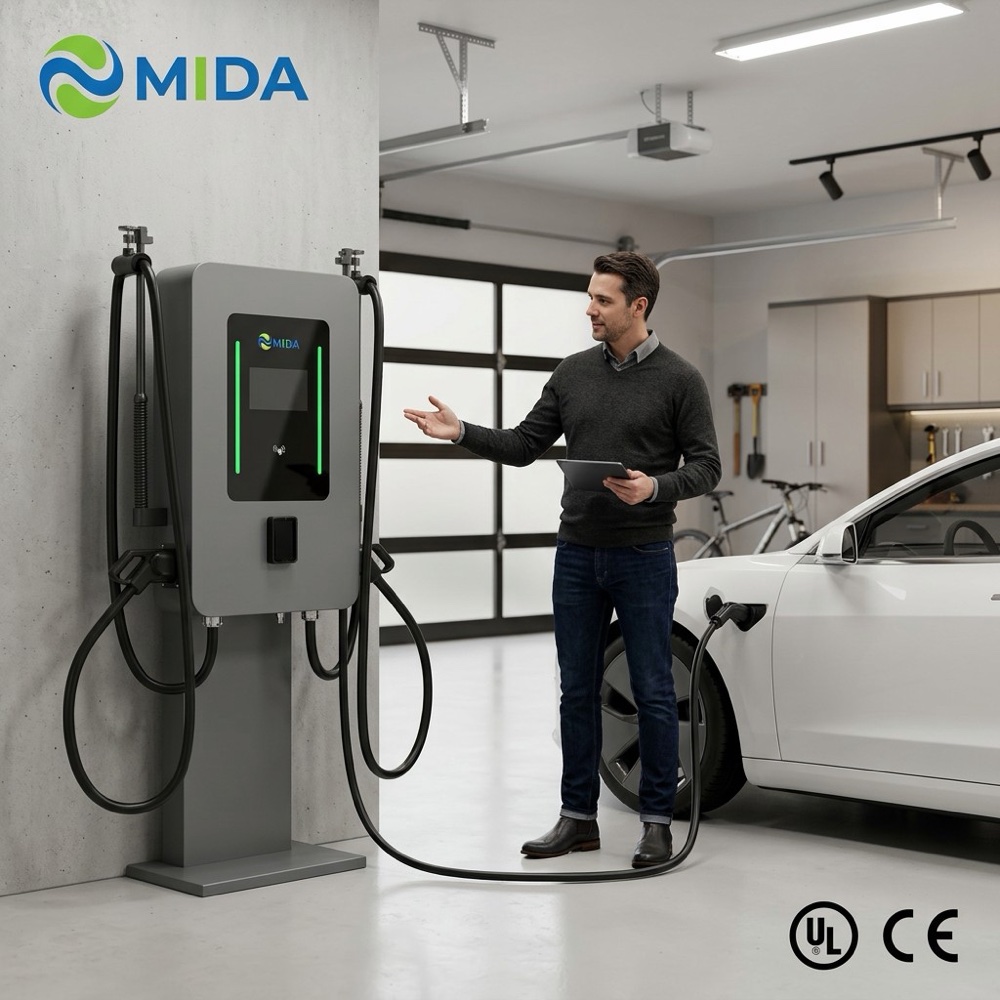
Destination Charging Is an Experience Business
A charging destination is any place people already stop: hotels, shopping centers, restaurants, gyms, medical offices, and event venues. Unlike highway fast charging, where the product is speed, destination charging sells the stay. The driver arrives with a partially charged battery, parks for 30 minutes to several hours, and expects to leave with a useful amount of range — without thinking about the charger at all. The professional buyer’s job is to provide that reassurance invisibly, at a cost structure that makes sense over a 10-year asset life.
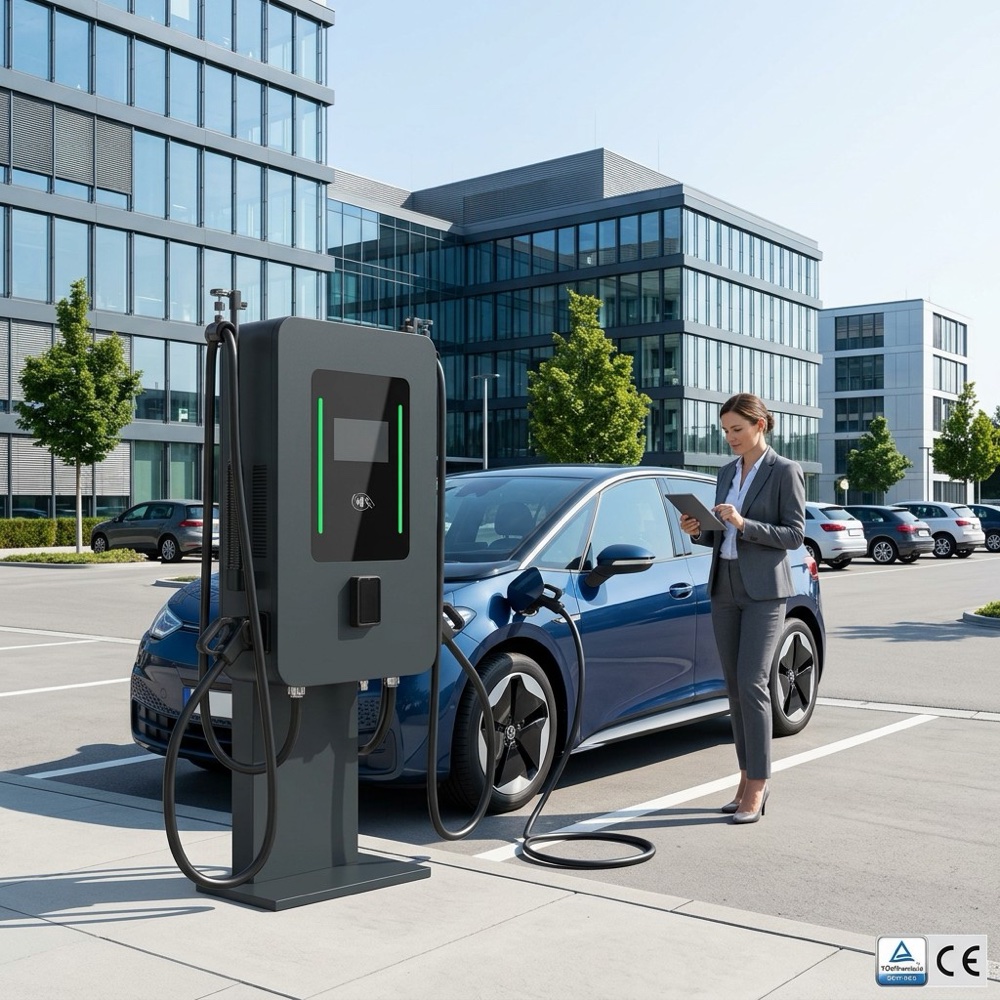
This context explains why the pedestal station, so logical for highways, misfires at destinations. A pedestal is a freestanding metal cabinet occupying valuable ground space, surrounded by safety bollards, with cables trailing across the pavement. It signals “fueling infrastructure.” At a destination, that signal is noise. It disrupts the visual language of the site, complicates circulation for pedestrians and luggage trolleys, and creates conflict points that facility managers would rather not manage. The wallbox, mounted flush on a building wall or structural column, disappears into the architecture. The psychological difference is decisive: guests perceive a hotel with wallboxes as modern and thoughtful; the same hotel with pedestal cabinets reads as a parking lot with utility equipment.
Why 80kW Is the Destination Power Sweet Spot
Professional buyers evaluate power class against their actual dwell-time distribution, not against marketing claims. The math favors 80kW. Consider a hotel guest staying 45 minutes: an 80kW session at typical 65–70kW average power delivers roughly 48–52kWh, restoring about 200–300km of range for a modern EV — a complete “stay charge.” A 22kW AC unit delivers only 16kWh in the same window, which covers daily commuting but not a full recharge for larger-battery vehicles. A 150–240kW pedestal, meanwhile, finishes the job in 15 minutes and then idles — the extra power is wasted and the extra capex is never recovered at destination utilization levels.
There is also a grid-connection angle. 80kW units draw at levels that most commercial sites can host with modest upgrades — often within an existing 100–200A three-phase service when combined with load management. The same site facing 150kW+ equipment usually requires a transformer upgrade, which can add USD 30,000–80,000 and a year of utility lead time to a project. For a buyer whose site already exists, that difference alone often decides the procurement.
The vehicle population also matters. In 2026, the average battery capacity of new EVs sold in Europe and China exceeds 70kWh, and long-range models pass 100kWh. A 22kW AC charger cannot meaningfully replenish such packs inside a restaurant or gym visit, while an 80kW DC wallbox can add a full daily commute in 25 minutes. Professional buyers who have measured their guests’ average battery state on arrival — typically 30–55% — consistently conclude that 80kW DC is the minimum power class that delivers a defensible “worthwhile stop” promise across the whole vehicle population, not just compact city cars.
Wallbox versus Pedestal: The Buyer’s Decision Matrix
The following comparison reflects the criteria professional buyers apply in 2026 RFPs for destination charging.
| Criterion | 80kW Dual-Gun Wallbox | Pedestal Station (150kW+) | Buyer Impact |
|---|---|---|---|
| Footprint per bay | 0 m² ground; wall-mounted | 1–3 m² plus bollards and clearance | Wallbox preserves parking capacity and circulation |
| Installed cost per bay | Lower by 30–50% (no trenching/pads) | Higher civil works and protection | Direct capex and payback improvement |
| Vandalism and collision risk | Low; elevated and protected by structure | Higher; exposed cabinet and cables | Lower insurance and maintenance costs |
| Visual integration | High; reads as building infrastructure | Low; reads as utility equipment | Faster landlord, architect, and zoning approval |
| Charge value in 45-min stay | 48–52kWh (meaningful recharge) | 60–70kWh (overkill; idles afterward) | Wallbox matches dwell without wasted power |
| Grid upgrade requirement | Often none with load management | Transformer upgrade common | Wallbox avoids utility lead time and cost |
| Permitting complexity | Low–moderate | High (footprint, screening, zoning) | Wallbox reaches operation months sooner |
Every row of the matrix pushes the same direction. For destinations, the 80kW dual-gun wallbox is not merely an adequate option; it is the option that survives contact with architects, insurers, utilities, and the finance committee.
The Dual-Gun Advantage at Destination Sites
Two bays per unit, one installation
Destination demand is spread out: a handful of sessions per hour, arriving irregularly. A dual-gun wallbox turns that pattern into an advantage by serving two bays from one unit and one electrical connection. The site gains redundancy — if one connector is occupied, the second is usually free — and the buyer halves the number of cabinets, meters, and network subscriptions versus single-gun equipment. For a 10-bay hotel or restaurant site, this can cut infrastructure complexity by nearly half.
Power sharing that matches arrival patterns
Intelligent power sharing lets the wallbox allocate its 80kW between two vehicles dynamically. When one guest leaves, the full power rolls to the remaining vehicle, shortening its session. Arrival patterns at destinations are uneven, and this adaptive behavior keeps both bays productive without overbuilding. High-power 80kW dual-gun wallbox DC fast charging stations with intelligent APP monitoring are increasingly specified for commercial parking hubs for exactly this reason: operators watch live session status and intervene remotely when a session underperforms.
Hidden Costs That Bias Buyers Toward Wallboxes
Professional buyers compare total cost of ownership, and the hidden costs of pedestal stations are substantial. Bollards and clearance zones consume parking spaces that generate revenue. Ground-level cabinets collect dirt, require periodic cleaning and inspection, and attract graffiti in some districts. Cable management at pedestals — where cables lie on the pavement — creates trip hazards, wear, and theft risk; wall-mounted units route cables at height and keep them short. Insurance underwriters in 2026 increasingly price EVSE installations by exposure class, and elevated wall-mounted hardware consistently earns more favorable rates than ground-level cabinets. Finally, maintenance logistics differ: a wallbox’s serviceable components are reachable from a ladder or small platform, while pedestal repairs often require isolating a full bay area and lifting equipment. Multiplied across a 10-year asset life, these items routinely shift the TCO decision to the wallbox by 15–30%.
The Guest Experience Metric: Perceived Convenience
Professional buyers know that charging ROI is mediated by perception. A guest who returns to a hotel and finds a confusing, industrial-looking pedestal surrounded by bollards registers friction; a guest who parks beside a discreet wallbox on a clean wall registers service. This perceived convenience drives measurable outcomes: venues with visible, well-integrated charging report higher EV-driver occupancy, longer dwell, and stronger repeat-visit intention in 2026 operator surveys. Designers reinforce the effect by pairing wallboxes with simple wayfinding, reserved signage, and a reliable app or RFID authorization flow. The hardware choice sets the ceiling on that experience: a wallbox reads as an amenity the venue chose deliberately, while a pedestal reads as infrastructure the venue merely tolerated. Buyers who track net promoter scores and session-start friction consistently see the wallbox choice return value well beyond the energy ledger.
What Professional Buyers Should Specify
Destination buyers should specify hardware that balances guest experience with operational reality: a dual-gun 80kW class unit, OCPP-managed, rated for the site’s outdoor or semi-outdoor environment, with power sharing and remote monitoring. For most hospitality and retail destinations, a high-efficiency dual-gun wallbox with APP management covers the operating requirement, while weatherproof IP55 dual-gun wall-mounted DC charging points suit exposed outdoor lots where rain, dust, and temperature swings are routine. Mini dual-gun DC fast charging stations work where the site has structural columns but limited wall runs, and IP54 CE-certified dual-gun wall-mounted DC charging stations with CCS2/GBT/Type 2 options accommodate mixed vehicle populations at international venues. OCPP smart-network dual-gun wall-mounted DC charging piles complete the shortlist for public facilities that must report uptime and energy data to regulators or funding bodies.
FAQ
Why do professional buyers prefer wallboxes for destination charging?
Wallboxes integrate with the building, preserve parking space, cost 30–50% less to install, face fewer permitting objections, and carry lower insurance and maintenance costs than pedestal stations.
Is 80kW fast enough for destination charging?
Yes for most destinations. In a 45-minute stay, an 80kW unit delivers 48–52kWh — a meaningful recharge for nearly all EVs — while keeping grid and capex requirements moderate.
When does a pedestal station make more sense than a wallbox?
When there is no suitable wall or column, when the site demands 150kW+ throughput (e.g., highway corridor), or when ground-level placement is architecturally required. These are exceptions in destination environments.
Do wallboxes have higher vandalism risk than pedestals?
No — the opposite. Elevated mounting, short cables, and structural protection make wallboxes significantly less exposed to collision, cable theft, and graffiti than ground-level pedestal cabinets.
How does a dual-gun wallbox serve two vehicles at once?
Through dynamic power sharing: the unit splits its 80kW between two connected vehicles and reallocates power when one session ends, keeping both bays productive.
Will an 80kW wallbox require a transformer upgrade?
Usually not. With load management, most commercial sites host 80kW units on existing services; 150kW+ pedestal equipment is where transformer upgrades and utility lead times become common.
How should destination buyers measure charging ROI?
On total cost of ownership plus guest-experience metrics: utilization per bay, charge delivered per stay, uptime, and incremental occupancy or spend attributable to charging availability.
Post time: Sep-01-2026