
Solving Power Constraints: A Deep Dive into Dynamic Load Balancing in Dual-Gun EVSE Deployments
Quick Answer
Dynamic load balancing (DLB) lets a site install more dual-gun EVSE than its utility connection would nominally allow, by continuously measuring total site demand — building loads plus charging — and throttling charger power in real time to stay inside the agreed capacity envelope. For a facility with a 200A three-phase service, DLB commonly unlocks 60–100% more charging power than a fixed-allocation design, postponing or eliminating transformer upgrades that can cost USD 30,000–80,000 and take a year of utility lead time. In dual-gun deployments, DLB operates at two levels: across the site (building vs. charging) and across the guns (vehicle vs. vehicle), with the controller prioritizing sessions by urgency. The result is higher charger utilization, lower peak demand charges, and a charging estate that scales with the fleet instead of with the utility’s construction schedule.
Key Takeaways
- DLB measures real-time site demand and curtails charging before the main breaker trips, converting spare capacity into usable charging power without infrastructure upgrades.
- A 200A site can typically host 60–100% more DC charging power under DLB than under static allocation, at a fraction of transformer upgrade cost.
- In dual-gun systems, DLB spans two layers: building-vs-charging curtailment and gun-vs-gun power sharing, with session-level priority policies.
- CT metering, OCPP telemetry, and a controller with sub-second response are the three non-negotiable components of a safe DLB deployment.
- DLB reduces peak demand charges and supports demand-response participation, converting a constraint problem into an operating-cost lever.
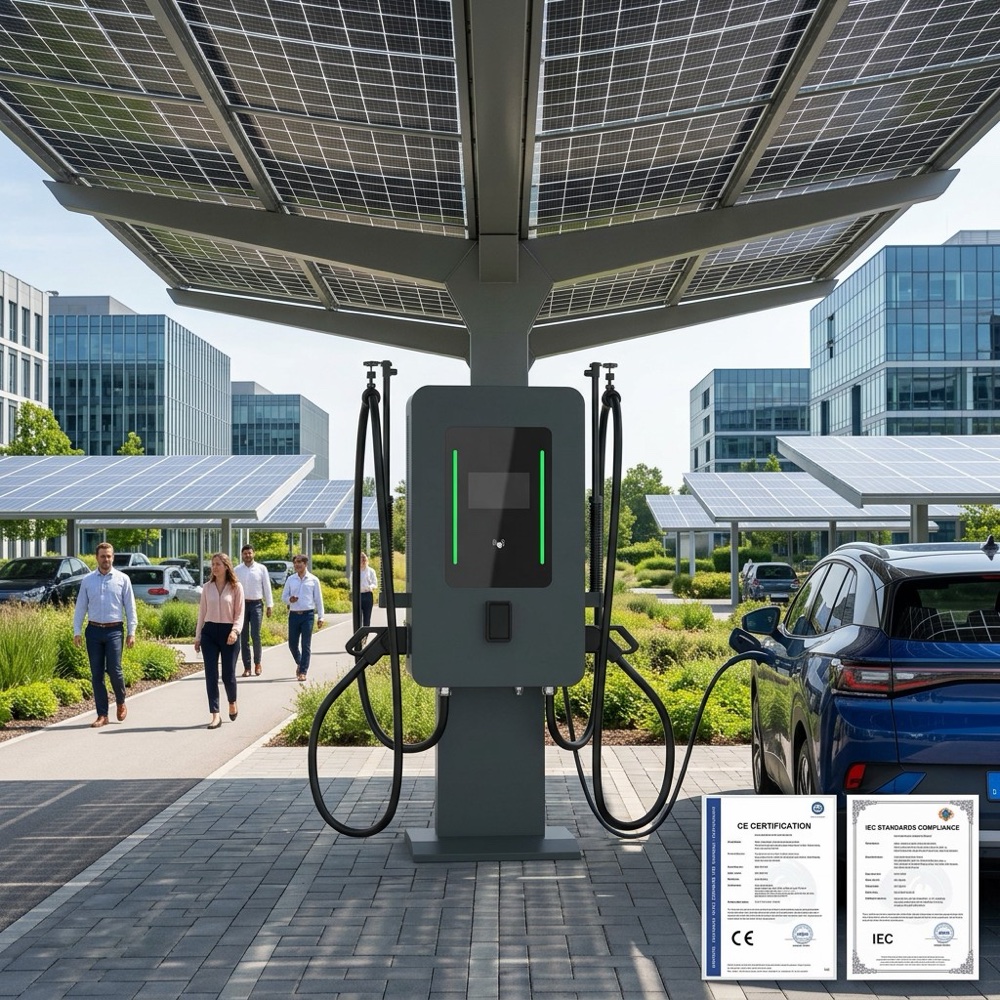
The Power Constraint Is the Real Bottleneck
Most commercial sites considering EV charging in 2026 discover quickly that the constraint is not the charger market — it is the electrical service. A supermarket with a 300A service, a hotel with 200A, or a warehouse with 400A already operates near its breaker limits through refrigeration, HVAC, lighting, kitchens, and machinery. Adding a bank of 80kW dual-gun chargers naively would demand 25–40A per active gun and trip the main breaker during the exact peak hours when guests and drivers most need charging.
The traditional answer — upgrade the transformer and service entrance — is slow and expensive. Utility upgrade lead times in many regions stretch 9–18 months, and costs of USD 30,000–80,000 are routine before trenching and switchgear. For a facility whose charging revenue is modest, that math rarely closes. Dynamic load balancing exists to make the constraint disappear: instead of reserving headroom for charging that is only used a few hours a day, the site shares its real, momentary capacity between building and charging loads, prioritizing whichever need is more urgent at that instant.
How Dynamic Load Balancing Works
At the heart of DLB is a simple feedback loop. Current transformers (CTs) clamp onto the site’s incoming feeders and report live current draw per phase, typically at intervals of 100ms–1s. A controller compares measured demand against a configured limit — the utility contract capacity minus a safety margin — and computes the headroom available for charging. It then issues power setpoints to each charger (or each gun) via OCPP or a vendor protocol. If the building’s HVAC kicks on and demand rises, the controller trims charging power within seconds; when demand falls, charging ramps back up. The main breaker never trips, the site never exceeds its contracted capacity, and charging still captures every genuine spare kilowatt.
Two layers of control in dual-gun sites
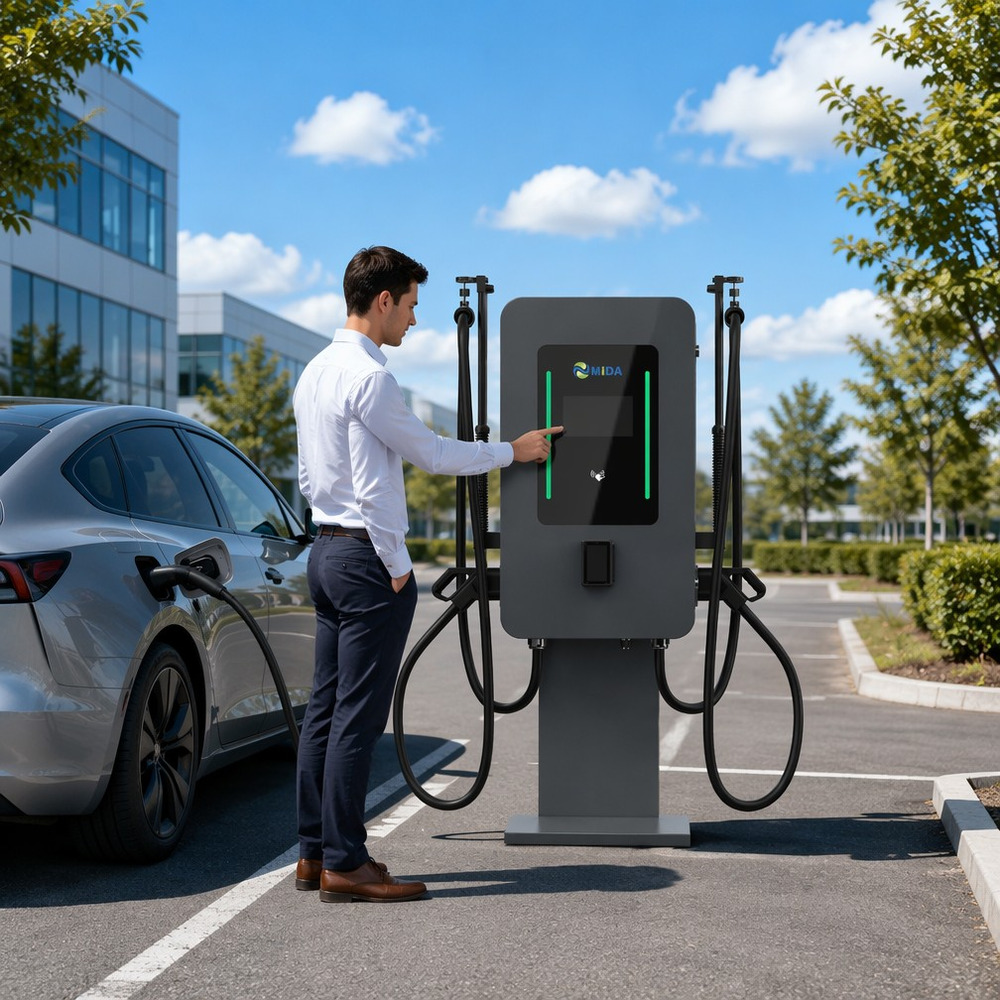
Dual-gun EVSE adds a second, finer control layer. The site controller manages total charging budget; each wallbox then distributes that budget between its two guns. This nesting matters because fleet and commercial sites rarely have uniform urgency: a departing delivery van needs 80kW now, while the vehicle beside it can accept 20kW for another hour. With per-gun priority policies, the system serves the urgent session at full power and throttles the patient one — a capability that is standard in intelligent dual-gun wallbox DC fast chargers with load balancing functions, and that turns a two-bay unit into a true scheduling asset rather than a shared outlet.
Static allocation versus dynamic balancing
The difference between static and dynamic management is best expressed in capacity terms. Under static allocation, the designer reserves a fixed charging budget (say 60kW) that is never exceeded — simple, safe, but wasteful, because the building rarely draws its full allocation and the spare capacity is locked away. Under DLB, the same service can make 100–120kW available during off-peak building load and still protect the breaker during surges. The table below compares the standard approaches.
| Approach | Capacity Utilization | Installed Cost | Complexity | Peak Demand Charges | Best Fit |
|---|---|---|---|---|---|
| Static allocation (no management) | Low; reserves headroom forever | Lowest | None | Controlled but wasted | 1–2 chargers, ample spare capacity |
| Scheduled / time-based control | Medium; predictable but rigid | Low | Low | Partially optimized | Shifts with stable load profiles |
| Dynamic load balancing | High; uses all real spare capacity | Medium (CTs + controller) | Medium | Minimized in real time | Multi-charger commercial and fleet sites |
| DLB + battery storage | Highest; can exceed service capacity in bursts | High | High | Minimized; supports demand response | High-utilization hubs with demand-charge exposure |
For the majority of 2026 deployments — retail, hospitality, and depot sites with 4–30 charge points — DLB without storage is the sweet spot: it captures most of the available upside at a fraction of the complexity of adding batteries, and it can be retrofitted to almost any site with a metering cabinet.
Design Rules for a Safe and Effective DLB Site
Metering placement and accuracy
The quality of DLB is bounded by the quality of its measurement. CTs must be installed on the correct feeders — upstream of both building and charging loads — and configured per phase. Class 1 or better CT accuracy is recommended, and the controller should validate phase balance, because unbalanced three-phase sites can trip on one phase even when the aggregate looks safe. Many engineers specify a revenue-grade meter at the service entrance precisely so the DLB limit matches the utility contract with a defensible margin.
Response time and fail-safe behavior
Sub-second response matters. HVAC and elevator start currents can spike demand in hundreds of milliseconds; a DLB controller that reacts in 1–2 seconds may be too slow to prevent a trip. Hardware-class controllers with local processing (rather than cloud-dependent loops) are strongly preferred. Equally important is fail-safe design: if the controller loses communications, chargers must revert to a preconfigured safe power level — never to maximum. This single rule prevents the most dangerous failure mode in DLB deployments.
Load profiles and commissioning
Before commissioning, the integrator should capture a week of building load data to identify peak hours and phase imbalances, then set the DLB limit with a safety margin (typically 80–90% of contract capacity). During commissioning, staged testing should verify that a deliberate building-load spike correctly curtails charging, and that charging ramps back smoothly. Documentation of these tests is increasingly required by insurance and utility inspectors in 2026.
Sizing example: a 200A site with eight dual-gun wallboxes
A concrete example ties the rules together. A warehouse has a 200A three-phase service; the building draws a measured 90–140A during operating hours and 40–60A at night. Without management, the site could safely reserve perhaps 60A for charging — about 40kW at 400V — supporting only one 80kW wallbox at reduced power. With a DLB controller set to an 85% capacity limit (170A), the site can allow charging headroom of up to 80–130A in off-peak moments and still protect the breaker when the building peaks. That headroom comfortably supports eight dual-gun wallboxes at low simultaneous utilization, or four wallboxes at full 80kW — a 2–3x capacity gain over static design, delivered with a few thousand dollars of CTs, a controller, and configuration time rather than a transformer upgrade.
Beyond the Breaker: DLB as an Operating-Cost Lever
DLB does more than prevent trips. Commercial tariffs in most markets penalize peak demand, and charging that spikes at 19:00 alongside building load inflates the monthly demand charge. A DLB controller that spreads charging across the night or throttles during building peaks directly reduces this line item — frequently by 10–25% on the total facility bill for high-utilization sites. The same measurement and control infrastructure enables demand-response participation: when the utility signals a grid event, the controller curtails charging and the site earns incentive payments. In 2026, several operators report that demand-response revenue and reduced demand charges together cover the entire cost of the DLB system within two years.
Specifying DLB-Ready Dual-Gun EVSE
Buyers should treat DLB as a system property, not a checkbox. The shortlist criteria are: native support for external power-setpoint control (OCPP 1.6J or vendor API), per-gun power allocation with configurable priorities, local fail-safe fallback, and a documented integration with the site controller or CT metering package. Commercial deployments commonly standardize on 80kW dual-gun wallbox fast charging stations with intelligent load balancing, while multi-vehicle facilities choose intelligent 40–80kW dual-gun wallbox DC fast chargers with load balancing functions to spread capacity across more bays. Where the site is part of a larger network, smart commercial dual-gun wall-mounted OCPP 1.6J DC fast charging stations and OCPP 1.6J dual-connector wall-mounted EVSE for car parks ensure the backend can orchestrate sessions fleet-wide, and high-power dual-gun wallbox DC fast chargers with intelligent APP monitoring give operations teams the visibility to verify DLB behavior remotely during commissioning and peak events.
FAQ
What is dynamic load balancing in EV charging?
It is a control system that measures the site’s total electrical demand in real time and throttles charger power to keep the site within its utility capacity, so more chargers can be installed on an existing connection.
How much more charging power can DLB unlock?
On a typical commercial site, DLB unlocks 60–100% more charging power than static allocation by using real spare capacity — often avoiding a transformer upgrade costing USD 30,000–80,000.
Is dynamic load balancing safe?
Yes, when properly engineered: accurate CT metering, sub-second response, and fail-safe fallback that reduces charging to a safe level if the controller loses communication. These are standard requirements in professional deployments.
Does load balancing slow down charging for drivers?
Only during genuine grid peaks. Sessions are throttled temporarily and resume when capacity frees up; priority policies ensure urgent sessions (e.g., departing fleet vehicles) receive power first.
What hardware do I need for dynamic load balancing?
Current transformers on the incoming feeders, a controller (hardware or site gateway), chargers that accept remote power setpoints, and OCPP or API integration between them.
Can DLB be retrofitted to an existing charging site?
Yes. If the chargers support external power control, adding CTs and a controller is a standard retrofit. Sites with non-manageable chargers may need a gateway or, in the worst case, hardware refresh.
How does DLB interact with dual-gun power sharing?
DLB sets the site-level charging budget; the wallbox then splits that budget between its two guns. Priority policies at the gun level ensure urgent sessions get power first — the two layers work together.
Post time: Sep-01-2026