
Quick Answer
Selling or deploying DC EV charging stations internationally is a certification game before it is a sales game. The European Union requires CE marking under the Low Voltage, EMC, and Radio Equipment Directives; North America demands UL listing (UL 2202/UL 2594) plus FCC compliance; the UK uses UKCA; Japan requires PSE; South Korea mandates KC; China requires GB/T conformity; and Australia applies the RCM scheme. On top of hardware conformity, ISO 15118 (Plug & Charge) and OCPP 2.0.1 have become de facto compliance requirements for network integration and government funding programs. Certification lead times typically run 2–6 months per market. MIDA Power’s product portfolio carries 22+ international certificates — including TUV CE, UKCA, UL, FCC, PSE, KC, and GB/T — with full documentation support for OEM and ODM projects.
Key Takeaways
- CE marking is a legal requirement for EU market access — it is not a quality badge, and non-compliance carries penalties and product recalls.
- North America hinges on UL 2202 (DC charging equipment) and UL 2594 (EV supply equipment) listings through an NRTL, plus FCC Part 15 for radio/EMC.
- ISO 15118-20 (Plug & Charge) and OCPP 2.0.1 compliance are increasingly written into network contracts and public funding rules (NEVI, AFIR).
- Secondary markets — UKCA (UK), PSE (Japan), KC (Korea), GB/T (China), RCM (Australia) — each add market-specific testing and documentation.
- Working with a manufacturer that already holds certified platforms, like MIDA Power’s 22+ certificate portfolio, cuts time-to-market by months.
Certification Is the Real Barrier to Market Entry
A DC fast charging station is simultaneously a power electronics converter, a communication device, a metering system, and a safety-critical installation. That combination explains why no single global certificate exists: every market regulates the product through its own conformity framework, and the frameworks differ in scope, test standards, and enforcement.
For a buyer — a CPO, distributor, or installer — certification is the primary evidence that equipment is legal, insurable, and fundable. Insurers and lenders increasingly refuse to underwrite uncertified charging infrastructure, and public funding programs reject it outright. For a manufacturer or importer, certification mistakes are expensive: a non-compliant product can be blocked at customs, delisted from networks, or recalled, with liability reaching back to the importer under regulations such as the EU General Product Safety Regulation.
The practical consequence for 2026: procurement decisions should start with a certification audit, not a price comparison. The rest of this guide maps the certification landscape market by market, explains the standards that matter, and shows how MIDA Power’s certified platform accelerates the process.
Europe: CE Marking and Beyond
The Directives That Apply
CE marking is mandatory for any DC charger placed on the European Economic Area market. A typical DC charging station triggers three directives simultaneously:
- Low Voltage Directive (LVD) 2014/35/EU — electrical safety of equipment operating at 50–1000 VAC / 75–1500 VDC. DC chargers operate well inside this envelope.
- EMC Directive 2014/30/EU — electromagnetic compatibility, covering both emissions and immunity, tested to harmonized standards such as EN 61851-21-1 for conductive charging systems.
- Radio Equipment Directive (RED) 2014/53/EU — applies whenever the station contains radio modules (4G, Wi-Fi, Bluetooth), which virtually all networked chargers do.
Additional obligations include RoHS 2011/65/EU (restricted substances), REACH (chemicals), and the WEEE directive (waste handling). Chargers with revenue metering may trigger the Measuring Instruments Directive 2014/32/EU where billing accuracy is regulated. Since December 2024, the EU Cyber Resilience Act (CRA, Regulation 2024/2847) has also entered the framework, with mandatory cybersecurity requirements for connected products applying from late 2027 — smart chargers will need security-by-design documentation and vulnerability handling in place.
TUV Testing and Notified Bodies
CE marking is self-declaration in principle, but in practice the market demands third-party evidence. TUV Rheinland, TUV SUD, and other accredited bodies test to the harmonized standards and issue test reports that manufacturers use to support the Declaration of Conformity (DoC). For DC chargers, TUV certification of the charging gun, control box, and complete station is the de facto commercial requirement — most European distributors and networks refuse products without it. MIDA Power’s European certificates include TUV CE coverage for CCS2 250 A DC charging guns, control boxes, and European-standard connectors, with test documentation issued under certificate R 50569168.
UKCA for the United Kingdom
Great Britain operates its own UKCA (UK Conformity Assessed) regime, which mirrors CE requirements for electrical safety, EMC, and radio equipment. The UK government currently continues to accept CE marking for most electrical products placed on the GB market, but UKCA remains the definitive mark for many regulated categories, and Northern Ireland follows separate EU alignment rules. For long-horizon market strategies, dual CE + UKCA certification removes all ambiguity, which is why MIDA Power’s portfolio carries UKCA alongside CE.
North America: UL, FCC, and the NACS Transition
UL 2202 and UL 2594
The North American market is governed by the National Electrical Code (NEC) and enforced through Nationally Recognized Testing Laboratory (NRTL) listings. The controlling standards are:
- UL 2202 — Standard for EV Charging System Equipment (DC fast chargers).
- UL 2594 — Standard for Electric Vehicle Supply Equipment (AC and some DC configurations).
- UL 2231 — Personnel protection systems, referenced by both standards.
- UL 2251 — Plugs, receptacles, and couplers, covering the CCS1 and NACS connectors.
The certification is performed by an NRTL such as UL, Intertek (ETL), or CSA; the mark must appear on the equipment, and field inspections during installation verify listing compliance. MIDA Power’s portfolio includes UL 2594 test reports (covering the MD-PA-16E series) alongside ETL and ENERGY STAR status, with additional UL project scopes across power modules and connectors — for example the UL-certified EV charging power modules family.
FCC Part 15 and EMC
All electronic devices that generate radio-frequency energy must comply with FCC Part 15 — intentional radiators (Wi-Fi, 4G) require certification, while unintentional radiators require verification. FCC compliance is enforced through import and marketing restrictions, and chargers sold into the US without proper FCC filings face customs holds and retailer delisting.
The NACS Transition and Program Requirements
The North American market is consolidating around the NACS connector, adopted by nearly every major automaker since 2023. Two program-level requirements are reshaping certification strategy: the federal NEVI program (which mandates 150 kW+ output, ISO 15118 and OCPP compliance, and 97% uptime) and Buy America provisions in federally funded projects. MIDA Power’s NACS-certified connector line — including liquid-cooled 600 A NACS couplers — allows OEM customers to certify complete NACS-native stations rather than adapting CCS1 hardware.
Asia-Pacific: PSE, KC, GB/T, and RCM
Japan — PSE. The Electrical Appliance and Material Safety Act (DENAN law) requires the PSE mark for EV chargers; specific product categories need a diamond PSE mark via a registered conformity body, while others use the circular PSE with self-declaration. Testing follows JIS C 61851 and JET program requirements.
South Korea — KC. The KC mark, administered under the Electrical Appliances and Consumer Products Safety Control Act, requires testing against Korean standards (KC 61851 series) at accredited laboratories such as KTL or KTC, followed by factory inspection and annual surveillance.
China — GB/T and CCC. The domestic Chinese market operates on GB/T 18487.1 (conductive charging) and GB/T 27930 (DC communication protocol), with GB/T-compliant GBT connectors. Depending on product classification, China Compulsory Certification (CCC) may apply, and grid integration follows national interconnection rules.
Australia — RCM. The RCM (Regulatory Compliance Mark) combines electrical safety under the Electrical Equipment Safety System (EESS) with EMC compliance under ACMA. Safety testing references AS/NZS 61851.1 and AS/NZS 3000 installation rules; state regulators require registered Responsible Suppliers before equipment can be sold.
Emerging markets. Brazil (INMETRO), India (ARAI/CMVR certification), and the Gulf states each layer their own requirements on top of IEC-based testing. For manufacturers, the pragmatic path is IEC-standards-first engineering: because most regional regimes accept IEC 61851-family test data as the technical base, a charger engineered and tested to IEC 61851-1, IEC 61851-23, and ISO 15118 can be adapted to regional marks with incremental testing rather than full redesign.
ISO 15118 and OCPP: The New Compliance Frontier
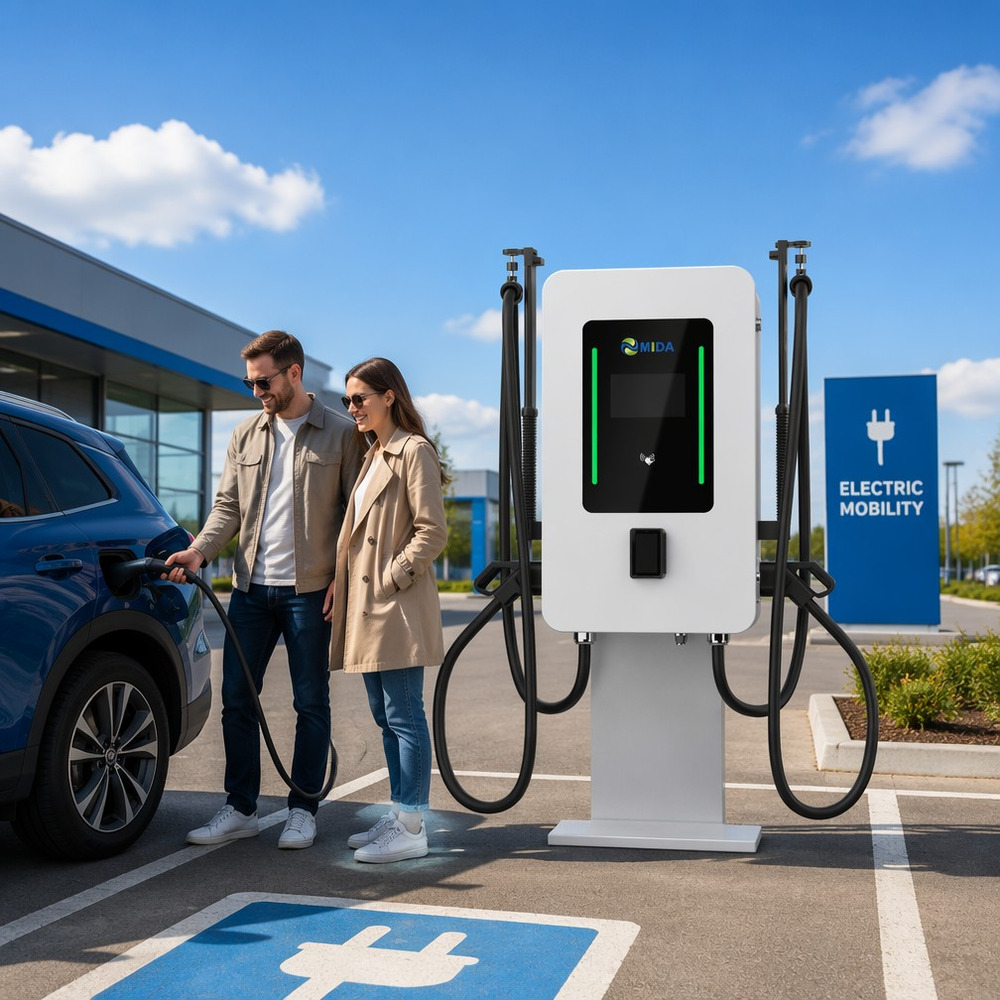
Hardware certification gets a product to market; communication standards get it into networks. Two protocols have become quasi-regulatory in 2026:
ISO 15118 governs vehicle-to-charger communication. ISO 15118-20 (2019) introduced TLS-secured Plug & Charge — the vehicle authenticates itself automatically via certificates, so the driver simply plugs in and the session starts, authorizes, and bills without cards or apps. The EU AFIR regulation explicitly requires Plug & Charge-capable charging points for new deployments, US NEVI-funded stations must support ISO 15118, and most major OEM programs now mandate it. MIDA Power ships ISO 15118 Plug and Charge ready DC fast chargers, including a 200 kW station variant built specifically for this requirement. ISO 15118-20 also defines bidirectional power transfer (BPT), which V2G-capable stations and MIDA’s 40 kW bidirectional modules implement today.
OCPP (Open Charge Point Protocol) standardizes charger-to-backend management. OCPP 2.0.1 adds security profiles based on TLS and device certificates, device management, and smart charging — all required by modern CSMS platforms and grid-flexibility schemes. Chargers limited to OCPP 1.6J remain marketable but face shrinking eligibility in smart-charging programs; MIDA supports both 1.6J and 2.0.1 with deep customization through its Easy Charging Cloud CSMS.
Together, ISO 15118 and OCPP 2.0.1 form the interoperability stack that funding agencies, utilities, and network operators audit alongside hardware certification. Compliance should be treated as a first-class deliverable in any procurement specification.
The Certification Journey in Practice
The certification pathway for a new DC charger model follows a repeatable sequence:
- Standards mapping — identify the destination market(s) and the exact standards scope (LVD+EMC+RED, UL 2202, PSE, KC, etc.).
- Pre-compliance engineering — design review against safety clearances, EMC filtering, thermal limits, and connector requirements before lab testing, which avoids expensive retest cycles.
- Laboratory testing — safety, EMC, and environmental testing at an accredited lab; test durations of 6–12 weeks are typical.
- Factory inspection — NRTL/notified-body audits of production quality systems (referencing ISO 9001) for marks that require it.
- Documentation and declaration — technical files, risk assessments (per CRA for the EU), Declaration of Conformity, and user documentation.
- Marking and surveillance — applying the mark, registering with relevant authorities, and maintaining annual surveillance testing.
| Market | Mark | Key Standards | Scope | Typical Timeline |
|---|---|---|---|---|
| European Union | CE | LVD 2014/35/EU, EMC 2014/30/EU, RED 2014/53/EU, RoHS, REACH, CRA (from 2027) | Safety, EMC, radio, cybersecurity | 2–4 months |
| Germany/Europe (market) | TUV CE | EN 61851-21-1, EN 61851-23 | Third-party safety + EMC evidence | 3–5 months |
| United Kingdom | UKCA | UK electrical safety, EMC, radio regulations | Same scope as CE, GB-specific | 2–4 months |
| United States | UL / ETL + FCC | UL 2202, UL 2594, UL 2231, UL 2251, FCC Part 15 | Safety listing, personnel protection, EMC | 3–6 months |
| Canada | cUL / CSA / ETLc | CAN/CSA C22.2 No. 281.2, UL 2594 | Safety listing for Canadian codes | 3–6 months |
| Japan | PSE | DENAN law, JIS C 61851 | Product safety | 2–4 months |
| South Korea | KC | KC 61851 series | Safety + EMC, factory audit | 2–4 months |
| China | GB/T (+ CCC where applicable) | GB/T 18487.1, GB/T 27930 | Safety, protocol, grid | 2–5 months |
| Australia | RCM | AS/NZS 61851.1, EESS, ACMA EMC | Safety + EMC, supplier registration | 2–4 months |
Common Pitfalls and How to Avoid Them
Assuming CE is enough. CE covers the EU; it does not cover the US (UL), the UK (UKCA), or any other jurisdiction. Each market’s certification must be scoped explicitly.
Ordering chargers without a certification audit. Uncertified or region-mismatched hardware causes customs delays, insurance gaps, and network rejection. Procurement should request certificate copies, verify the certificate holder, and confirm the certificate covers the exact model and connector variant being purchased.
Ignoring the connector standard. A CCS2 charger cannot be legally deployed as CCS1 or NACS without re-certification of the connector assembly. Regional connector variants (CCS1/CCS2/CHAdeMO/GB/T/NACS) must match the certification scope.
Treating software as out of scope. OCPP compliance and ISO 15118 Plug & Charge are contractual requirements in most 2026 network agreements and funding programs. Verify them in writing, not by brochure.
Forgetting ongoing obligations. NRTL listings, KC, and several other marks require factory surveillance audits and production-line consistency checks. Certificates can lapse — always verify current validity dates.
MIDA Power’s Certification Portfolio
MIDA Power’s engineering philosophy is “certify the platform, not the project.” Because the company manufactures power modules, connectors, cables, and complete stations under one roof, its 22+ international certificates cover the full stack: TUV CE (including CCS2 250 A DC guns and European connectors), UKCA, UL 2594 test reports and UL project scopes across certified DC fast charging stations, FCC, ENERGY STAR, ETL, PSE (Japan), KC (Korea), and GB/T (China), supported by ISO 9001 quality management and ISO 14001 environmental systems.
For OEM and ODM buyers, this certified platform shortens time-to-market by months: instead of commissioning a full test campaign for a first product, a buyer selects a certified MIDA platform, applies market-specific variants, and carries the existing test reports into their own technical file. MIDA’s regulatory team supports documentation transfer, label customization, and compliance consulting for the regulatory landscape of storage-integrated systems as well as pure charging hardware.
Certification as a Competitive Weapon
In a market where hundreds of DC charger models compete on power ratings and price, certification is the differentiator that survives scrutiny. A certified station is financeable, insurable, fundable, and network-ready; an uncertified one is a liability at every stage of the value chain. As ISO 15118 Plug & Charge, OCPP 2.0.1 security, and regional marks converge into a single procurement checklist, the manufacturers and buyers who treat certification as a strategic asset — not an administrative chore — will capture the market’s growth.
FAQ
1. Which certifications does a DC EV charging station need for Europe?
CE marking under the Low Voltage, EMC, and Radio Equipment Directives, plus RoHS/REACH compliance; in practice, distributors and networks also require third-party TUV CE testing. From late 2027, cybersecurity certification under the EU Cyber Resilience Act applies to connected chargers.
2. What is the difference between UL 2202 and UL 2594 for EV chargers?
UL 2202 covers DC fast charging system equipment, while UL 2594 covers electric vehicle supply equipment (primarily AC and some DC configurations). Both reference UL 2231 for personnel protection, and the applicable standard depends on the charger architecture and the NRTL’s evaluation scope.
3. Is ISO 15118 mandatory for DC charging stations?
It is not a universal legal mandate, but it is effectively mandatory for modern networks: the EU AFIR requires Plug & Charge-capable points in new deployments, US NEVI-funded stations must support ISO 15118, and most major OEM programs demand it.
4. How long does DC charger certification take?
Typically 2–6 months per market, including lab testing (6–12 weeks), factory inspection where required, and documentation. Selecting a manufacturer with certified platforms, like MIDA Power’s 22+ certificate portfolio, compresses this dramatically.
5. Can one charger model be sold in both Europe and North America?
Yes, but with regional variants: connector standards differ (CCS2 in Europe versus CCS1/NACS in North America), and separate CE and UL/FCC certification campaigns are required. The power electronics can be shared, but the connector and communication layers must be market-specific.
6. What is Plug & Charge, and why does it matter?
Plug & Charge, defined in ISO 15118-20, lets the vehicle authenticate itself with digital certificates so the driver just plugs in — the session starts, authorizes, and bills automatically. It reduces fraud, improves driver experience, and is a stated requirement of major funding programs.
7. Does MIDA Power provide certification documentation for OEM projects?
Yes. MIDA Power’s certified platforms include TUV CE, UKCA, UL, FCC, PSE, KC, and GB/T certificates across modules, connectors, and complete stations, with test-report transfer, label customization, and compliance support for OEM/ODM buyers.
Post time: Aug-18-2026