
Hydrogen vs. Electric: The Symbiosis and Competition of FCEV and BEV for Heavy-Duty Transport
Quick Answer
For heavy-duty transport, battery-electric (BEV) and hydrogen fuel-cell (FCEV) trucks are not interchangeable technologies fighting a winner-take-all war; they are complementary powertrains whose economics diverge sharply by duty cycle. BEV wins decisively where vehicles return to a depot with predictable downtime: regional distribution, urban delivery, drayage, and short-haul routes under roughly 500 km, where depot charging at 150–1,000 kW delivers energy at well-to-wheel efficiencies of 70–80% and operating costs well below diesel. FCEV retains structural advantages where BEV struggles: continuous long-haul above 700–1,000 km per day, cold climates where battery performance degrades, payload- and time-sensitive operations where a 5–15 minute hydrogen fill beats an hour of charging, and routes with constrained grid capacity. The competition is real — both compete for the same decarbonization budgets — but the symbiosis is stronger: hybrid depots, shared corridors, and green hydrogen produced from curtailed renewables can make the two systems jointly displace diesel faster than either could alone. This article quantifies the efficiency and cost gap, maps the duty-cycle divide, compares infrastructure economics, and provides a 2026–2030 fleet procurement framework.
Key Takeaways
- Efficiency is not close: BEV delivers 70–80% well-to-wheel efficiency versus roughly 30–40% for FCEV using electrolytic hydrogen, making BEV the energy-cheap option wherever the duty cycle fits.
- Duty cycle decides the winner: depot-returning routes under ~500 km favor BEV; sustained 700–1,000+ km, cold-climate, payload-critical, and grid-constrained operations favor FCEV.
- Infrastructure asymmetry is decisive near term: depot charging builds on existing grid assets and matures fast, while hydrogen refueling needs a production, transport, and storage chain that is still scaling.
- The technologies are symbiotic in practice: hybrid depots, dual-fuel corridors, and hydrogen from curtailed renewables create a joint system that outperforms either powertrain deployed alone.
- Fleet strategy should be powertrain-portfolio-based: model routes, not dogma, and keep charging/refueling decisions flexible as vehicle economics and hydrogen prices evolve through 2030.
The Efficiency Gap: A Well-to-Wheel Reality Check
The energy chain sets the baseline for everything else. A battery-electric truck converts electricity to wheel motion at roughly 85–95% efficiency at the vehicle, and even after grid losses the well-to-wheel figure lands around 70–80%. A fuel-cell truck converts electricity to hydrogen (electrolysis at 60–75%), compresses and transports it (another 10–20% loss), then converts it back to electricity in the fuel cell at 50–60% before the drivetrain — a round trip that lands well-to-wheel efficiency near 30–40%. The practical meaning: an FCEV truck needs roughly twice the primary energy per kilometer of a BEV truck. With grid electricity at USD 0.08–0.15/kWh, BEV energy costs run USD 0.25–0.45 per km for a Class 8 truck, while hydrogen at USD 6–12/kg (the realistic 2026–2028 range for green hydrogen delivered to the pump) costs USD 0.55–1.10 per km. Hydrogen only becomes competitive on energy cost at USD 4–5/kg at the pump — a target that depends on cheap renewable electricity, electrolyzer scale, and distribution density that the industry has not yet achieved.
Where BEV Wins Today: Depot, Regional, and Urban Duty Cycles
Battery-electric trucks dominate where the schedule is depot-centric. A regional distribution fleet runs 300–500 km per day, returns to the depot overnight or between shifts, and can charge at 150–1,000 kW from infrastructure built on an existing grid connection. The economics compound: energy is cheap, maintenance is low (an electric drivetrain has an order of magnitude fewer moving parts than a diesel or hydrogen system), and the vehicle’s total cost of ownership already beats diesel on many European and Chinese routes at 2026 battery prices. Depot charging also scales with predictable, non-public infrastructure: no hydrogen supply chain, no corridor build-out, just power electronics, transformers, and load management — the same stack operators already buy. For urban delivery, drayage, port operations, and regional hub-and-spoke networks, the BEV case is not speculative; it is the default economic recommendation in most markets.
Where FCEV Holds Its Ground: Long-Haul, Cold Climate, and Payload
Hydrogen retains three structural advantages. The first is range and refueling time: an FCEV truck can carry enough hydrogen for 700–1,000+ km and refuel in 10–15 minutes, while a BEV truck on the same route needs a 350–1,000 kWh battery — costly, heavy, and slow to recharge even at megawatt rates. The second is payload and weight: a 700–900 kg hydrogen storage and fuel-cell system displaces far less payload than a 2,500–5,000 kg battery pack, a decisive factor in weight-regulated markets and high-utilization freight. The third is cold climate and energy density: battery performance and fast-charging capability degrade at low temperatures, while fuel cells maintain output; and hydrogen’s gravimetric energy density (about 120 MJ/kg) makes it the only zero-emission carrier that approaches diesel’s range-to-weight profile. Routes with sustained 1,000+ km daily distances, mandatory 15-minute turnaround windows, extreme cold, or grid connections too small for megawatt charging remain the credible FCEV stronghold through 2030.
Infrastructure Economics: Charging Corridors vs. Hydrogen Refueling Networks
The infrastructure asymmetry is where the 2026–2030 story is decided.
Depot Charging: The Fast-Scaling Asset Class
Depot and corridor charging builds on existing electrical infrastructure, scales in modular increments — a depot adds 2–4 MW of charging, a corridor adds stations every 100–150 km — and monetizes through the same electricity markets operators already understand. The EU’s AFIR and US tax credits are building both ecosystems, but the charging ecosystem benefits from a shorter, cheaper capital stack and existing supply chains, which is why BEV infrastructure deployment is running one to two years ahead of hydrogen corridors in most regions.
Hydrogen Refueling: The Capital-Intensive Chain
Hydrogen refueling stations (HRS) are a different asset class: a single heavy-duty HRS costs USD 2–5 million, requires a guaranteed hydrogen supply — electrolyzer at site, pipeline, or tube-trailer delivery — and needs throughput to amortize, creating a chicken-and-egg problem that public funding is only beginning to break.
BEV vs. FCEV Heavy-Duty: A Comparison Table
| Dimension | Battery-Electric (BEV) | Hydrogen Fuel-Cell (FCEV) |
|---|---|---|
| Well-to-wheel efficiency | 70–80% | 30–40% (electrolytic hydrogen) |
| Energy cost per km (Class 8) | USD 0.25–0.45 | USD 0.55–1.10 at USD 6–12/kg H2 |
| Typical range | 300–600 km (growing with battery density) | 700–1,000+ km |
| Refuel/recharge time | 1–8 hours depot; 40–90 min fast; 15–30 min megawatt (MCS) | 10–15 minutes |
| Payload impact | High (2,500–5,000 kg battery) | Low–moderate (700–900 kg system) |
| Cold-climate performance | Degraded range and charge rate | Stable output; minor cold-start penalties |
| Infrastructure cost per vehicle served | Depot charging USD 10k–60k per bay; corridor stations modular | HRS USD 2–5M each; supply chain capex upstream |
| Infrastructure maturity | High; scaling on existing grid assets | Low–medium; production/transport chain scaling |
| Maintenance profile | Simple drivetrain, few moving parts | Fuel cell stack degradation, compressor systems, more balance-of-plant |
| Best-fit duty cycle | Depot-returning regional, urban, drayage, <500 km | Long-haul >700–1,000 km, cold climate, payload-critical |
| 2030 outlook | Default choice for majority of truck sales | Niche but growing; corridor and special-duty complement |
The table sharpens the decision rule: BEV wins on energy economics wherever the schedule allows depot charging; FCEV wins where energy density, refueling speed, or grid limits override energy cost. The two are not competitors in the same lane — they are different tools for different parts of the freight network, and the enterprise question is which mix optimizes the whole portfolio.
The Symbiosis Playbook: Hybrid Depots and Corridors
The most practical near-term strategy is deliberate symbiosis. A hybrid depot operates BEV trucks on regional routes with depot charging and FCEV trucks on long-haul routes with on-site or nearby hydrogen supply, sharing the same site infrastructure, energy procurement, telematics, and maintenance organization — spreading fixed costs and hedging against changes in either technology’s economics. Corridors can be planned the same way: a motorway corridor that co-locates megawatt charging hubs and heavy-duty hydrogen refueling stations serves both vehicle classes, gives drivers redundancy, and makes the corridor’s business case stronger than either technology alone. There is also an energy-system symbiosis: green hydrogen produced from curtailed renewable generation — solar and wind that would otherwise be wasted — turns otherwise-stranded energy into transport fuel, and can be stored and delivered to fuel-cell trucks while batteries smooth the grid in the same region. Fleet operators that plan for both powertrains now will not be locked out of either market’s cost curve.
A 2026–2030 Procurement Framework for Fleets
- Model routes, not vehicles: classify every route by daily distance, turnaround windows, payload utilization, climate, and grid access; the route profile, not ideology, selects the powertrain.
- Default BEV for depot-returning routes: regional, urban, and drayage operations under ~500 km should be battery-electric on depot charging, where energy economics are structurally superior.
- Reserve FCEV for the structural niches: sustained 1,000+ km long-haul, cold-climate corridors, payload-critical freight, and grid-constrained sites justify the hydrogen premium today.
- Build for powertrain flexibility: specify depot electrical capacity and site layouts that can add megawatt charging, and keep energy contracts that can accommodate hydrogen supply when corridors open.
- Co-locate where possible: hybrid depots and shared corridors spread fixed costs and hedge technology risk; evaluate co-located projects before single-fuel builds.
- Re-model annually: battery density, megawatt charging, and hydrogen prices are all moving; the optimal powertrain mix shifts every 12–24 months through 2030.
- Prepare the electrical estate regardless: BEV or FCEV, the depot needs a serious electrical backbone — transformers, switchgear, and power management that every future powertrain depends on.
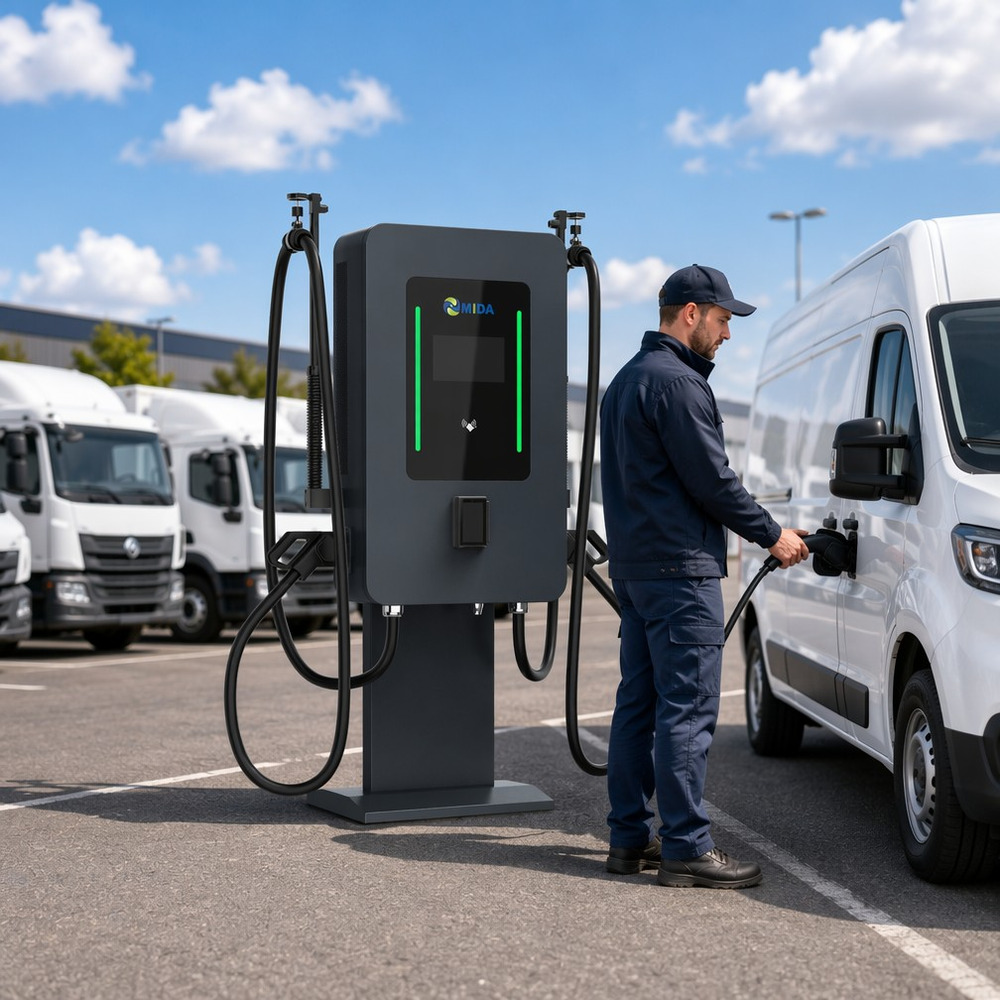
The electrical backbone is the common denominator, and the hardware purchased today must serve both worlds. Universal dual-gun DC fast charging stations built for electric bus and fleet vans anchor depot yards with rugged, high-throughput charging, while premium dual-gun wallbox DC fast charging stations configured for fleet high-speed charging cover the crew-vehicle and support fleet layer of a hybrid depot. Commercial-grade 80kW dual-gun wallbox DC fast chargers with a 150–1000V range future-proof the depot for next-generation high-voltage BEV trucks, and heavy-duty dual-gun wall-mounted DC fast charging piles for public highway corridors build the corridor layer that hydrogen refueling will one day share. Fleet-preferred dual-gun wall-mounted DC fast chargers with CCS2/GBT interfaces round out a multi-site fleet standard that keeps one management platform across BEV depots and co-located corridor assets.
Frequently Asked Questions
Q1. Which is cheaper to operate, a battery truck or a hydrogen truck?
At 2026 energy prices, battery-electric is significantly cheaper on energy: roughly USD 0.25–0.45/km versus USD 0.55–1.10/km for hydrogen at USD 6–12/kg. Maintenance also favors BEV’s simpler drivetrain. Hydrogen only closes the energy-cost gap near USD 4–5/kg at the pump, which requires cheap renewable power, electrolyzer scale, and distribution density.
Q2. Why use hydrogen at all if it is less efficient?
Because efficiency is not the only metric. Hydrogen’s energy density, 10–15 minute refueling, cold-climate performance, and lighter onboard system make it the only zero-emission option for sustained long-haul, payload-critical, and grid-constrained operations where battery-electric cannot fit the schedule or the weight budget.
Q3. What is the realistic range of current battery trucks?
Production battery trucks in 2026 deliver 300–600 km of usable range depending on load, terrain, and climate. With 800V architectures and larger packs, ranges are creeping toward 700 km, but payload trade-offs and charge time still limit continuous long-haul operations.
Q4. Can hydrogen trucks use the same depots as electric trucks?
Yes, and they increasingly should. A hybrid depot provides electrical infrastructure for BEV charging and either on-site hydrogen production or delivered-hydrogen storage for FCEVs, sharing site, energy procurement, telematics, and maintenance — spreading fixed costs and hedging technology risk.
Q5. How much does a heavy-duty hydrogen refueling station cost?
Typically USD 2–5 million per station, plus the upstream cost of hydrogen production and transport. That is an order of magnitude more per vehicle served than depot charging bays, which is why charging infrastructure is deploying faster and why hydrogen corridors depend on public funding.
Q6. Will hydrogen trucks ever beat electric trucks on TCO?
On specific duty cycles, yes — sustained long-haul with high utilization and payload sensitivity — once green hydrogen reaches USD 4–5/kg and fuel-cell stack costs fall. On depot-returning routes, BEV will almost certainly retain the TCO advantage through 2030 and beyond.
Q7. Should my fleet commit to one powertrain or both?
Plan a portfolio. Classify routes by distance, turnaround, payload, climate, and grid access, then assign powertrains by economics, not preference. A hybrid strategy with a shared electrical backbone and co-located corridors keeps the fleet flexible as battery, megawatt-charging, and hydrogen economics all improve through 2030.
Post time: Sep-01-2026