
Quick Answer
PV-storage-charging integration combines on-site solar photovoltaic (PV) generation, a lithium iron phosphate (LFP) battery energy storage system (BESS), and DC fast charging into one intelligent energy platform. In 2026, this architecture is the fastest route to deploy 120 kW–480 kW DC charging without waiting for grid upgrades, while reducing demand charges and energy costs by 30–60% and enabling genuinely low-carbon miles. MIDA Power delivers turnkey integrated stations — from 120 kWh modular storage piles to megawatt-scale solar microgrids — built on MPPT DC-DC converters, high-efficiency charging modules, and AI-driven energy management. For charge point operators (CPOs), fleet managers, and highway developers, the integrated model converts a charging site from a pure grid cost into a managed, revenue-generating energy asset.
Key Takeaways
- PV-storage-charging decouples DC fast charging from transformer capacity, enabling 120–480 kW output on weak or congested grids.
- BESS peak shaving combined with PV self-consumption can cut charging-site energy OPEX by 30–60% versus grid-only operation.
- LFP chemistry with ≥6,000-cycle life and multi-level BMS protection makes storage safe, fire-compliant, and economical over a 10+ year asset life.
- ISO 15118, OCPP 2.0.1, and AI-based energy management systems (EMS) orchestrate solar, battery, and vehicle power flows in real time.
- MIDA Power offers one-stop integrated solutions: MPPT solar modules, 60 kW–480 kW DC chargers, and 120 kWh–2 MWh BESS systems, all CE/UL-certified hardware.
The Energy Problem That Defines Modern DC Charging
The EV market has moved past the infrastructure tipping point. Electric vehicles now account for more than one in five new car sales worldwide, and public fast charging has become a competitive battlefield where speed, uptime, and price per kilowatt-hour decide site profitability. Yet the physical bottleneck is no longer the charger — it is the grid connection behind it.
A conventional 120 kW DC fast charger demands roughly 160 kVA of dedicated transformer capacity. A 480 kW ultra-fast hub requires 600 kVA or more. In dense urban districts, highway service areas, and industrial parks, distribution transformers are already near capacity, and grid reinforcement lead times routinely stretch from 12 to 36 months. Meanwhile, utility demand charges in many markets add €5–€20 per kW of peak demand every month, meaning a single 480 kW hub can accrue six-figure annual penalties if utilization is uneven.
PV-storage-charging integration attacks all three constraints simultaneously: it reduces grid dependency, flattens peak demand, and converts solar irradiance into directly sellable charging energy. This is why the model has evolved from pilot projects into a mainstream deployment strategy for CPOs, fleet operators, and retail developers.
What PV-Storage-Charging Integration Actually Is
A PV-storage-charging (PVS+C) station is a microgrid with a single purpose: charge electric vehicles at maximum speed while minimizing grid import and carbon footprint. The system continuously balances four power sources and sinks — solar generation, battery storage, grid connection, and vehicle loads — through a central EMS.
The core operating principle is buffering. Solar arrays produce energy during daylight hours, often when charging demand is low. The battery absorbs surplus solar energy and low-cost grid energy during off-peak periods, then discharges it during peak charging windows. The result is that the DC charger sees a stable, high-power supply regardless of what the grid or the sun is doing at that moment. This buffering logic is what allows a 120 kVA grid connection to power a 320 kW charging hub — the battery supplies the delta.
MIDA Power’s engineering of this architecture is described in its integrated BESS charging stations line, where storage, charger, and control system ship as a single factory-integrated cabinet rather than as separately procured components. Factory integration matters: it collapses installation time, guarantees protocol compatibility, and shifts commissioning risk from the site contractor to the manufacturer.
The Three Building Blocks
Solar PV: The Generation Layer
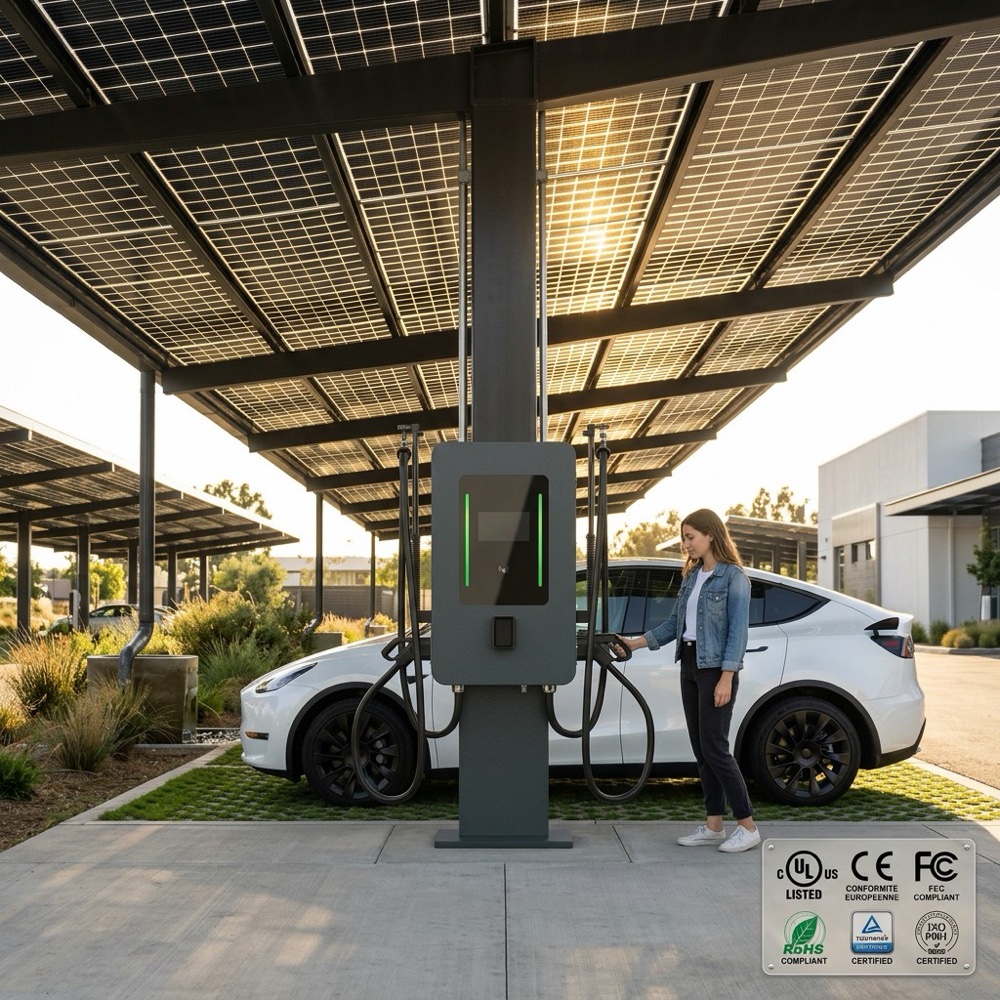
The PV array is the “free energy” engine of the station. Typical configurations use carport structures over parking bays — which simultaneously shade vehicles and generate power — or roof-mounted arrays on adjacent buildings. System sizes for charging sites typically range from 50 kWp for a single-aisle urban site to 1 MWp or more for highway plazas.
The technical key is how solar energy enters the DC system. Rather than converting PV DC power to AC and back to DC (which loses 4–8% through double conversion), MIDA’s MPPT DC-DC modules — available in 30 kW and 60 kW variants — couple the PV array directly to the DC bus of the storage system. This single-stage topology raises effective solar utilization and simplifies the power architecture, a design approach detailed in MIDA’s analysis of BESS and solar power coupling.
Battery Storage: The Buffer Layer
The BESS is the heart of the integration. MIDA’s systems use A-grade LFP cells (CATL, Gotion, and equivalent tier-1 suppliers), which deliver three decisive advantages over NMC chemistry: thermal stability that resists thermal runaway, a cycle life of ≥6,000 cycles at 80% depth of discharge, and no cobalt dependency in the supply chain. A 215 kWh LFP buffer, charged overnight at off-peak rates and discharged during daytime peaks, typically achieves payback in 3–5 years on demand-charge savings alone.
The BESS cabinet integrates the battery rack, battery management system (BMS), bidirectional power conversion, and fire suppression as one unit. MIDA’s cabinets carry IP54 ingress protection, integrated automatic heptafluoropropane (FM200-class) fire extinguishing, and multi-level BMS with cell, module, and pack protection. System conversion efficiency reaches 98.5% at full load, and the storage layer supports both V2G bidirectional modules (40 kW liquid-cooled, ≥96% efficiency) and future second-life battery applications.
DC Fast Charging: The Demand Layer
The charging hardware itself must be capable of drawing energy from both the grid and the battery simultaneously. MIDA’s DC fast charging stations range from 60 kW wall-mounted units to 480 kW floor-standing systems and 400 kW liquid-cooled ultra-fast chargers with 1000 V output for next-generation high-voltage vehicle platforms. Chargers support CCS1, CCS2, CHAdeMO, GB/T, and NACS connectors, with dynamic dual-gun power distribution that splits station capacity intelligently between two vehicles.
At the flagship level, the 400 kW liquid-cooled ultra-fast charger demonstrates the integration principle at scale: liquid-cooled cables and modules sustain high current without derating, so the station can deliver its full rated power session after session — exactly what a solar-plus-storage hub needs to monetize stored energy during peak traffic windows.
Why the Business Case Now Works
The economics of PVS+C stations have crossed the viability threshold for three reasons: falling battery prices, rising grid costs, and regulatory support.
LFP pack prices have fallen below $80/kWh in 2025, making the storage layer an investment rather than a cost center. On the other side of the ledger, European and US utilities continue to raise demand charges and grid connection fees, while programs such as the EU’s AFIR regulation and the US NEVI program explicitly favor sites that demonstrate grid-friendly, smart, renewable-integrated charging.
| Parameter | Grid-Only Station | BESS-Only Station | PV + BESS + Charging |
|---|---|---|---|
| Typical grid connection required (for 320 kW output) | 400 kVA+ | 160 kVA | 160 kVA (or off-grid in remote sites) |
| Demand charge exposure | Full, continuous | Reduced ~40–60% via peak shaving | Minimized; solar offsets daytime peaks |
| Energy cost per kWh delivered | 100% grid tariff | 75–85% of grid tariff (arbitrage) | 55–75% of grid tariff (solar + arbitrage) |
| Carbon intensity of charging | Grid average | Grid average (timing-shifted) | Lowest; up to 100% renewable in daytime |
| Grid reinforcement lead time | 12–36 months | 3–9 months | 3–9 months |
| Revenue options | Charging only | Charging + grid services | Charging + grid services + solar export |
| Typical payback (commercial site) | 5–8 years | 4–6 years | 3–5 years |
The comparison table above assumes a 320 kW hub with 400 kWh of usable storage and 250 kWp of solar. Site-specific figures vary with tariffs, irradiance, and utilization, but the structural advantage is consistent: each additional layer of integration compounds the savings while reducing grid dependency.
Real-World Deployment Scenarios
Highway service areas. These sites face the harshest combination of high power demand and limited transformer headroom. A 625 kWh storage cabinet paired with a 400 kW charger lets a service area deliver ultra-fast charging using only a modest existing connection, with carport solar offsetting daytime demand.
Fleet and bus depots. Depot charging concentrates demand at night, when solar is unavailable but off-peak tariffs are low. Here the BESS charges during the cheapest overnight window and the fleet charges on a scheduled basis, while the PV array feeds the depot building during the day. MIDA’s larger configurations — 313 kWh, 625 kWh, and 960 kWh cabinets with 160–480 kW output — are engineered for exactly this duty cycle.
Remote and weak-grid locations. In tourist regions, islands, mining sites, and emerging markets where grid infrastructure is unreliable, the PVS+C station operates as a self-contained microgrid. With sufficient solar and storage, the station can function fully off-grid, and the battery serves as emergency power supply (EPS) for critical loads during outages.
Retail and destination charging. Shopping centers and hotels monetize dwell time. A solar carport over parking bays converts an amenity into an energy asset, and the storage buffer protects the host building’s transformer from charging-induced peaks — a critical requirement for landlords who would otherwise bear upgrade costs.
Standards and Protocols That Make Integration Possible
Integration is a software problem as much as a hardware problem. Four standards govern how the layers talk to each other:
- ISO 15118 defines the vehicle-to-charger communication protocol, including ISO 15118-20 which enables Plug & Charge (automatic authentication via certificate) and bidirectional power transfer. Stations compliant with ISO 15118 are mandatory for many 2026-era network programs and OEM partnerships.
- OCPP 2.0.1 (Open Charge Point Protocol) standardizes charger-to-backend communication, including smart charging profiles and cybersecurity features. MIDA supports both OCPP 1.6J and 2.0.1 with deep customization.
- Modbus TCP / CAN links the EMS to the inverter, BMS, and metering infrastructure inside the station.
- IEC 61851 provides the base AC/DC charging semantics on which ISO 15118 layers its digital communication.
On top of these protocols, MIDA’s Easy Charging Cloud CSMS (charging station management system) delivers the AI energy dispatch layer: it forecasts solar generation, predicts site demand, schedules battery charge/discharge against tariff curves, and balances power between vehicles in real time. The result is that the station’s energy flows are optimized automatically rather than by static rules.
Safety and Compliance by Design
Integration compounds electrical risk, so safety engineering is non-negotiable. Three frameworks dominate:
- Fire safety (NFPA 855, IEC 62619). Storage cabinets must maintain separation distances from structures, integrate thermal runaway detection, and include automatic suppression. MIDA’s cabinets use tier-1 LFP cells, FM200-class automatic extinguishing, and pressure-vented enclosures to contain any cell-level event.
- Electrical safety (IEC 61851-1, UL 2202, CE LVD). All charging hardware must comply with the electrical safety requirements of the destination market — CE under the Low Voltage Directive in Europe, UL 2202/UL 2594 in North America. MIDA’s product range holds CE and UL-certified variants across modules, chargers, and connectors.
- Grid code compliance (G98/G99 in the UK, IEEE 1547 in the US). Distributed storage connected to the grid must satisfy local interconnection rules, including anti-islanding protection and export limits. Site engineering must confirm the applicable grid code before commissioning.
Installation quality completes the picture: DC station installs require concrete foundations, incoming-line conduit, and a main breaker rated ≥1.2× the unit’s rated power, while storage cabinets need clear condenser drainage and fire separation per local codes.
MIDA Power’s Integrated Platform
MIDA Power supplies the entire PVS+C value chain from a single source, which eliminates the integration risk of mixing vendors. The platform spans four scales:
| Configuration | Battery Capacity (Usable) | Charging Output | Typical Application |
|---|---|---|---|
| Compact integrated storage pile | 120 / 215 / 241 kWh | 60 / 120 / 160 kW | Urban fast charging, dealer showrooms, small commercial |
| Mobile emergency charging station | 65–200 kWh | 15–60 kW | Road rescue, events, temporary sites, weak-grid areas |
| Large integrated storage system | 313 / 625 / 960 kWh | 160 / 400 / 480 kW | Fleet depots, bus terminals, highway hubs |
| Megawatt-level solar microgrid | 1,000–2,000+ kWh | 480–960 kW+ | Charging corridors, industrial parks, island grids |
Every configuration supports CCS2, GB/T, and NACS connectors, 1000 V high-voltage output, OCPP 1.6J/2.0.1, and optional V2G capability. A typical turnkey delivery — for example the solar-battery integrated EV charging station combining 200 kWh storage with 120–160 kW charging and PV input — ships factory-integrated, pre-tested, and ready for rapid site deployment.
The Road Ahead: 2026 and Beyond
Three trends will accelerate the PVS+C model over the next 24 months. First, bidirectional charging (V2G) will turn station batteries and connected vehicles into grid-flexibility assets that earn revenue through demand response programs. Second, megawatt-scale systems aligned with the MCS (Megawatt Charging System) standard will bring the same integration logic to heavy-duty truck corridors. Third, AI-driven energy trading will let stations arbitrage energy across day-ahead and intraday markets, pushing solar-plus-storage charging toward the point where the station’s energy desk, not just the charger, drives profitability.
For any organization planning DC charging capacity in 2026 — whether a two-cabinet urban site or a highway corridor — the question is no longer whether to integrate PV and storage, but how fast the transition can be executed. The green evolution of DC stations is already underway, and the integrated model is its engine.
FAQ
1. What is PV-storage-charging integration for DC charging stations?
It is an energy architecture that combines solar PV generation, a battery energy storage system, and DC fast chargers under a single EMS, so the station can charge vehicles from solar and stored energy while minimizing grid dependency and peak demand.
2. How does a PV-storage-charging station reduce electricity costs?
By peak shaving (discharging the battery during expensive high-demand windows), arbitraging off-peak tariffs, and self-consuming solar energy, operators typically cut energy and demand-charge costs by 30–60% compared with a grid-only station.
3. Can a BESS-powered DC station operate without a grid connection?
Yes. With sufficient solar capacity and storage, the station functions as an off-grid microgrid; the battery also provides emergency power supply (EPS) for critical loads during grid outages.
4. What battery chemistry is used in integrated charging stations, and is it safe?
MIDA Power uses A-grade LFP cells with ≥6,000-cycle life, multi-level BMS protection, IP54 enclosures, and automatic FM200-class fire suppression, complying with frameworks such as NFPA 855 and IEC 62619.
5. What role does ISO 15118 play in integrated stations?
ISO 15118 (including ISO 15118-20) enables Plug & Charge authentication and bidirectional power transfer, allowing the vehicle to participate in smart energy dispatch and making the station eligible for modern network and OEM programs.
6. How long does a PV-storage-charging station take to deploy?
Factory-integrated systems — where storage, charger, EMS, and PV interface ship as one unit — can be commissioned in weeks rather than months, and they avoid 12–36 month grid reinforcement waits by operating on a modest connection.
7. Which chargers and connectors does a MIDA integrated station support?
MIDA stations support CCS1, CCS2, CHAdeMO, GB/T, and NACS connectors, from 60 kW to 480 kW output (up to 960 kW+ in megawatt configurations), with dynamic dual-gun power distribution and 1000 V high-voltage capability.
Post time: Aug-18-2026