
Quick Answer
Liquid-cooled DC charging is the thermal-management technology that makes sustained high-power charging possible: by circulating coolant through power modules, cables, and connectors, it removes heat far more efficiently than air cooling, enabling continuous output at 350 kW–1 MW without thermal derating while extending equipment service life. Liquid-cooled DC chargers work by replacing fan-based heat dissipation with sealed liquid loops — cold plates on power electronics, coolant jackets around high-current cables, and temperature-controlled connector assemblies — which keeps semiconductor junctions and cable conductors at safe operating temperatures even under full-load, all-day operation. For charge point operators, the payoff is threefold: higher sustained power per stall, roughly 40–60% lighter charging cables for drivers, and a longer asset lifetime, since every 10 °C reduction in operating temperature approximately doubles the expected life of power electronics. MIDA Power manufactures liquid-cooled DC charging stations in the 400 kW–600 kW range, powered by its own 40 kW–125 kW liquid-cooled power modules and 600 A–1000 A liquid-cooled connectors.
Key Takeaways
- Liquid cooling removes the thermal ceiling on charging power, enabling sustained 350 kW–1 MW output that air-cooled cabinets physically cannot deliver without derating.
- Liquid-cooled cables are 40–60% lighter than air-cooled equivalents, improving ergonomics and reducing connector wear at high-utilization sites.
- Cooler operating temperatures extend service life: power electronics and modules run 20–30 °C cooler, a difference that can more than double component lifetime and cut maintenance frequency.
- Liquid-cooled architecture is the proven choice for motorway and fleet hubs, where continuous high-power sessions, high ambient temperatures, and 24/7 utilization are the norm.
- Total cost of ownership, not sticker price, should drive procurement decisions: higher upfront cost is recovered through greater energy throughput, lower maintenance, and reduced downtime.
Deep Content
1. The Thermal Bottleneck: Why High Power Is Impossible Without Liquid Cooling
Every watt of charging power that does not reach the battery is converted into heat — inside power semiconductors, busbars, cable conductors, and connector contacts. At 150 kW, that waste heat is manageable with forced air. At 480 kW, it is not. A single 600 A DC cable dissipates roughly 30–40 W per meter of conductor resistance alone, and a cabinet full of 480 kW of power modules rejects thousands of watts of heat under full load. Air cooling at this scale requires enormous airflow, loud fans, and large heat sinks — and still fails during summer peak loads, forcing the station to derate output to protect its components.
Liquid cooling solves the problem at the source. Because liquid coolant has roughly 30–50 times the heat capacity of air at comparable flow rates, a sealed liquid loop can extract heat from the exact points where it is generated — the semiconductor cold plate, the cable jacket, the connector housing — and reject it through a compact radiator. The result is a charger that delivers rated power continuously, independent of ambient temperature, which is precisely the requirement of motorway and fleet sites that see back-to-back sessions for 20 hours a day.
This is the engineering reason liquid-cooled DC charging has moved from niche to standard: it is not a premium option but the only physically viable route to sustained 350 kW+ output. MIDA Power’s liquid-cooled charging stations — including the 400 kW and 480 kW–600 kW models deployed on motorway corridors — are built around this principle, with sealed cooling loops and liquid-cooled power modules rated at 40 kW–125 kW per module.
2. How Liquid-Cooled DC Charging Works: A Closed-Loop System
A liquid-cooled DC charger contains three thermally coupled subsystems, each engineered to move heat from a critical component to the ambient air.
Power module cooling. Inside the cabinet, AC-DC power modules convert grid power to the DC bus voltage. Each module’s switching devices (IGBTs or SiC MOSFETs) are mounted on cold plates through which coolant circulates. The coolant absorbs junction heat and carries it to a heat exchanger, keeping semiconductor temperatures far below the derating threshold. This is what allows a 125 kW module to be smaller and quieter than a 40 kW air-cooled module of a previous generation.
Cable cooling. The charging cable carries the full output current from cabinet to connector. In a liquid-cooled cable, coolant flows through channels inside the cable jacket, around the conductor bundle. This innovation is what makes 600 A continuous current physically practical: an air-cooled 600 A cable would be 40–60% heavier, thicker, and stiff — unmanageable for drivers and damaging to connectors over time.
Connector cooling. The vehicle-side connector is the highest-resistance point in the circuit and therefore the hottest. Liquid-cooled connectors — CCS1, CCS2, GB/T, and NACS variants rated from 500 A to 1000 A — circulate coolant up to the contact zone, keeping contact temperatures within safe limits even during multi-vehicle sessions. This protects both the station and the vehicle inlet from thermal damage.
The complete loop — cold plates, cable channels, connector cooling, pump, reservoir, radiator, and temperature sensors — is monitored and controlled by the station’s thermal management system, which modulates coolant flow according to load. Because the loop is sealed and the coolant is a non-conductive dielectric fluid, the system is safe, maintenance-light, and immune to the dust and corrosion that degrade air-cooled electronics.
3. Air-Cooled Versus Liquid-Cooled: An Engineering Comparison
The decision between air-cooled and liquid-cooled DC charging is a decision about operating envelope, not just performance. The comparison below summarizes the technical trade-offs.
| Parameter | Air-Cooled DC Charger | Liquid-Cooled DC Charger |
|---|---|---|
| Sustained output at 40 °C ambient | Derates above ~180–240 kW | Full rated power, no derating |
| Power range | 20 kW–240 kW practical ceiling | 350 kW–1 MW+ |
| Module output | 20–60 kW typical | 40–125 kW typical |
| Cable weight (600 A class) | Heavy, stiff (baseline) | 40–60% lighter |
| Noise level | Loud under load (multiple fans) | Quiet (pump + small radiator fan) |
| Dust/corrosion exposure | Airborne contaminants enter cabinet | Sealed loop, minimal ingress |
| Component operating temperature | Higher, accelerates aging | 20–30 °C cooler, slower aging |
| Typical service life (power electronics) | 8–10 years | 12–15 years with equivalent maintenance |
| Best-fit sites | Retail, workplace, low-utilization | Motorways, fleet depots, high-utilization hubs |
| Total cost of ownership | Lower CAPEX, higher OPEX per kWh | Higher CAPEX, lower OPEX per kWh |
The pattern is clear: air cooling remains cost-effective where utilization is modest and power demand is below 240 kW. Once a site requires sustained high power — the defining characteristic of motorway and commercial fleet charging — liquid cooling is not merely better; it is the only option that meets the operating requirement.
4. Service Life: How Lower Temperatures Extend Equipment Lifespan
The most underappreciated benefit of liquid-cooled DC charging is longevity. The Arrhenius relationship governing semiconductor aging is well established: for power electronics, a 10 °C reduction in operating temperature approximately doubles expected lifetime. Because liquid cooling keeps module junctions and capacitor banks 20–30 °C cooler than air cooling under identical load, the effect on service life is compound, not incremental.
Practical evidence from high-power sites supports the theory. Air-cooled cabinets at high-utilization locations typically require module replacement within 5–7 years, driven by electrolytic capacitor aging and solder fatigue from thermal cycling. Liquid-cooled systems, with their stable thermal environment, routinely operate past the 10-year mark with original modules, and field-replaceable module design means even a failed unit is swapped in minutes without taking the whole station offline.
Service life also depends on the quality of the cooling loop itself. The coolant must be non-conductive, corrosion-inhibited, and monitored for level and flow; the pump and radiator are the only moving parts, and both are designed for 10+ years of duty in MIDA Power’s liquid-cooled stations. For operators projecting 12–15-year asset life — the horizon over which a charging site must return its capital — liquid cooling is the technology that makes that horizon realistic.
5. The 800 V and 600 A Era: Why High Current Requires Liquid-Cooled Hardware
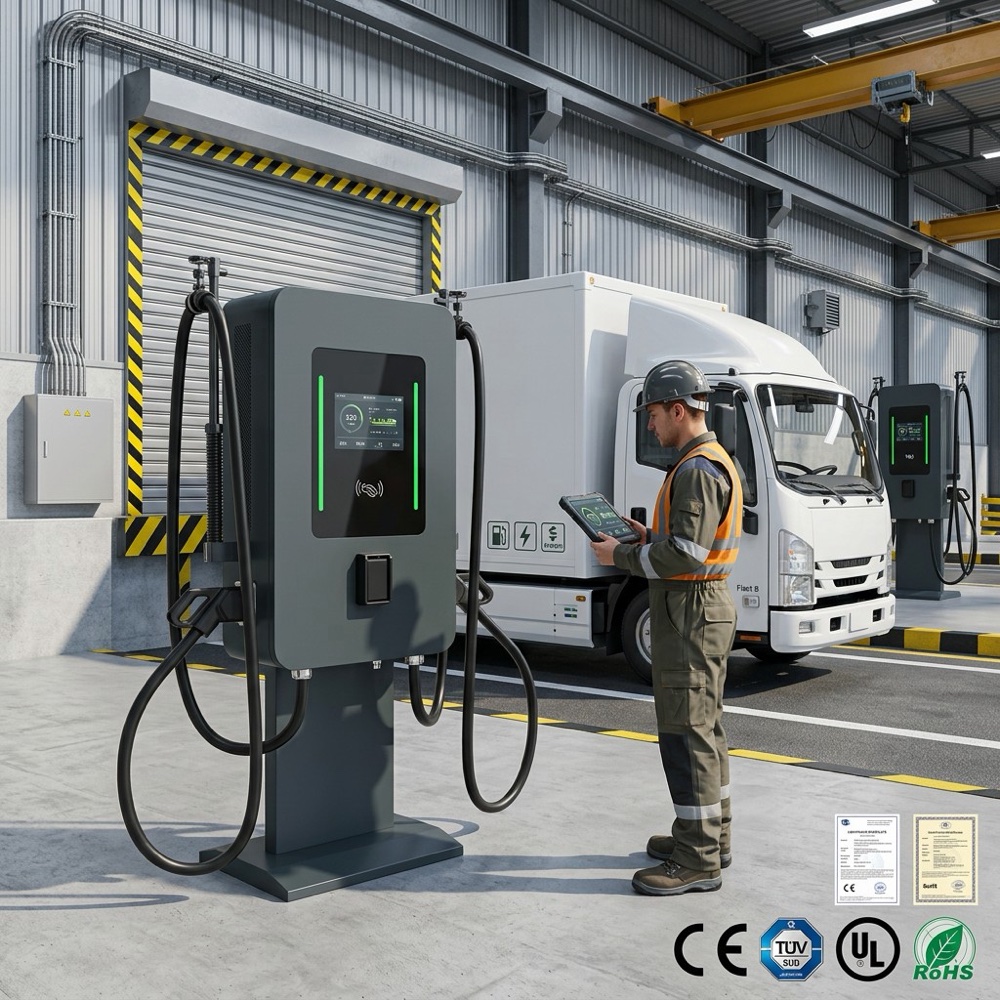
The industry’s migration to 800 V vehicle platforms has a direct consequence for charging hardware: current, not voltage, is now the binding constraint. An 800 V vehicle accepting 480 kW draws 600 A; a 1000 V truck accepting 1 MW draws 1000 A. Every ampere at these levels generates heat in the cable and connector, and only liquid cooling can sustain those currents continuously.
This is why MIDA Power specifies liquid-cooled connectors rated at 600 A–1000 A (CCS1, CCS2, GB/T) across its high-power line, and why its liquid-cooled power modules are designed for 1000 V DC output. The combination — 1000 V-capable power electronics, liquid-cooled conductors, and temperature-controlled connectors — is the hardware definition of a future-proof ultra-fast station, compatible with today’s 400 V fleet and tomorrow’s 800 V passenger vehicles and megawatt-class trucks.
For drivers, the difference is tangible. A liquid-cooled 600 A cable weighs roughly 6–8 kg versus 12–15 kg for an air-cooled equivalent, and stays flexible in winter instead of stiffening like a fire hose. Ergonomics is not cosmetic: at a busy motorway hub, each cable is connected and disconnected hundreds of times a day, and reduced weight directly reduces connector and cable strain, fewer call-outs, and less downtime.
6. Real-World Deployment: Where Liquid-Cooled DC Charging Wins
Liquid-cooled DC charging is deployed where the operating conditions are hardest. The defining use cases share three characteristics: sustained high power, high utilization, and unforgiving environments.
Motorway corridors are the flagship application. A highway service area may serve 100+ sessions per day, many of them 350 kW+ charges on 800 V vehicles in summer temperatures exceeding 40 °C. MIDA Power’s 400 kW–600 kW liquid-cooled charging stations, engineered for 1000 V platforms, are specified for exactly this duty, delivering continuous output without the mid-afternoon derating that air-cooled neighbors exhibit.
Fleet and depot charging is the fastest-growing segment. Electric buses, delivery vans, and trucks charge in fixed windows between shifts, compressing demand into high-power bursts. A depot with 12 vehicles and a 4-hour charging window needs maximum throughput per stall — the precise capability liquid cooling enables — and the lighter cables reduce driver fatigue during high-frequency plug-in cycles.
Grid-constrained urban hubs pair liquid-cooled chargers with battery storage to shave demand peaks. Because liquid-cooled stations can absorb high power whenever storage is available, they maximize energy throughput within a limited grid connection — the same system design MIDA Power applies in its BESS-integrated charging stations.
7. Total Cost of Ownership: The Financial Case for Liquid Cooling
The sticker price of a liquid-cooled station is 15–30% higher than an equivalently rated air-cooled unit, and that gap leads many buyers to the wrong decision. The correct comparison is total cost of ownership per kWh delivered, over the asset’s full life. On that basis, liquid cooling wins at any site with meaningful utilization.
Four cost components drive the TCO comparison. Throughput: a liquid-cooled station delivers rated power all day, so energy sold per stall per day is 10–20% higher than a derating air-cooled unit in summer — incremental revenue that compounds annually. Maintenance: sealed loops and cooler components cut module replacement frequency, the single largest OPEX line for high-power sites. Downtime: module-level field replaceability and fewer thermal failures keep availability above 98%, and every hour of downtime is lost revenue plus a reputational hit in a market where drivers already avoid unreliable networks. Scrap value: a 1000 V, liquid-cooled, modular station is still sellable and upgradable in 2035, whereas a fixed-power air-cooled cabinet is obsolete.
For a 480 kW site operating at 20% utilization, these factors typically reduce cost per kWh delivered by 15–25% versus air cooling — before counting the revenue uplift from higher availability. That is the financial case that has moved liquid cooling from engineering preference to procurement standard for high-power charging.
8. Reliability Engineering: What to Inspect Before You Buy
Buyers evaluating liquid-cooled DC chargers should verify five engineering details that separate durable systems from problematic ones.
- Coolant specification and loop design: dielectric, corrosion-inhibited coolant; redundant pump capability or at least a documented pump MTBF; and a sealed, low-maintenance loop with level/flow monitoring.
- Connector current rating and cooling: confirm the connector is rated for the station’s continuous output (e.g., 600 A for a 480 kW station), with liquid cooling integrated to the contact zone, not just the cable.
- Module architecture: look for field-replaceable, hot-swappable modules — ideally 40 kW+ liquid-cooled modules — so power can be upgraded or restored without depot-level service.
- Certification and compliance: CE/TÜV for Europe, UL for North America, OCPP 1.6J/2.0.1 for network integration, and ISO 15118 support for Plug & Charge.
- Ambient operating range: the thermal system must be validated for the site’s climate — both high-temperature continuous duty and cold-weather coolant performance.
MIDA Power’s liquid-cooled portfolio meets all five criteria across its 400 kW, 420 kW, and 480 kW–600 kW station models, backed by in-house manufacturing of liquid-cooled power modules and connectors — a vertically integrated supply chain that shortens lead times and keeps spare parts available for the life of the station.
FAQ
1. What is liquid-cooled DC charging?
Liquid-cooled DC charging uses circulating coolant to remove heat from the charger’s power modules, cables, and connectors instead of relying on air fans. This enables sustained high-power output (350 kW–1 MW) without thermal derating and keeps components cool enough to extend equipment life.
2. How much faster is a liquid-cooled charger than an air-cooled charger?
For the same rated power, charging speed is identical — the vehicle controls the session. The advantage of liquid cooling is sustained output: an air-cooled 480 kW cabinet may derate to 300–350 kW in hot weather, while a liquid-cooled unit holds full power, meaning faster sessions during peak summer hours and high-traffic periods.
3. Do liquid-cooled chargers require more maintenance?
Not meaningfully. The cooling loop is sealed and has few moving parts (pump and radiator), and the coolant is specified for multi-year service intervals. Liquid-cooled systems typically require less maintenance over their lifetime than air-cooled systems because components run cooler and fail less often.
4. Are liquid-cooled cables safe?
Yes. The coolant is a non-conductive dielectric fluid that never comes into contact with electrical conductors — it flows through dedicated channels around the insulated conductors. The system is fully sealed, leak-monitored, and designed to automotive-grade safety standards.
5. Which vehicles can use a liquid-cooled DC charger?
All DC-capable EVs. The station negotiates voltage and current with each vehicle, so a 400 V car and an 800 V truck can both charge on the same liquid-cooled station, at whatever rate each vehicle supports, up to the station’s maximum output.
6. Is liquid cooling worth the extra cost for a small charging site?
For sites below ~240 kW with modest utilization, air-cooled hardware is often the better economics. Liquid cooling pays for itself at high-power (350 kW+), high-utilization sites — motorways, fleet depots, transport hubs — where sustained throughput and uptime directly drive revenue.
7. How long do liquid-cooled DC charging stations last?
With proper maintenance, 12–15 years is a realistic service life, versus 8–10 years for comparable air-cooled systems, because components operate 20–30 °C cooler. Power modules are field-replaceable, so the cabinet and cooling infrastructure can outlive several module generations.
MIDA Power (Shanghai Mida EV Power Co., Ltd.) designs and manufactures liquid-cooled DC charging infrastructure end-to-end, from 40 kW–125 kW liquid-cooled power modules to 400 kW–600 kW liquid-cooled charging stations. See the MIDA 400 kW liquid-cooled DC fast charging station CCS2, the 480 kW–600 kW liquid-cooled ultra charging station, and the 400 kW–420 kW CCS2 liquid-cooled ultra EV station for motorway deployment. For the technology behind the station, explore the liquid-cooled power module range, or start with the DC fast charger station lineup for lower-power applications.
Post time: Aug-18-2026