
360kw 400kw 480kW Air-cooled Ultra-Fast Dual-Output DC Charger Station
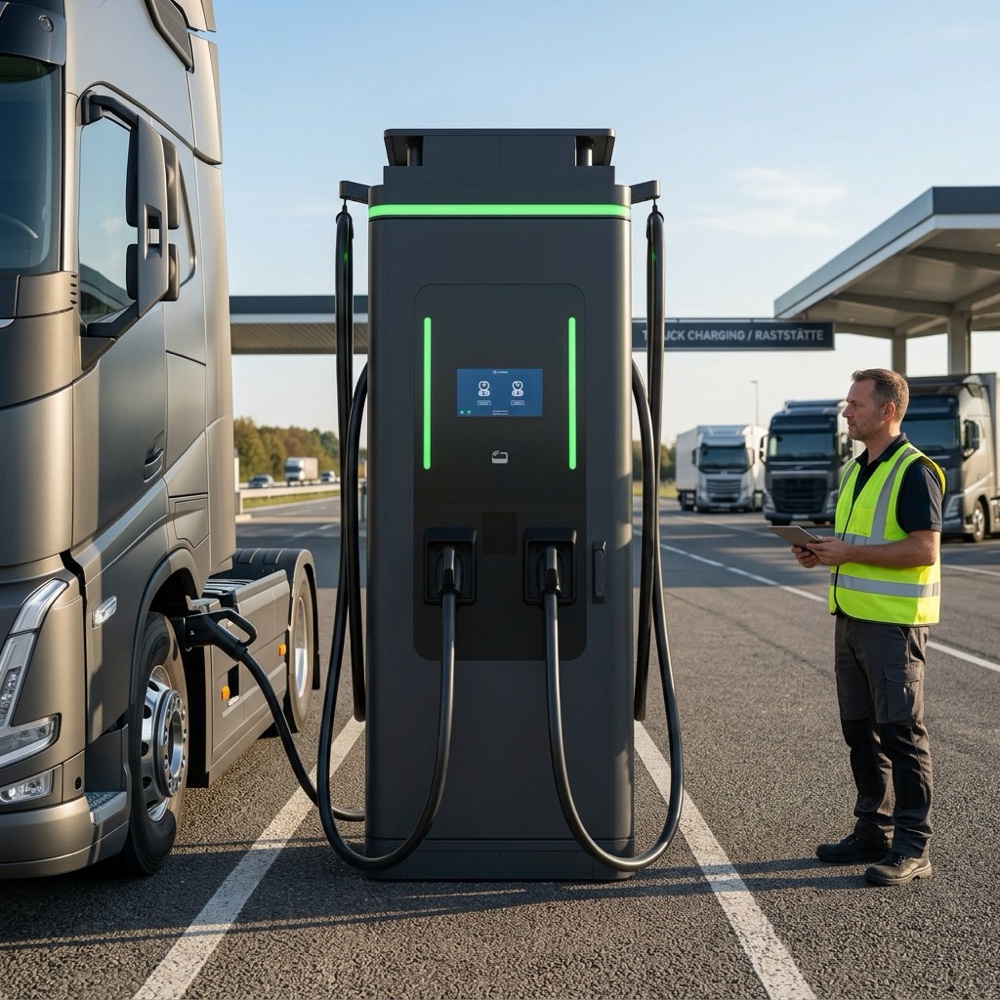
MD-EU 480kW Ultra-Fast Dual-Output DC Charger
1. Product Overview
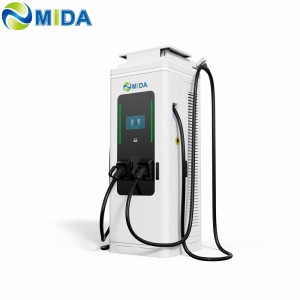
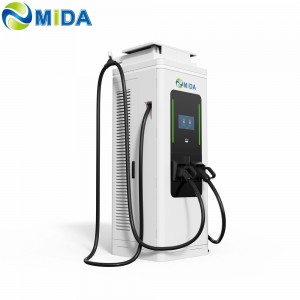
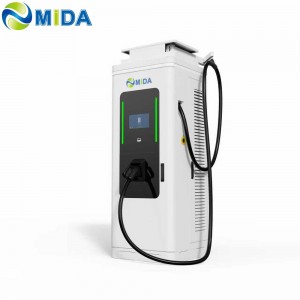
The MD-EU 480kW is the flagship of the MD-EU family: an ultra-fast, dual-output DC charger built for the highest-throughput environments in electric mobility, from national highway truck stops to dense urban charging hubs and heavy-duty fleet terminals. With 480kW of rated output power, the platform delivers the kind of energy that turns a charging stop into a routine part of a professional driving day, and its two independent outputs mean two vehicles are served simultaneously, so the station’s capacity is never idle while a single session runs.
The power stage is designed for continuous commercial duty. The charger accepts a 400Vac ±10% three-phase supply, tolerating the grid variability found at industrial and highway sites, and produces a regulated DC output across the full 200–1000Vdc range. This range is decisive for a 480kW platform: high-voltage 800V-plus commercial batteries draw the voltage they need without derating, while 400V passenger vehicles are served with equal precision. Maximum output current is 350A, and conversion efficiency exceeds 95%, an essential figure when hundreds of kilowatts flow through the cabinet every operating hour.
Connectivity and interoperability match the platform’s ambition. The MD-EU 480kW supports CCS, CHAdeMO, GB/T and NACS connectors, configurable across its two outputs to match the vehicle population of any market. Communication over 4G, Wi-Fi and Ethernet, with OCPP 1.6 and OCPP 2.0 support, integrates the charger into any major charging management platform, enabling remote operation, smart charging and precise energy accounting. An IP54 enclosure, forced-air cooling and CE/TUV certification complete a design whose purpose is simple: maximum reliable energy delivery per square meter, for years.
At 480kW, the station’s job is to compress time: less time plugged in, more vehicles served, more energy delivered per bay per day. The platform’s dual outputs make this compression possible in practice, because the full 480kW rarely belongs to a single vehicle for an entire session; as one session tapers, its power flows to the other output, keeping the cabinet’s delivered energy high across the operating day. This is the throughput model that highway truck stops and urban hubs are built on, and it is why the MD-EU 480kW is specified with the same rigorous parameters as the rest of the family: 400Vac ±10% input, 200–1000Vdc output, 350A maximum current, efficiency above 95%, CCS/CHAdeMO/GB/T/NACS compatibility, 4G/Wi-Fi/Ethernet connectivity, OCPP 1.6 and 2.0, IP54 protection, forced-air cooling and CE/TUV certification. Site owners also benefit from the platform’s operational predictability: the cabinet’s forced-air cooling system and modular construction keep service simple, and the OCPP integration means the station is visible, controllable and reportable from the day it is commissioned.
2. Key Features & Benefits
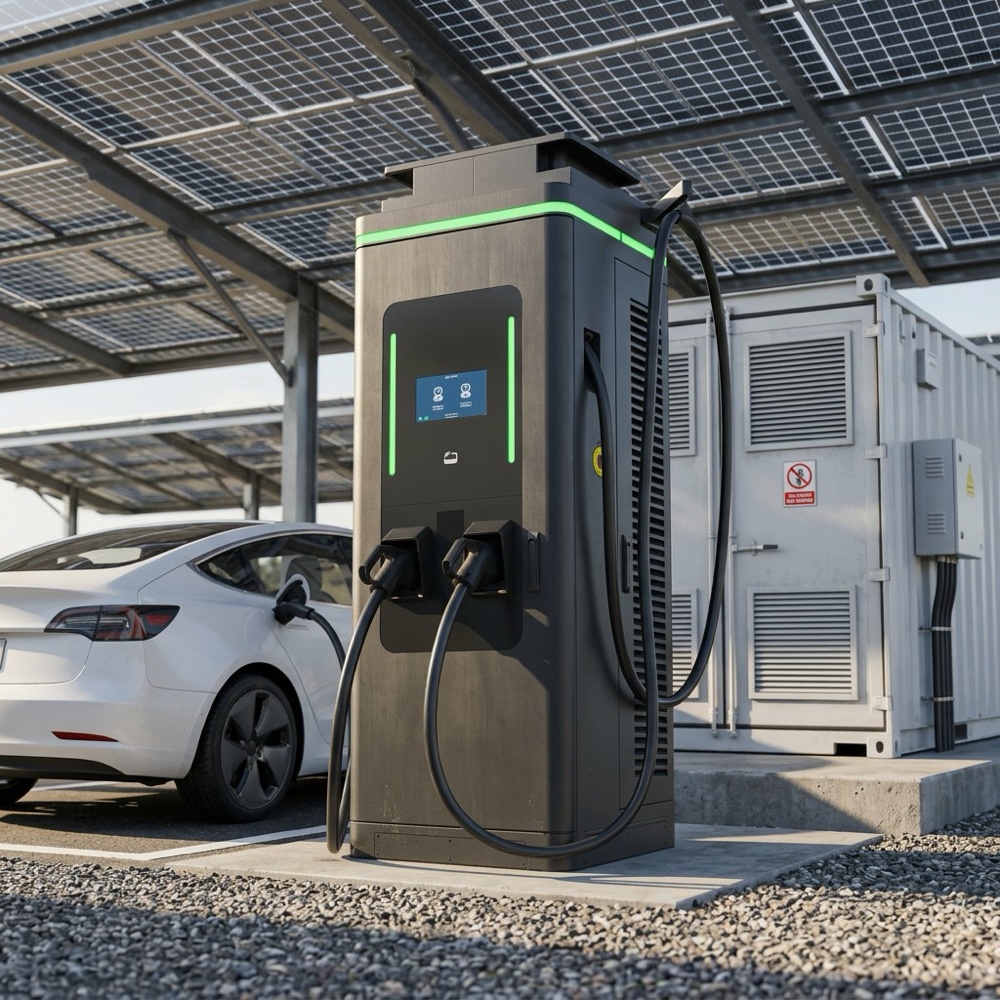
- 480kW of ultra-fast charging power. Flagship capacity that restores long-range driving or heavy-duty duty cycles in minutes, positioning the site as a premier charging destination.
- Dual output design. Two independent outputs run simultaneous sessions with real-time power balancing, maximizing vehicles served per hour and keeping both bays busy even at peak demand.
- Full 200–1000Vdc output range. Native-voltage charging for 400V and 800V-plus architectures, covering passenger cars, vans, trucks and future high-voltage platforms without derating.
- 350A maximum current. The current delivery that ultra-fast sessions depend on, shaped precisely to each vehicle’s charging curve for speed without compromise.
- Efficiency above 95%. At 480kW, even small efficiency gains are worth substantial money annually; above-95% conversion keeps losses, heat and OPEX at a minimum.
- CCS, CHAdeMO, GB/T and NACS support. Universal connector compatibility with per-output configuration, future-proofing the asset against any market’s connector evolution.
- OCPP 1.6 and OCPP 2.0 over 4G, Wi-Fi and Ethernet. Redundant, standards-based connectivity for integration, remote management, security and smart-charging readiness.
- IP54 enclosure and forced-air cooling. Outdoor durability with a simple, serviceable thermal architecture that avoids complex cooling systems and their maintenance burden.
- CE and TUV certification. Audited compliance evidence that de-risks deployment, permitting and insurance for flagship installations.
3. Technical Specifications
The MD-EU 480kW is delivered against the fixed specification below, which forms the performance contract between manufacturer and operator.
| Parameter | Specification |
|---|---|
| Model | MD-EU 480kW |
| Input voltage | 400Vac ±10% (three-phase) |
| Output voltage | 200–1000Vdc |
| Output power | 480kW |
| Max output current | 350A |
| Output configuration | Dual output (two vehicles simultaneously) |
| Efficiency | >95% |
| Connector standards | CCS, CHAdeMO, GB/T, NACS |
| Cooling | Forced-air cooling |
| Enclosure rating | IP54 |
| Communication | 4G, Wi-Fi, Ethernet |
| Charging protocol | OCPP 1.6, OCPP 2.0 |
| Certifications | CE, TUV |
Each line of the specification contributes to the platform’s mission. The 400Vac ±10% input window keeps the charger operating at full capability across the voltage swings that occur at real sites, avoiding the downtime that stricter input requirements would cause. The 200–1000Vdc output range with a 350A ceiling gives the power electronics a wide, future-proof operating envelope: the station is equally at home delivering high voltage to an 800V truck platform and high current to a 400V passenger vehicle, precisely following each battery’s request.
The dual-output architecture is the platform’s defining operational feature. The station controller manages both sessions as a single energy pool, continuously reallocating power toward the vehicle that can use it most effectively. A truck session at the start of its charge curve receives the lion’s share of the 480kW; as its demand tapers, the freed power migrates to the second output. This dynamic optimization keeps average power delivery per hour high, which is the foundation of the business case for flagship charging infrastructure.
Understanding the numbers clarifies the value. Consider a truck stop running the MD-EU 480kW through a peak hour: a heavy truck connects at low state of charge and draws maximum current at its native high voltage, with the station delivering the 350A-limited profile the battery requests; a second vehicle arrives minutes later and the controller partitions the budget so both sessions advance. By the time the first truck reaches its target, the station has delivered a large fraction of the day’s energy in a single hour, and the second output has been serving continuously rather than waiting. Over a full day, the dual-output design lifts average delivered power well above what a single-session cabinet of the same rating could achieve, because capacity follows demand instead of sitting idle during tapers and handshakes. The platform’s 400Vac ±10% input tolerance and smooth power ramping keep this throughput compatible with the site’s grid connection, and the OCPP-based load reporting lets site controllers coordinate additional units. This is the arithmetic that makes 480kW-class charging profitable, and it is built into every element of the MD-EU 480kW’s design.
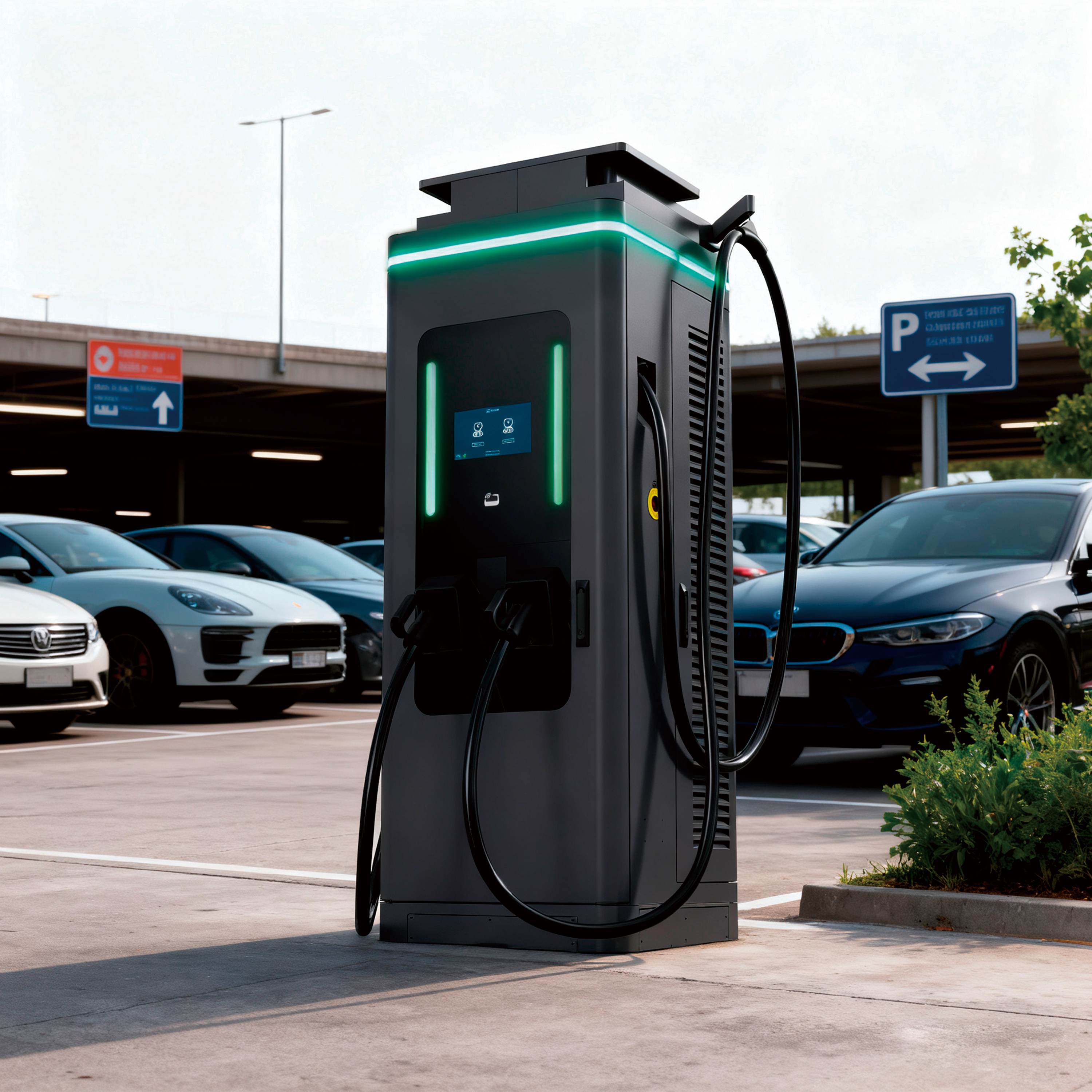
4. Charging Protocols & Connector Compatibility
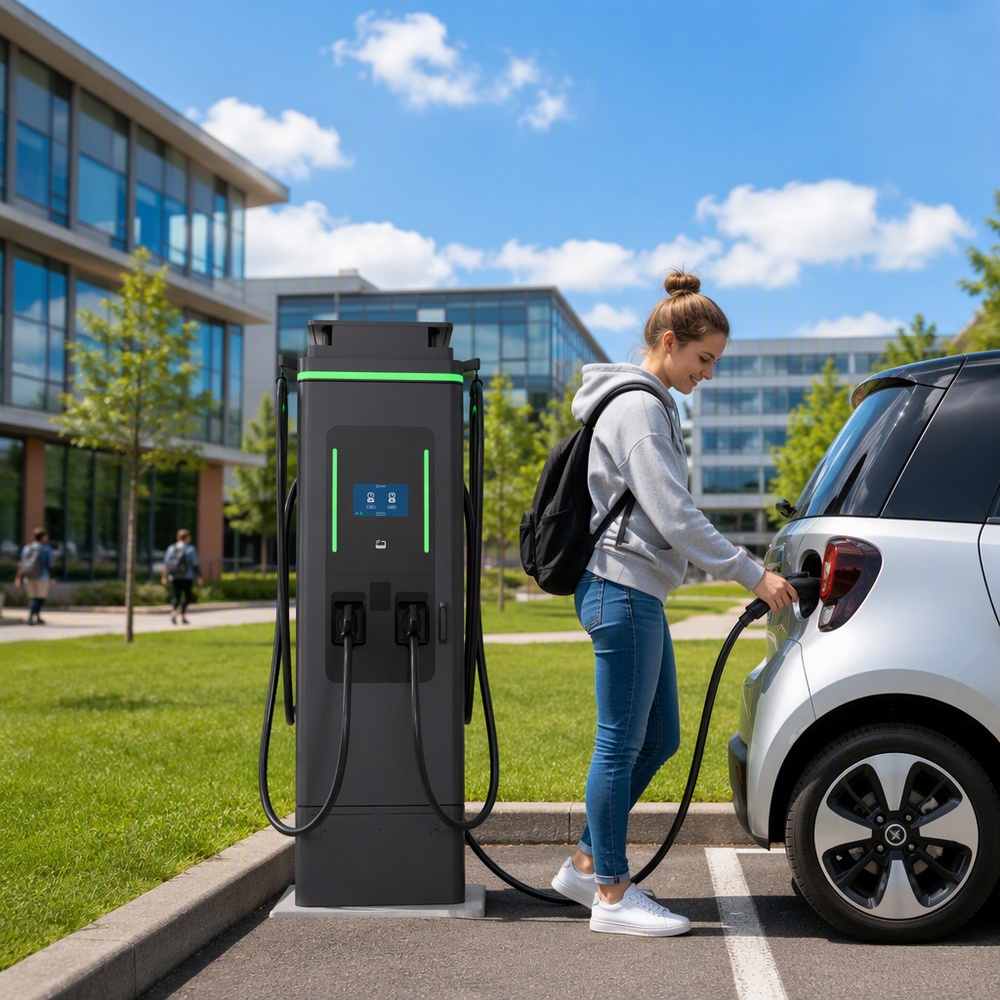
A 480kW station is built for the mainstream of the future, so it must serve the full breadth of today’s vehicle population. The MD-EU 480kW supports the four connector standards that define the global market: CCS, CHAdeMO, GB/T and NACS. CCS is the standard for most fast-charging vehicles in Europe and North America; CHAdeMO serves the established Japanese fleet; GB/T covers the Chinese market; and NACS is the fast-rising North American standard embraced by an expanding roster of manufacturers. By supporting all four, the platform ensures no vehicle is turned away at a destination built to represent the future of charging.
The two outputs give operators complete freedom in connector strategy. A truck-stop installation might pair NACS with CCS to cover North American traffic, while an international corridor station could combine CCS and CHAdeMO, or GB/T where that market dominates. Both outputs can also carry the same connector to double capacity for a uniform fleet. Because each output is independently controlled within the shared 480kW budget, mixed-standard sessions coexist cleanly: a GB/T vehicle’s charging profile never disturbs a CCS vehicle on the neighboring output.
Session speed is the ultimate measure of an ultra-fast charger. With 350A of current capability and voltage matching across the entire 200–1000Vdc window, the MD-EU 480kW delivers energy as fast as each battery can accept it, then tapers smoothly as the session completes. For long-haul trucking, this capability transforms duty cycles: a high-voltage battery pack can be restored to a meaningful state of charge within a scheduled rest stop, while the second output continues serving other vehicles in parallel. It is this combination of 480kW, 350A and dual output that makes the platform a genuine enabler of electric long-haul operations.
The ultra-fast session is choreographed in detail. When a high-voltage truck connects, the charger completes the handshake and insulation checks, then raises voltage and current toward the battery’s request, constrained only by the 200–1000Vdc envelope, the 350A ceiling and the 480kW budget. Early in the session, the vehicle typically accepts maximum current, and the station delivers it steadily; as the battery fills, the current tapers, and the controller immediately routes the freed capacity to the second output, where another vehicle begins its own charge curve. Because each output maintains its own voltage domain and control loop, the two sessions proceed independently, even when one vehicle operates at 400V and the other at 800V. The result is a station that behaves like a small charging hub in a single cabinet: high average power delivery, short effective queues, and sessions that finish when the driver is ready to leave rather than when the station frees up. For fleet schedulers, that predictability is worth as much as the peak rating itself.
5. Smart Connectivity, OCPP & Remote Management
A flagship charging asset must be manageable as part of a network, and the MD-EU 480kW is built for exactly that. The charger provides 4G cellular, Wi-Fi and Ethernet interfaces, enabling operators to design redundant communication paths into every site. Primary and backup links can be configured per installation, so the station remains connected, controllable and billable even when one path fails. For networks that span hundreds of sites, this resilience is what protects the availability commitments that drivers and fleets depend on.
Protocol support spans OCPP 1.6 and OCPP 2.0, covering both generations of the charging management ecosystem. OCPP 1.6 offers the proven remote session control, transaction handling and diagnostics that existing backends expect, while OCPP 2.0 provides stronger security, structured firmware management and the smart-charging messaging required for energy market participation. Dual-version support lets operators standardize hardware across heterogeneous networks and evolve their backend strategy without field retrofits.
Remote management delivers the operational control that high-power assets demand. Operators monitor live power on both outputs, review session and energy records, manage pricing and access, and roll out firmware updates over the air from their central platform. Fault conditions generate immediate backend alerts, enabling fast, data-driven response. The combination of more than 95% efficiency and precise metering gives operators trustworthy energy data for billing, fleet cost allocation, subsidy reporting and performance analytics across the whole installed base.
Enterprise networks place demands on assets that single-site operations never see, and the MD-EU 480kW is built to meet them. The charger supports multi-tenant operation through the backend: a highway plaza may be owned by one entity, operated by another and used by many fleets, with session data, pricing and access managed per tenant through the OCPP platform. Firmware management is structured and secure, with staged rollout and version control handled by the backend over OCPP 2.0, so a network of hundreds of units can be updated systematically without field visits. The redundant 4G, Wi-Fi and Ethernet interfaces allow network architects to design for resilience, and the charger’s local control keeps charging safe and compliant even during communication outages, buffering session data until the link returns. Metering and reporting are accurate to the level that commercial billing and regulatory reporting require. For enterprises consolidating multiple networks or migrating between backends, the dual OCPP 1.6/2.0 support removes the hardware migration cost from the equation.
6. Safety, Cooling & Certifications
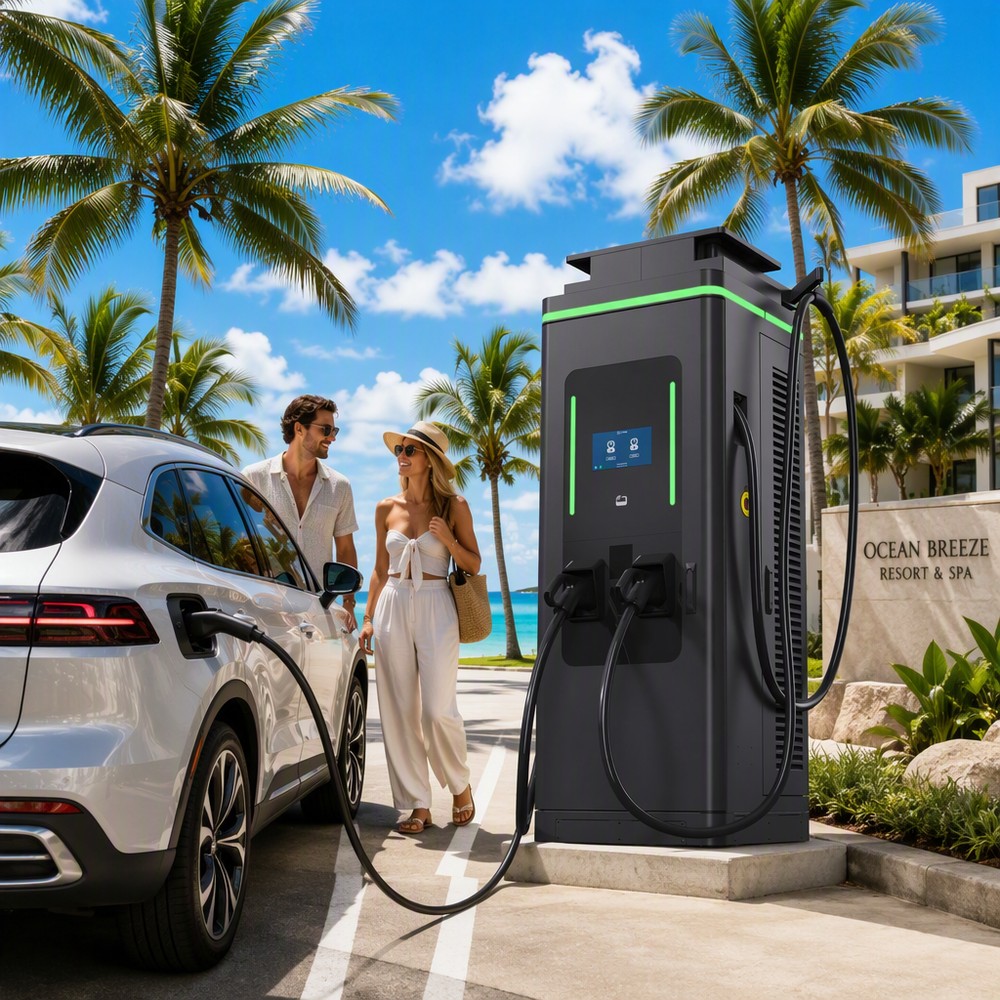
At 480kW, safety engineering is paramount, and the MD-EU 480kW is protected on every axis. The IP54 enclosure defends the power electronics against dust and water splashes in the demanding outdoor environments where flagship stations are placed, from exposed highway plazas to coastal sites. The protection architecture continuously monitors over-voltage, under-voltage, over-current, over-temperature and leakage conditions across the power path, interrupting delivery safely and notifying the operator the instant any limit is approached or exceeded.
Thermal management uses forced-air cooling, the architecture of choice for reliable high-power outdoor operation. Filtered airflows maintain the power modules inside their specified temperature window through sustained ultra-fast sessions and extreme ambient conditions, with no pumps and no coolant to maintain. This simplicity removes the most common failure and service burden of alternative cooling systems: routine maintenance is limited to scheduled filter care, performable by any qualified technician, keeping lifetime cost of ownership low and predictable.
Uptime engineering is a discipline visible in every subsystem of the MD-EU 480kW. The power stage uses conservative component derating, so the stresses of continuous high-power operation stay well inside each component’s rated envelope, which is the most effective insurance against premature failure. The control system monitors temperatures, currents and voltages across the cabinet and can adapt operating parameters before protective limits are reached, preventing nuisance trips and maintaining availability. The forced-air cooling architecture supports this by design: fans are monitored for performance, filters are accessible for routine service, and the cabinet layout allows a service engineer to reach key assemblies quickly, minimizing mean time to repair. Communication paths are equally protected, with automatic fallback between 4G, Wi-Fi and Ethernet and clear status reporting so network issues are visible before they become outages. Taken together, these measures deliver the availability profile that flagship sites demand: a station that stays online through peak seasons, reports its own health, and returns to service quickly if anything does need attention, backed throughout by the CE and TUV certification evidence.
Certification underpins the flagship claim. The MD-EU 480kW carries CE marking and TUV certification, backed by documented testing of electrical safety, electromagnetic compatibility and performance. These credentials streamline grid connection, permitting and insurance processes for flagship installations, and provide operators with an auditable quality baseline consistent across the MD-EU family, from the 60/80/120kW entry platform to the 480kW flagship.
7. Applications & Why Choose MD-EU
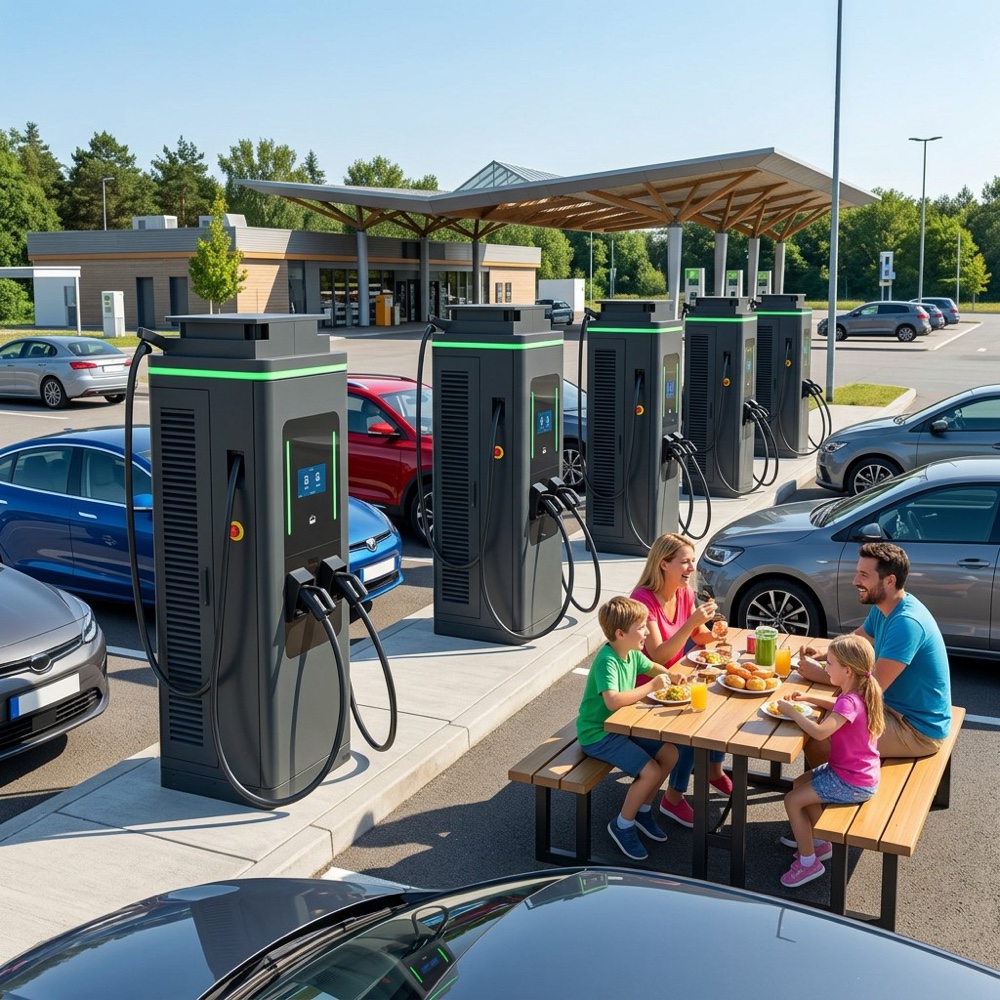
The MD-EU 480kW is built for the sites that will define the electric decade. Highway truck stops install it to give long-haul operators a fast, reliable charging point that fits professional schedules, with dual outputs handling a truck and a passenger vehicle simultaneously during peak flows. High-density urban hubs use it to serve ride-hail fleets, taxis and delivery operators whose vehicles must turn around in minutes. Heavy-duty fleet terminals rely on it to electrify distribution operations at scale, where 480kW and 350A restore large battery packs within operational windows.
For site owners, the business case is built on throughput and efficiency. Efficiency above 95% minimizes energy cost on a machine that moves enormous annual energy volumes. The dual-output architecture maximizes the utilization of grid capacity and site footprint. The 200–1000Vdc range and multi-standard connector support keep the asset valuable as vehicle technology evolves, while IP54 protection, forced-air cooling and CE/TUV certification minimize approval friction and lifetime maintenance. OCPP 1.6/2.0 connectivity over 4G, Wi-Fi and Ethernet integrates the flagship into the operator’s existing management ecosystem from day one.
The specification is fixed and verifiable: 400Vac ±10% input, 200–1000Vdc output, 350A maximum current, greater than 95% efficiency, dual outputs, CCS/CHAdeMO/GB/T/NACS compatibility, 4G/Wi-Fi/Ethernet connectivity, OCPP 1.6 and 2.0, IP54 enclosure, forced-air cooling, and CE/TUV certification. When the ambition is maximum charging throughput with commercial-grade reliability, the MD-EU 480kW is the platform built for the job.
The business case at flagship scale is built on energy economics. Every kilowatt-hour that the MD-EU 480kW converts is subject to the platform’s above-95% efficiency, so across a high annual throughput, the difference between this converter and a less efficient design is measured in tens of thousands of kilowatt-hours of avoided loss per year. The dual-output architecture maximizes the utilization of the site’s grid capacity: the same connection that serves a truck can serve a stream of passenger vehicles in between, which is how a high-power site keeps its revenue per grid-ampere high. The 350A current capability and 200–1000Vdc range ensure the station can exploit the full charge acceptance of today’s and tomorrow’s vehicles, from 800V truck platforms to 400V urban fleets. Deployment is streamlined by IP54 construction, forced-air cooling and CE/TUV certification, and operation is streamlined by OCPP 1.6/2.0 connectivity over 4G, Wi-Fi and Ethernet with full remote management. For owners planning the charging infrastructure of the next decade, the MD-EU 480kW combines the throughput of a mini-hub with the simplicity of a single, certifiable product.
Products categories
-
MIDA 400kW Ultra Fast DC Charger CCS2 Dual Gun ...
-
MIDA 240kW 320kW DC Fast Charger CCS2 Dual Gun ...
-
MIDA 160kW 180kW DC Fast Charger CCS2 EV Chargi...
-
MIDA 120kW Dual Gun DC Fast Charger CCS2 EV Cha...
-
MIDA 60kW 80kW Dual Gun DC Fast Charger CCS2 EV...
-
MIDA 120kW 200kWh BESS DC Fast Charging System ...