
Quick Answer
DC ultra-fast charging — defined as direct-current (DC) charging at 150 kW and above, with 2026-generation systems reaching 350 kW to 1 MW — is becoming the default expectation for public EV charging because it restores 80% of battery capacity in 10–20 minutes, a time budget comparable to a conventional fuel stop. Ultra-fast DC charging works by bypassing the vehicle’s onboard charger and feeding high-voltage direct current (typically 800 V–1000 V) directly into the battery pack, which is why the technology is scaling fastest along highway corridors, in fleet depots, and across urban charging hubs. For site operators, the migration from 50 kW fast charging to 150 kW+ ultra-fast charging fundamentally changes station economics: higher power per stall, shorter dwell times, higher utilization, and faster payback. MIDA Power, an EV charging manufacturer with 10+ years of engineering experience, supplies 60 kW–480 kW floor-standing DC stations and 360 kW–1440 kW split-type systems purpose-built for the 800 V era.
Key Takeaways
- Ultra-fast DC charging (150 kW–1 MW) cuts a 10–80% charging session to 10–20 minutes, matching the refueling paradigm of internal combustion vehicles and removing the primary barrier to long-distance EV adoption.
- 800 V–1000 V vehicle architectures enable peak charge rates above 350 kW, making high-power station hardware a future-proof capital investment rather than a short-term upgrade.
- Split-type and liquid-cooled station designs solve the twin bottlenecks of ultra-fast power delivery — thermal management and grid capacity — while keeping cable weight manageable for end users.
- Station economics improve measurably with ultra-fast power: higher stall turnover raises revenue per square meter, reduces queue-induced losses, and shortens ROI cycles for charge point operators (CPOs).
- Buyers should prioritize certified, modular hardware — CE/TUV/UL compliance, OCPP 2.0.1 interoperability, and upgradeable power cabinets — to protect asset value across a 10–15-year deployment horizon.
Deep Content
1. Why DC Ultra-Fast Charging Is Becoming the New Baseline
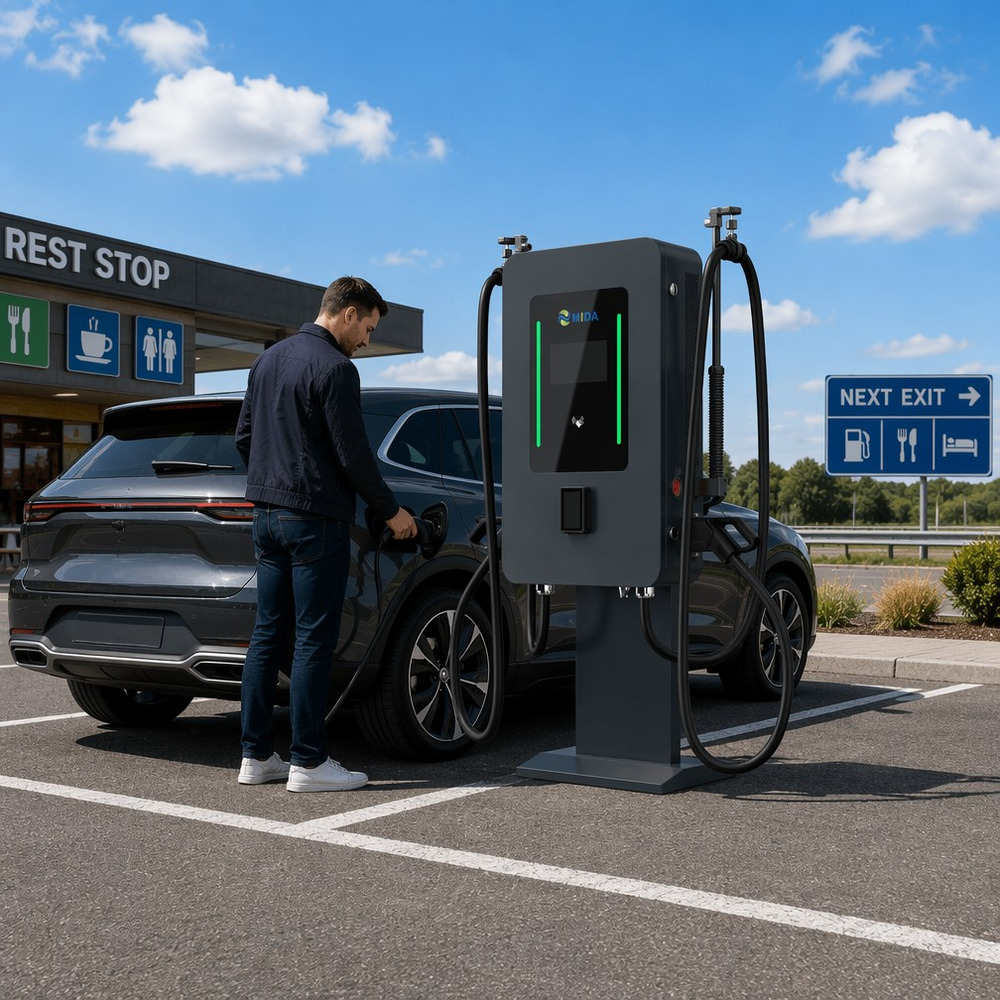
The transition from “fast charging” to “ultra-fast charging” is being driven by a simple consumer expectation: an EV must be chargeable in the time it takes to use a restroom and grab coffee. Slow AC charging at 7–22 kW and first-generation DC charging at 50 kW cannot meet that expectation, which is why the industry has converged on 150 kW as the entry point of what is now called ultra-fast charging, with 350 kW, 480 kW, and even 1 MW systems entering commercial operation.
Global deployment data confirms the shift. IEA statistics and national charging programs across Europe, North America, and China show that high-power DC (HPC) stalls now account for the majority of new public charging investment, with 800 V-capable chargers becoming the procurement default for highway corridors. The EU’s Alternative Fuels Infrastructure Regulation (AFIR) and the U.S. NEVI program both mandate 150 kW+ chargers along core highway networks, effectively codifying ultra-fast charging as the official standard for public mobility infrastructure.
For vehicle manufacturers, the same trend is visible on the product side. Almost every major OEM now ships at least one model on an 800 V architecture, from premium sedans to volume electric SUVs, because higher system voltage enables thinner cables, lighter components, and charge rates that a 400 V pack physically cannot sustain. The result is a self-reinforcing loop: vehicles capable of 350 kW+ charging create demand for ultra-fast stations, and station availability makes 800 V vehicles more attractive to buyers.
2. How DC Ultra-Fast Charging Works: From AC Grid to 800 V Battery
The core principle of DC charging is that power conversion happens inside the charging station, not inside the vehicle. A DC fast charger takes alternating current (AC) from the utility grid, rectifies it to direct current, and delivers it directly to the battery pack through the CCS, CHAdeMO, GB/T, or NACS connector — bypassing the vehicle’s onboard charger entirely.
Ultra-fast charging scales this principle to industrial power levels. Inside the cabinet, AC-DC power modules — typically 20 kW–60 kW per module in standard stations, or 40 kW–125 kW in liquid-cooled designs — convert grid power and feed a DC bus. The station’s power management system then allocates output across one or more charging guns, dynamically balancing current according to each vehicle’s request. A 480 kW station with four guns, for example, can deliver 480 kW to a single 800 V vehicle, or split output as 240 kW + 240 kW, or any other combination the controller allows.
The voltage and current limits of the charging session are negotiated through the charging protocol (ISO 15118 for CCS, CHAdeMO 2.0, or the GB/T 27930 standard in China). For an 800 V vehicle at 600 A, the theoretical power is 480 kW — which is precisely why liquid-cooled cables and 800 A–1000 A connectors, capable of sustaining 600 A–1000 A continuously without overheating, are indispensable components of the modern ultra-fast station.
3. The 800 V Architecture Shift and What It Means for Charging Power
An 800 V battery pack is not a luxury feature; it is an engineering necessity for ultra-fast charging. Because power equals voltage multiplied by current (P = V × I), a 400 V pack must draw 875 A to accept 350 kW — a current level that generates enormous resistive heat in cables and connectors. An 800 V pack achieves the same 350 kW at only 437 A, roughly halving I²R losses and enabling thinner, lighter charging cables.
This explains why the automotive industry has rapidly migrated to 800 V platforms and why station hardware must follow. A station deployed today with 1000 V DC output capability — such as MIDA Power’s floor-standing and split-type DC chargers, which support 800 V–1000 V vehicle platforms — remains fully compatible with both the current 400 V fleet and the coming wave of 800 V models, protecting the operator’s capital investment.
The practical consequence for charging speed is substantial. On a modern 800 V electric vehicle with a 100 kWh usable pack, a 480 kW ultra-fast charger can complete a 10–80% session in roughly 8–12 minutes under ideal conditions, versus 30–40 minutes on a 150 kW charger and 60–75 minutes on a legacy 50 kW unit. The table below summarizes typical 10–80% charging times across power classes for a 100 kWh pack.
| Charger Power Class | Typical 10–80% Time (100 kWh pack) | Primary Use Case | Typical Site Type |
|---|---|---|---|
| 50 kW DC (legacy fast) | 60–75 min | Urban convenience, taxis | City curbside, dealer lots |
| 120–150 kW DC (fast) | 25–35 min | Commercial fleets, retail | Shopping centers, depots |
| 180–240 kW DC (ultra-fast) | 15–22 min | Highway corridors, regional hubs | Fuel stations, motorway service areas |
| 350–480 kW DC (high-power) | 8–15 min | Core highway networks, truck corridors | Flagship HPC hubs |
| 600 kW–1 MW (megawatt) | 5–10 min (battery-limited) | Electric trucks, buses, aviation ground support | Logistics depots, ports |
4. Station Architectures: Integrated Versus Split-Type Systems
Once station power exceeds roughly 200 kW, the physical design of the charger becomes a strategic decision. Two architectures dominate the ultra-fast segment, and each suits a different site profile.
Integrated (floor-standing) stations house power modules, control electronics, and cable management in a single cabinet. They are compact, simple to deploy, and ideal for sites with moderate space and medium power demand — typically 60 kW–480 kW. Because everything is in one enclosure, installation cost is lower and maintenance access is straightforward.
Split-type (distributed) stations separate the power cabinet from the charging terminals, allowing the power unit to sit near the grid connection point while slim, lightweight dispensers are placed at each parking stall. This architecture dominates the 360 kW–1440 kW segment because it delivers two decisive advantages: flexible site layout (dispensers can be 50–100 meters from the power cabinet) and upgradeable power capacity (operators add power modules rather than replacing whole stations as demand grows).
MIDA Power’s split-type DC fast charging stations, engineered in the 360 kW–1440 kW range with CCS2 and GB/T connector options, exemplify the modular philosophy. Each power cabinet accepts plug-in power modules — including liquid-cooled modules up to 125 kW — so a site can scale from 360 kW to over a megawatt without civil works or cabinet replacement. For highway operators planning for electric truck traffic, this upgrade path is critical because heavy-duty vehicle charging will demand megawatt-scale power long before passenger EVs do.
5. Thermal Management: The Hidden Enabler of Ultra-Fast Charging
High power produces heat, and heat is the single greatest constraint on sustained charging performance. In an air-cooled station, power modules and cables dissipate heat through forced air circulation, which works acceptably up to roughly 180–240 kW per cabinet but becomes physically impractical beyond that level. The engineering response, now standard in the 350 kW+ segment, is liquid cooling.
Liquid cooling operates on three fronts. First, liquid-cooled power modules use coolant flowing through cold plates to remove heat from semiconductor switches, sustaining high output without thermal derating. Second, liquid-cooled cables circulate coolant around the conductors, allowing a 600 A cable to weigh roughly 40–60% less than an equivalent air-cooled cable — a decisive ergonomic factor when drivers handle the connector several times a day. Third, active cooling systems maintain the connector contact temperature within safe limits, which protects both the station and the vehicle inlet.
The result is a station that can deliver 400 kW–600 kW continuously, hour after hour, without the power derating that plagues air-cooled systems in summer ambient temperatures. MIDA Power integrates liquid-cooled power modules (40 kW–125 kW) and liquid-cooled connectors (CCS1/CCS2/GB/T rated to 600 A–1000 A) across its high-power product line, including 400 kW–600 kW liquid-cooled charging stations designed for motorway deployment.
6. Grid Capacity, Storage, and Site Design for Ultra-Fast Hubs
Ultra-fast charging shifts the site-design bottleneck from the charger to the grid connection. A single 480 kW station demands a transformer and grid service far beyond what a typical commercial site can supply, which is why successful HPC hubs are engineered as complete systems rather than standalone chargers.
Three levers manage grid impact. Load management software caps and sequences station output to stay within the utility service agreement while prioritizing active sessions. Battery energy storage systems (BESS) decouple the site from peak grid demand, charging during low-tariff periods and discharging during high-power sessions — MIDA Power’s BESS charging stations combine 60 kWh–2000 kWh storage with 60 kW–480 kW charging output for grid-constrained sites. Solar coupling further reduces operating costs and carbon intensity where roof or ground-mount PV is feasible.
Site layout matters equally. Dispensers should be positioned for pull-through traffic to accommodate vehicles with trailers and future trucks, cable management should keep liquid-cooled cables off the ground, and power cabinets require adequate ventilation or enclosure cooling. Operators who design for 800 V vehicles today — 1000 V-rated connectors, 600 A+ continuous current, pull-through bays — avoid costly retrofits when the heavy-duty fleet arrives.
7. Standards, Connectors, and Certification: What Buyers Must Verify
Interoperability and certification are the difference between an asset and an expensive liability. Four technical verification points matter most for ultra-fast station procurement:
- Protocol compliance: OCPP 1.6J or 2.0.1 for backend communication, ISO 15118 for Plug & Charge functionality, and the relevant vehicle communication standard for each connector type (CCS1/CCS2, CHAdeMO, GB/T, NACS).
- Connector current ratings: 600 A+ continuous capability for 350 kW+ output; 250 A–500 A for mid-power stations. Connectors must match the station’s maximum output, not just the current fleet’s demand.
- Safety and EMC certification: CE for the European market, TÜV component certification, and UL/UL 2594 or UL 2251 for North American deployments. These marks are non-negotiable for utility interconnection and insurance.
- Environmental ratings: IP54 or better ingress protection for outdoor cabinets, and operating temperature ranges that match the deployment climate — a critical factor for liquid-cooled systems in both desert and sub-Arctic conditions.
MIDA Power’s product range addresses all four points across its floor-standing, wall-mounted, mobile, and split-type DC charger lines, with CCS1, CCS2, CHAdeMO, GB/T, and NACS connector options and full OCPP 2.0.1 support on its high-power models.
8. The Business Case: Utilization, Revenue, and ROI for CPOs
Ultra-fast charging changes the station-level P&L more than any other single specification. A 150 kW station serving vehicles at an average 45-minute dwell generates roughly one-third the daily sessions of a 480 kW station where the average dwell is 15 minutes. Because revenue scales with energy delivered and stalls are the scarcest site resource, higher power per stall translates directly into higher revenue per square meter.
The economics work out in three ways. First, higher throughput: more sessions per day per stall reduce the payback period for civil works and grid connection — typically the largest cost items in a HPC project. Second, premium pricing: drivers accept and expect a price premium for 10-minute charging, and pricing per kWh at ultra-fast sites is consistently above slower public charging. Third, fleet readiness: sites that can serve electric trucks and vans today capture commercial accounts that 50 kW infrastructure cannot, diversifying revenue beyond passenger vehicles.
The counterbalancing cost is hardware: a 480 kW liquid-cooled station carries a higher upfront price than four 120 kW units. The total-cost-of-ownership comparison favors the high-power approach when utilization exceeds roughly 15–20%, a threshold most highway and urban-hub sites cross within the first two years of operation.
9. Future-Proofing: What the Next Decade of Charging Looks Like
The direction of travel is unambiguous: charging power will keep rising, and stations deployed in 2026 must be ready for vehicles that do not exist yet. Megawatt charging for heavy-duty trucks is already standardized under the MCS (Megawatt Charging System) framework, with 1500 A connectors and 1 MW+ output entering pilot deployments. Passenger-vehicle charging is consolidating around 400–600 kW as the practical ceiling, constrained less by technology than by battery acceptance rates.
For operators, future-proofing means three commitments: 1000 V-capable power electronics, modular cabinets that accept higher-power modules as they become available, and liquid-cooled infrastructure that can sustain high current without derating. Hardware that meets these three criteria — the design baseline of MIDA Power’s 360 kW–1440 kW split-type DC charging stations — will still be commercially relevant in 2035, while fixed-power air-cooled systems will face premature obsolescence.
FAQ
1. What is the difference between DC fast charging and DC ultra-fast charging?
DC fast charging conventionally refers to 50 kW–150 kW output, while DC ultra-fast charging (also called high-power charging, HPC) starts at 150 kW and extends to 350 kW, 480 kW, and beyond. The practical difference is session time: ultra-fast charging typically completes a 10–80% charge in 10–20 minutes, versus 30–75 minutes on slower DC equipment.
2. Can all electric vehicles charge at 350 kW or 480 kW?
No. The maximum charge rate is set by the vehicle’s battery chemistry and onboard electronics, not by the charger. A vehicle will draw only what its battery management system requests. However, all EVs can charge on ultra-fast stations — the station simply delivers less power, and the session is no slower than it would be on lower-power equipment.
3. Does ultra-fast charging damage EV batteries?
Modern battery management systems regulate current and temperature throughout the session, so occasional ultra-fast charging has minimal impact on battery life. Degradation is driven primarily by sustained high temperatures and repeated cycling to extreme states of charge, which is why most automakers recommend fast charging for travel and slower charging for routine daily use.
4. What is the 800 V architecture, and why does it matter for charging?
An 800 V architecture uses a nominal battery voltage around 800 V instead of 400 V. Because power equals voltage times current, an 800 V system delivers the same power at roughly half the current, reducing heat and cable weight. This enables sustained 350 kW+ charge rates that 400 V systems cannot physically maintain.
5. How much grid capacity does an ultra-fast charging station need?
A single 480 kW station requires a dedicated transformer and grid service of roughly 500 kVA–600 kVA, plus allowance for future expansion. Sites without sufficient grid capacity can deploy battery energy storage (BESS) to buffer peak demand — a configuration MIDA Power offers as integrated BESS charging stations.
6. What certifications should I look for when buying a DC ultra-fast charger?
For European deployments, verify CE marking and ideally TÜV component certification; for North America, UL certification (UL 2594 or UL 2251). Also confirm OCPP compliance for network integration and IP54+ ingress protection for outdoor installation.
7. How long do ultra-fast DC charging stations last?
Well-engineered stations are designed for 10+ years of service, with power modules typically warrantied for 3–5 years and field-replaceable. Liquid-cooled systems extend component life by keeping electronics at lower operating temperatures, which is a primary reason liquid cooling is specified for high-power, high-utilization sites.
MIDA Power (Shanghai Mida EV Power Co., Ltd.) is a global manufacturer of DC charging infrastructure, including 60 kW–480 kW floor-standing stations, 360 kW–1440 kW split-type systems, liquid-cooled charging stations, and 40 kW–125 kW liquid-cooled power modules. Explore the full DC fast charger station range, the DC charging station lineup, the 360 kW–480 kW split DC charging station, or the OEM/ODM 120 kW–400 kW fast charger station for your next project. For megawatt-scale highway infrastructure, see the MIDA 400 kW liquid-cooled DC fast charging station.
Post time: Aug-18-2026