
120kw 160kw 180kW Dual-Output DC Fast Charger CCS, CHAdeMO, GB/T, NACS
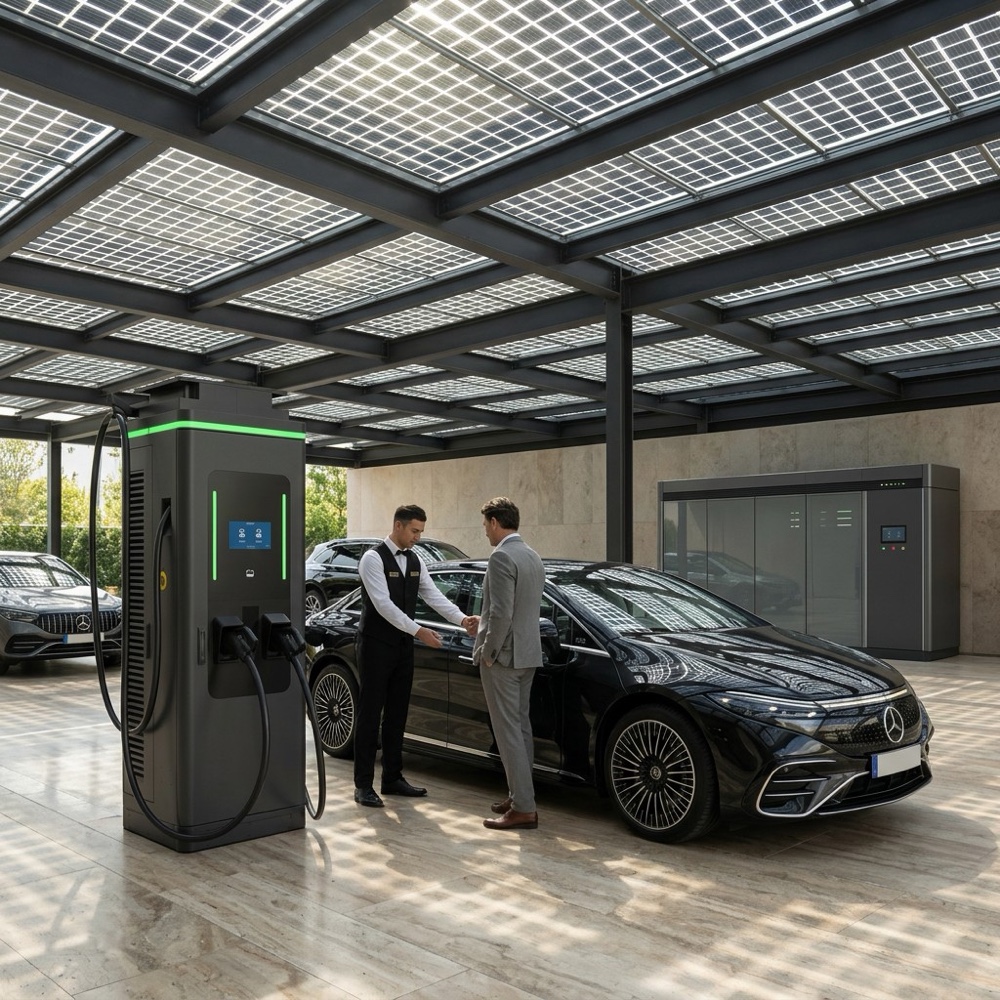
MD-EU 160/180kW Dual-Output DC Fast Charger
1. Product Overview
The MD-EU 160/180kW is a high-power, dual-output DC fast charger built for the busiest points of the electric vehicle ecosystem: highway corridors, fleet depots and high-utilization commercial hubs. Available with 160kW or 180kW of rated output power from a single cabinet, it delivers the speed that drivers expect from a modern fast-charging network while keeping installation complexity and footprint under control. Two independent outputs allow two vehicles to charge simultaneously, so the station maintains throughput even at peak hours and never leaves a bay idle while another vehicle finishes.
Under the hood, the charger accepts a standard 400Vac ±10% three-phase supply and converts it to a regulated DC output spanning the full 200–1000Vdc range. This wide window is essential for today’s mixed traffic: 400V passenger cars, 800V electric vans and light trucks all charge at their native voltage without derating. A maximum output current of 350A supports rapid sessions, and conversion efficiency above 95% keeps energy losses low, which matters enormously when a unit runs near-continuously through the day.
Compatibility is comprehensive. The MD-EU 160/180kW supports CCS, CHAdeMO, GB/T and NACS connectors, so one station serves European, North American and Asian vehicles without discrimination. The dual outputs can be fitted with different connector types to match the local vehicle population, and the smart power allocation engine shares the available kilowatts between both sessions in real time. For network operators, connectivity through 4G, Wi-Fi and Ethernet with OCPP 1.6 and OCPP 2.0 support means the charger drops straight into existing charging management platforms, while the IP54 enclosure and forced-air cooling design keep it reliable outdoors with minimal maintenance.
The MD-EU 160/180kW is deliberately sized for the middle of the market, where traffic justifies more than a compact charger but the site cannot yet justify the largest cabinets. At 160kW or 180kW, a typical passenger vehicle gains a substantial driving range in a 15-to-25-minute stop, while the 350A current capability and 200–1000Vdc output range keep larger commercial vehicles moving too. The dual outputs give the platform a throughput advantage that matters at highway rest areas, where arrivals cluster around meal times and shift changes; two vehicles charging in parallel smooths those peaks and keeps queues short. Site preparation is straightforward: the unit accepts 400Vac ±10% input, so it connects to standard three-phase distribution, and its IP54 enclosure allows outdoor placement with minimal civil work. Operators who plan for growth appreciate that the same footprint and grid connection can host a more powerful MD-EU family member later, while the 160/180kW platform itself remains a cost-effective choice for sites with steady, predictable demand. In short, the platform is sized for real-world utilization, not for a spec sheet.
2. Key Features & Benefits
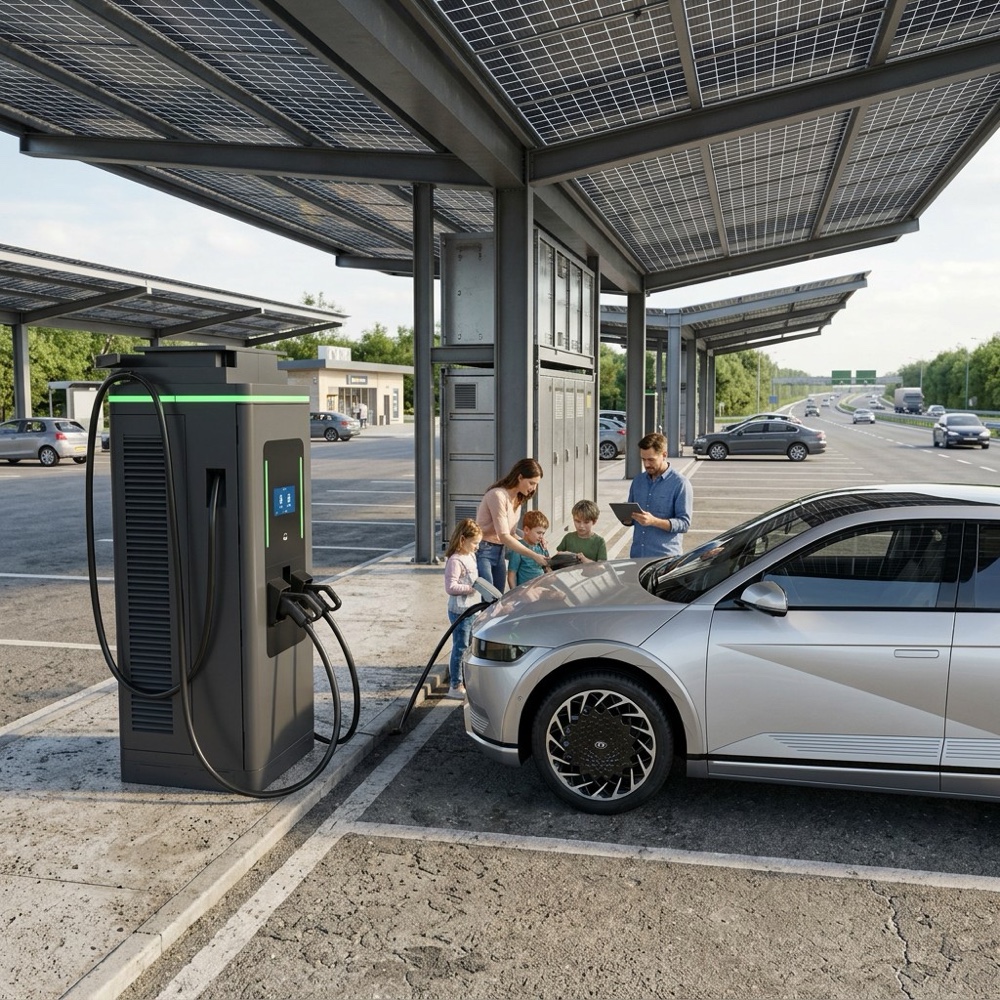
- High throughput through dual outputs. Two vehicles charging simultaneously doubles the number of sessions per hour compared with a single-output unit, which is the metric that determines revenue and driver satisfaction on a busy corridor.
- 160kW or 180kW in one platform. Operators choose the rating that matches grid capacity and traffic forecasts, and can revisit the choice without replacing the cabinet.
- 200–1000Vdc output. Full coverage of 400V and 800V vehicle architectures, including next-generation commercial vehicles, with automatic voltage matching per session.
- 350A output current. High current delivery shortens real-world charge times for batteries that can accept it, reducing queue times at high-utilization sites.
- Efficiency greater than 95%. Lower conversion losses cut energy cost per session and reduce thermal stress on the power electronics, extending component life.
- CCS, CHAdeMO, GB/T and NACS support. Interoperable with the dominant connector standards worldwide, configurable across the two outputs to match local traffic.
- OCPP 1.6 and OCPP 2.0 with 4G, Wi-Fi and Ethernet. Flexible, redundant connectivity to any OCPP-compatible charging management system, with full remote control and monitoring.
- IP54-rated, forced-air cooled. Outdoor-ready protection with simple, serviceable thermal management that needs no specialized maintenance beyond routine filter care.
- CE and TUV certified. Independent certification evidence that simplifies project approvals, insurance and cross-border deployment.
3. Technical Specifications
The MD-EU 160/180kW is engineered to deliver rated performance in real-world grid and climate conditions. Its core parameters are summarized below.
| Parameter | Specification |
|---|---|
| Model | MD-EU 160/180kW |
| Input voltage | 400Vac ±10% (three-phase) |
| Output voltage | 200–1000Vdc |
| Output power | 160kW / 180kW (selectable) |
| Max output current | 350A |
| Output configuration | Dual output (two vehicles simultaneously) |
| Efficiency | >95% |
| Connector standards | CCS, CHAdeMO, GB/T, NACS |
| Cooling | Forced-air cooling |
| Enclosure rating | IP54 |
| Communication | 4G, Wi-Fi, Ethernet |
| Charging protocol | OCPP 1.6, OCPP 2.0 |
| Certifications | CE, TUV |
The 400Vac ±10% input tolerance is a real-world requirement: grid voltage fluctuates with local load, especially near industrial zones and highway service areas. The MD-EU 160/180kW maintains full rated operation across this entire window, which reduces site-specific engineering and avoids costly voltage conditioning equipment. On the output side, the 200–1000Vdc range with a 350A ceiling defines a broad, practical operating envelope that keeps pace with evolving battery technology.
The dual-output configuration is the operational heart of the platform. Each output is independently controlled, so sessions can start, run and terminate without affecting each other. The power-sharing algorithm continuously balances the two sessions: when one vehicle tapers its current draw near the end of charging, the freed power is redirected to the other vehicle automatically. This keeps total delivered energy per hour high, which is the single most important economic metric for a charging network node.
A concrete example clarifies the benefit. Suppose a depot runs the MD-EU 160/180kW at the 180kW configuration, and a delivery van connects first at low state of charge; the van receives the full 180kW budget while its battery accepts high current. Ten minutes later, an 800V light truck connects to the second output requesting high voltage and high current. The controller immediately partitions the budget, directing the majority of power to the truck while the van, now mid-curve, continues at a reduced but still useful rate. As the truck’s charge tapers toward its target, power flows back toward the van, so both sessions complete without either vehicle waiting for the other to finish. Across a full day, this dynamic allocation lifts the station’s total delivered energy by a meaningful margin compared with a fixed-split design, because power always follows demand. The same logic applies on a highway corridor, where a taxi topping up and a long-distance driver starting a full charge can be served optimally at the same time. Dynamic power sharing is not a convenience feature; it is the mechanism that maximizes the return on the site’s grid connection and capital investment.
4. Charging Protocols & Connector Compatibility
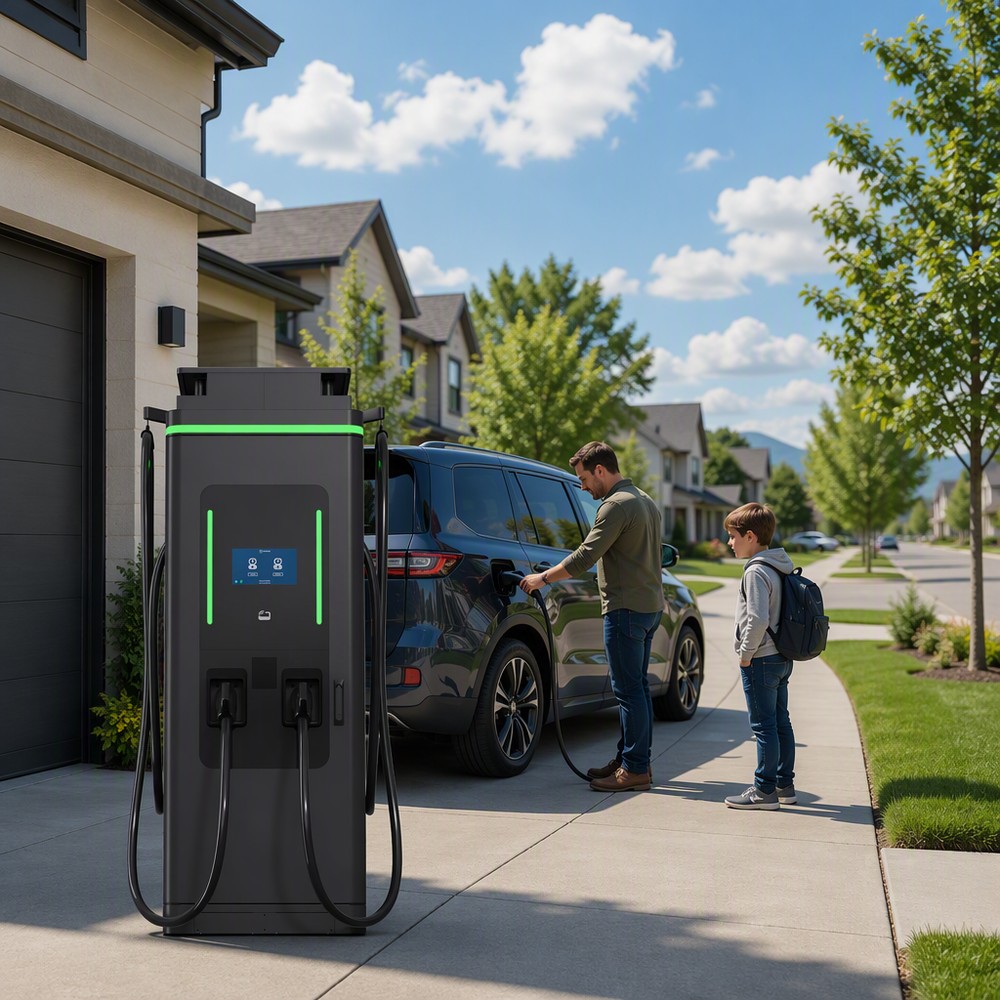
High-power charging sites must serve the widest possible mix of vehicles to justify their capital cost. The MD-EU 160/180kW supports all four major connector standards: CCS, CHAdeMO, GB/T and NACS. CCS dominates European and North American fast charging and is the default for most new passenger EVs. CHAdeMO remains in service across large Japanese fleets and older fast-charge vehicles. GB/T is the incumbent standard across China, and NACS is the fastest-growing standard in North America, adopted by a rapidly expanding list of manufacturers. Supporting all four means the station is a universal fast-charge point for the entire vehicle population, not a niche installation.
The dual outputs multiply this flexibility. Output A can be equipped with CCS while output B carries CHAdeMO, or the pair can combine GB/T and NACS, depending on the site’s traffic profile. The power management system then arbitrates between the two connectors in real time, prioritizing based on the charge state and voltage request of each connected vehicle. Because the outputs operate independently, a CHAdeMO vehicle with a low-voltage battery does not slow down a CCS vehicle on the neighboring output; each session receives exactly the voltage and current it can accept, within the 200–1000Vdc and 350A envelope.
Session speed is where the 160/180kW rating shows its value. Highway drivers expect a 10-to-30 minute stop, not an hour. With 350A of current capability and voltage matching across the full output range, the charger delivers energy as fast as the vehicle battery permits, then hands back gracefully as the session tapers. For fleet applications, this speed translates directly into vehicle availability: more kilometers of range restored per hour of parking, which means smaller fleets can cover the same delivery routes.
A closer look at session orchestration shows why the dual-output design works in mixed traffic. When the first vehicle connects, the charger performs the standard handshake, establishes insulation checks and then ramps voltage and current according to the vehicle’s request, respecting the 200–1000Vdc envelope and the 350A current ceiling. When the second vehicle connects to the other output, the controller reassesses the power budget: the session closest to its target state of charge, or the one whose battery can no longer accept high current, yields capacity to the newcomer, so the station’s 160kW or 180kW is never idle. Each output maintains its own voltage domain, which is essential when one vehicle runs on a 400V architecture and the other on 800V: the outputs are electrically separated and controlled independently, so one session never forces a compromise on the other. Drivers experience consistent, predictable sessions, and operators see the station’s energy throughput remain high even when the two connected vehicles are completely different in size, brand and battery technology. This is the practical meaning of interoperability at the station level.
5. Smart Connectivity, OCPP & Remote Management
A charging station is a networked asset, and the MD-EU 160/180kW is designed around that reality. It provides 4G cellular, Wi-Fi and Ethernet interfaces, giving operators three independent paths to the charging management platform. The station can be configured with primary and backup links, so a failed router or cut cable never takes the charger offline. In practice, this redundancy translates into measurable uptime: sessions keep starting, stopping and billing correctly even when one communication path degrades.
Protocol support spans OCPP 1.6 and OCPP 2.0. OCPP 1.6 is the battle-tested standard that powers the majority of today’s installed charging infrastructure, offering remote start and stop, transaction management, diagnostics and configuration. OCPP 2.0 brings stronger security, better firmware management and enhanced smart-charging messaging for sites that participate in demand response or energy management programs. Because both versions are implemented, the charger interoperates with legacy and modern backends alike, and operators can migrate platforms without touching the field hardware.
Remote management reduces the cost of running a dispersed network. Operators see live status of both outputs, session history, energy delivered and fault events from a single dashboard. Firmware updates roll out over the air, scheduled for low-traffic periods, eliminating expensive site visits. Alarm thresholds, price tables and access rules can be adjusted remotely at any time. Combined with more than 95% efficiency, the connectivity suite ensures accurate measurement and reporting of every kilowatt-hour, which is essential for billing, fleet accounting and utility programs.
High-utilization sites often run several chargers from one grid connection, and the MD-EU 160/180kW is built to participate in site-level coordination. Through OCPP 1.6 and OCPP 2.0, the charger reports live load and accepts control commands from the charging management platform or an energy management system, enabling load capping, scheduled charging and peak-shaving strategies that protect the site’s transformer and reduce demand charges. The 4G, Wi-Fi and Ethernet interfaces give operators deployment flexibility: a depot with existing structured cabling can use Ethernet, a temporary site can run on 4G, and Wi-Fi suits retail environments where adding cabling is impractical. Communication security is addressed at the protocol level, with OCPP 2.0′s strengthened security model available where networks demand it, and configuration tools let operators set communication priorities and fallback behavior. The result is a charger that behaves as a good citizen of the site’s electrical and digital infrastructure, coordinating with the network rather than competing with it, which is precisely what multi-unit sites need as they scale toward full electrification.
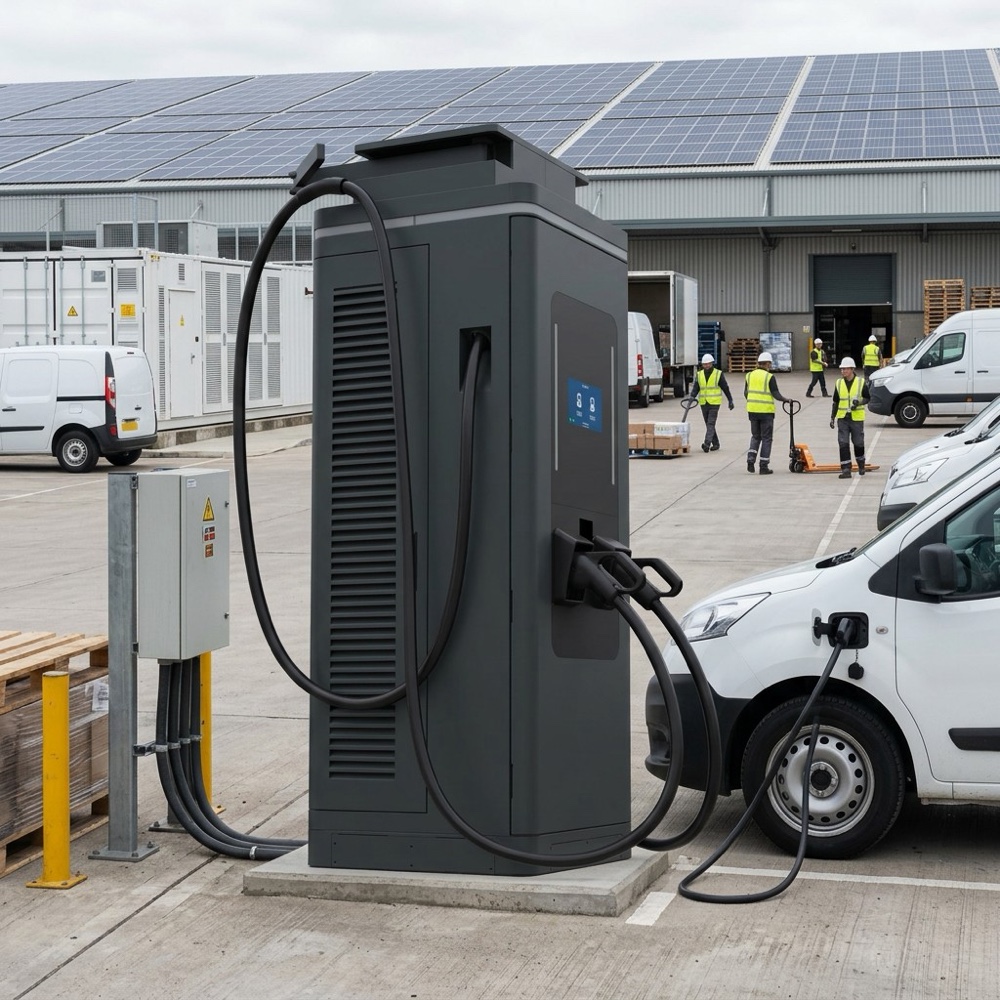
6. Safety, Cooling & Certifications
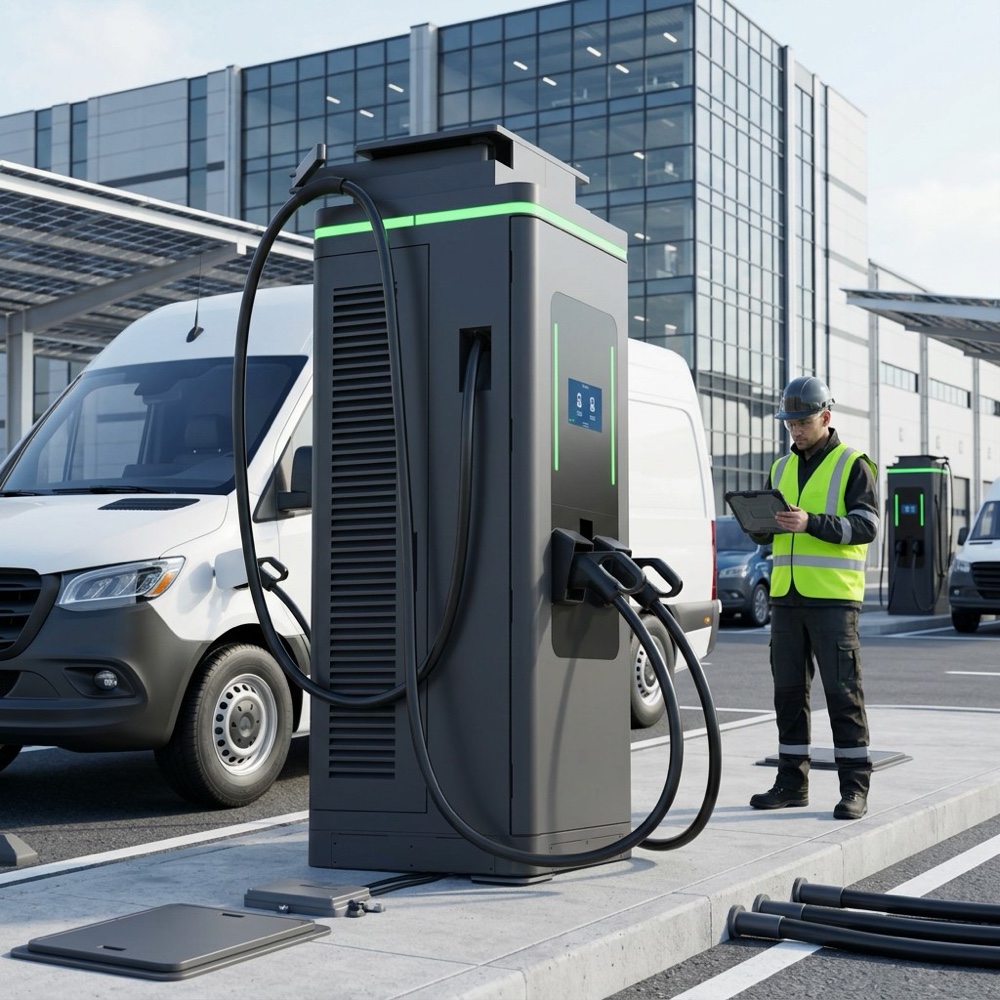
Reliability is the foundation of a charging network’s reputation, and the MD-EU 160/180kW is built to hold the line against the elements. The IP54 enclosure shields the power electronics from dust and water splashes, the conditions typical of roadside and outdoor depot installations. Internally, a comprehensive protection set monitors over-voltage, under-voltage, over-current, over-temperature and leakage conditions, shutting down safely and reporting the fault to the backend when limits are exceeded.
Thermal management relies on forced-air cooling, a deliberately simple and robust choice for high-power outdoor equipment. Filtered fans move air across the power modules, keeping junction temperatures inside their rated window even during back-to-back high-current sessions in summer heat. There are no pumps to fail, no coolant to leak, no fluid levels to check, and no specialized service training required. Routine maintenance is limited to cleaning or replacing air filters on a scheduled basis, which keeps lifetime service costs predictable and low.
Certifications close the loop on quality assurance. The MD-EU 160/180kW carries CE marking and TUV certification, recognized across the major global markets for electrical safety, electromagnetic compatibility and product performance. These certificates are backed by documented test reports that simplify permitting, insurance underwriting and compliance review, and they give network operators and fleet managers the confidence that the equipment they deploy meets a consistent, audited standard of quality.
Durability is engineered in at the component level. The power modules are designed with generous thermal margins, so the forced-air cooling system keeps semiconductor temperatures comfortably inside specification even during sustained high-current sessions; this margin is what prevents premature aging and unexpected failures in hot climates or poorly ventilated locations. Input protection includes surge suppression and transient handling, shielding the charger from the disturbances common on industrial and highway grids, and the output stage is protected against vehicle-side faults. The IP54 enclosure combines weather protection with serviceability: panels open without special tools, and the internal layout separates power, control and communication zones for safe, fast maintenance. All external components, from charge cables to the communication antennae, are selected for outdoor duty and UV resistance. Before release, the platform is exercised through extended test programs covering temperature extremes, humidity, vibration during transport and electrical stress, and the results are documented in the CE and TUV certification files. This engineering discipline is what allows the manufacturer to back the product with confidence across its service life.
7. Applications & Why Choose MD-EU
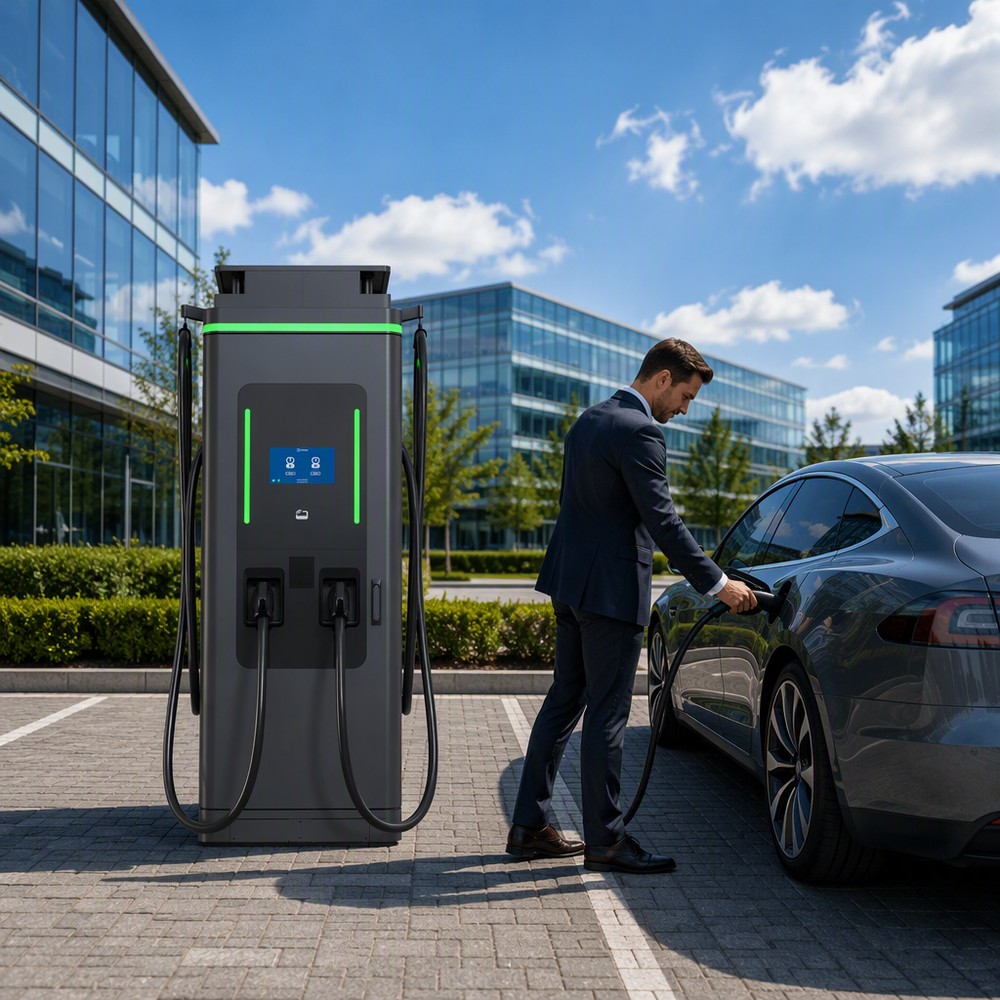
The MD-EU 160/180kW is the workhorse of the mid-power charging segment. Highway service stations use it to give drivers a fast, dependable top-up during long journeys, with the dual outputs keeping both parking bays productive during peak travel periods. Fleet operators install it at depots and logistics hubs to turn delivery vans and light trucks around between shifts, where the 160/180kW rating and 350A current capability restore meaningful range in a short window. Hotels, restaurants and retail destinations adjacent to major roads use it as a revenue-generating amenity that also lengthens customer dwell time.
The economics of the platform are compelling at scale. More than 95% efficiency minimizes wasted energy on a unit that may run thousands of sessions per month. Dual outputs double the utilization of each site position. The 200–1000Vdc voltage range and multi-standard connector support mean the investment is not hostage to one brand, region or battery architecture. IP54 protection, forced-air cooling and CE/TUV certification keep the total cost of ownership low, from installation approval through years of outdoor operation.
Network planners evaluating the MD-EU 160/180kW should check the same short list: 400Vac ±10% input, 200–1000Vdc output, 350A maximum current, greater than 95% efficiency, dual outputs, CCS/CHAdeMO/GB/T/NACS compatibility, 4G/Wi-Fi/Ethernet connectivity, OCPP 1.6 and 2.0, IP54 rating, forced-air cooling, and CE/TUV certification. When a site demands high power, high throughput and low total cost of ownership, the MD-EU 160/180kW is the clear choice.
Total cost of ownership is where the MD-EU 160/180kW makes its most compelling argument. On the energy side, conversion efficiency above 95% means the operator pays for energy delivered to vehicles, not energy wasted as heat, a difference that grows with the high annual throughput of a corridor or depot site. On the maintenance side, forced-air cooling and a modular layout keep service simple: scheduled filter care, occasional inspections, and quick replacement of field-serviceable modules when needed, all executable by local technicians without specialized equipment. On the network side, OCPP 1.6/2.0 compatibility over 4G, Wi-Fi or Ethernet means the charger joins the operator’s existing management platform without integration projects or proprietary adapters, and remote configuration and firmware updates eliminate most service dispatches. On the compliance side, CE and TUV certification, the IP54 rating and the 200–1000Vdc, 350A specification package keep permitting, insurance and grid connection processes predictable. When site owners add these benefits to the dual-output throughput advantage and the 160/180kW power headroom, the platform consistently ranks as one of the most economical ways to deliver high-power charging at commercial scale.
Products categories
-
MIDA 400kW Ultra Fast DC Charger CCS2 Dual Gun ...
-
MIDA 240kW 320kW DC Fast Charger CCS2 Dual Gun ...
-
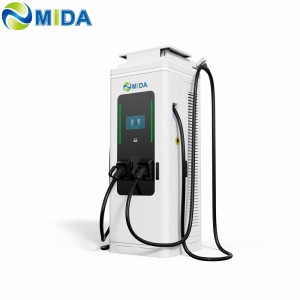
MIDA 160kW 180kW DC Fast Charger CCS2 EV Chargi...
-
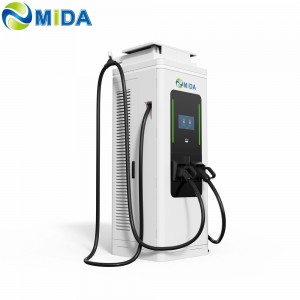
MIDA 120kW Dual Gun DC Fast Charger CCS2 EV Cha...
-
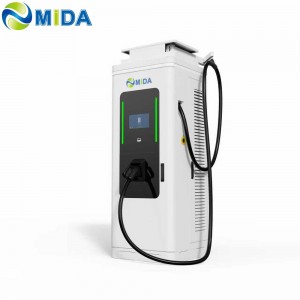
MIDA 60kW 80kW Dual Gun DC Fast Charger CCS2 EV...
-
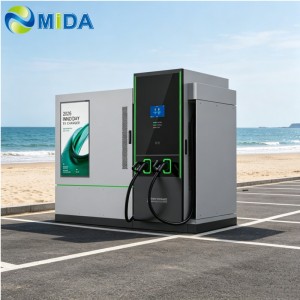
MIDA 120kW 200kWh BESS DC Fast Charging System ...